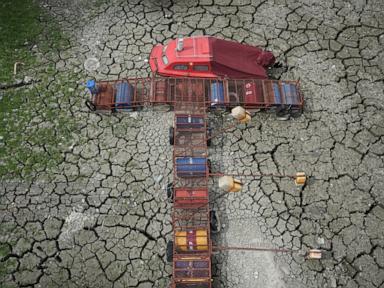
Europe is running dry. Across the continent, an unyielding sequence of scorching summers and historic precipitation deficits has transformed vital arteries like the Rhine, the Po, and the Danube into sluggish, shallow channels. While mainstream coverage often fixates on stranded shipping barges and withered grain fields, a silent ecological and economic collapse is unfolding beneath the surface. Rivers, lakes, and aquaculture farms are experiencing unprecedented thermal stress and severe water volume losses. The resulting crisis threatens wild fish populations, devastates commercial fish production, and exposes the structural fragility of Europe's freshwater management.
To understand why this aquatic crisis is uniquely dangerous, one must look beyond simple water scarcity and examine the complex physics of warming inland waters. When river volumes drop and air temperatures persistently exceed seasonal averages, water bodies absorb heat rapidly. Oxygen solubility decreases as water temperatures rise. At the same time, metabolic rates of aquatic organisms increase, demanding more oxygen just as the supply plummets.
For cold-water species such as brown trout and Arctic charr, native to northern regions and alpine streams, a threshold is quickly crossed. Once water temperatures consistently climb past 25 degrees Celsius, mortality rates spike. Fish are forced into shrinking thermal refuges—deep pools or cold-water spring inlets—where overcrowding triggers disease outbreaks, fungal infections, and aggressive competition for survival.
Anglers and environmental monitoring teams across Central and Western Europe report a staggering surge in emergency fish rescues. Volunteers wade into drying mudflats, netting stranded carp, pikeperch, and trout to relocate them into deeper reservoirs. Yet, these efforts are mere band-aids on a systemic wound. The sheer scale of the drainage means thousands of kilometers of river ecosystems are left to suffocate.
The Aquaculture Squeeze
Commercial fish farming faces an equally brutal reckoning. Inland aquaculture—ranging from intensive raceway systems for trout to traditional carp ponds in Central Europe—relies on a predictable, clean, and ample flow of water. As municipal authorities and agricultural regulators enforce strict water abstraction bans to preserve public supplies, fish farmers find themselves caught in a regulatory and environmental vice.
Consider a hypothetical commercial trout farm situated along a tributary of the Danube. Under normal operating conditions, the facility requires a continuous, high-volume throughput of cool river water to maintain oxygenation and flush metabolic waste. During severe drought conditions, abstraction licenses are slashed or suspended entirely. The farm cannot draw enough water to sustain its stock density.
Operators are forced to prematurely harvest undersized fish, accept massive yield reductions, or watch entire stocks perish from hypoxia. Feed conversion ratios deteriorate rapidly in warm, low-flow water, driving operational costs sky-high just as revenue plummets. Insurance policies rarely cover systemic climate-induced water failures, leaving many independent producers facing insolvency.
The economic fallout radiates outward. Local processing plants lose their supply chains, regional food markets face supply deficits, and consumer prices for freshwater fish climb. This sector-wide contraction demonstrates that Europe's food security vulnerability extends far beyond terrestrial crops and livestock.
Systemic Failures in Water Governance
The crisis is exacerbated by deeply outdated legal frameworks governing water allocation. For decades, European water management operated on the assumption of abundance. Allocation rights were distributed among competing sectors—hydropower generation, agricultural irrigation, industrial cooling, and public consumption—without accounting for the ecological minimum flows required to keep rivers alive.
When a drought hits, these sectors enter an immediate resource conflict. Energy companies want to hold water back in high-altitude alpine reservoirs to generate electricity during high-demand winter months. Farmers demand immediate water releases to save parched fields. Hydroelectric plants require continuous flow, while environmental agencies plead for water to dilute pollutants and protect aquatic life.
Fish and aquatic ecosystems do not have a lobbying voice at the negotiating table. Consequently, environmental flows are frequently sacrificed first. Rivers are treated as industrial plumbing systems rather than living habitats.
Furthermore, decentralized management creates cross-border friction. Major river basins like the Danube flow through multiple sovereign nations, each with disparate drought response protocols. If an upstream nation alters flow regimes or prioritizes filling domestic reservoirs, downstream nations face accelerated ecological degradation. Harmonized, basin-wide adaptive management remains more of an aspiration than a reality.
Engineering Resilience Out of the Crisis
Adapting to this arid new normal requires a fundamental redesign of how Europe handles its liquid assets. Patchwork emergency measures and ad-hoc water bans are no longer sufficient for a continent experiencing accelerated climate destabilization.
Investment must pivot toward decentralized storage and nature-based solutions. Restoring natural floodplains, wetlands, and meanders allows rivers to retain water longer, recharging aquifers naturally and providing critical cooling buffers during heatwaves. On-farm storage infrastructure, such as agricultural reservoirs designed to capture winter runoff, can reduce summer extraction pressure on sensitive river systems.
Simultaneously, regulatory agencies must rewrite abstraction licensing to incorporate dynamic ecological triggers. When river flows drop below predefined critical thresholds, water cuts must automatically cascade across industrial and agricultural users before aquatic ecosystems reach a point of total collapse.
The drying of Europe's rivers and fish farms is not a temporary anomaly or a string of unfortunate bad summers. It is a loud, undeniable structural warning. Unless water governance evolves to treat aquatic ecosystems as primary stakeholders in resource planning, the continent's inland waters will face a future of permanent ecological impoverishment.
The 2026 drought: Frequently asked questions and answers
This official governmental resource provides detailed insights into how low water levels, strict abstraction bans, and rising temperatures are currently impacting aquatic ecosystems and fisheries across Europe.


