Li Shufu does not look like a man who just upended the global automotive hierarchy. He often looks like a man who is quietly calculating the cost of a long-distance phone call. But while the world kept its eyes glued to the flickering screens of geopolitical tension in the Middle East, Li’s brainchild, Geely, quietly tore a hole through the stock market’s expectations.
Money is a nervous creature. It flees at the first scent of gunpowder. When the conflict in Iran began to escalate, the traditional script called for a retreat into gold, oil, or perhaps the safety of a Swiss vault. Instead, a strange thing happened. Investors began pouring billions into a Chinese car company that, for years, lived in the shadow of the more flamboyant BYD.
Geely shares didn’t just grow. They surged 50%.
This is not a story about spreadsheets. It is a story about a fundamental shift in the way the world perceives value during a crisis. It is about how a company built on the humble foundations of a refrigerator parts manufacturer became the sanctuary for global capital when the desert winds began to howl.
The Great Divergence
For the longest time, the narrative of the Chinese Electric Vehicle (EV) market was a one-horse race. BYD was the darling. Backed by Warren Buffett, it was the titan that could do no wrong. It owned the batteries, it owned the supply chain, and it owned the headlines.
But dominance breeds a specific kind of vulnerability. BYD became the proxy for the entire Chinese economy—when the economy sweated, BYD bled.
Enter the Iran conflict. War usually drives fuel prices through the ceiling, which should, in theory, send every EV stock into the stratosphere. But the market is more nuanced than a simple "if/then" statement. Investors started looking for resilience. They looked for a company that wasn't just a battery play, but a global conglomerate with its fingers in a dozen different pies.
They found Geely.
While BYD was locked into a brutal price war on the mainland, Geely was playing a different game. Think of it as the difference between a sprinter and a decathlete. Geely owns Volvo. It owns Polestar. It has a massive stake in Mercedes-Benz. It owns Zeekr and Lynk & Co.
When the conflict in Iran sparked fears of a fractured global trade system, Geely’s international footprint suddenly looked less like an overhead cost and more like a fortress. If one market freezes, Geely breathes through another. Investors realized that while BYD was betting on a specific future, Geely had already built several different versions of it.
A Hypothetical Morning in Hangzhou
To understand why a 50% jump matters, we have to look at someone like "Mr. Chen." He isn't a real person, but he represents the thousands of mid-level managers at Geely’s headquarters who have spent the last decade working eighteen-hour days.
In our scenario, Mr. Chen arrives at his desk as the first reports of the Iran strikes hit the wires. His peers at other firms are panicked. They are worried about shipping lanes in the Strait of Hormuz. They are worried about the cost of lithium.
But Chen’s department is looking at the telemetry from a Zeekr 001 driving through the streets of Stockholm. They are reviewing the safety ratings of a new Volvo platform in the United States.
The brilliance of Geely’s strategy—and the reason the stock is currently outperforming BYD—is that it has successfully decoupled itself from the "China-only" risk. When you buy Geely, you aren't just betting on the adoption of EVs in Shanghai. You are betting on the engineering of Sweden, the design of the UK, and the manufacturing might of the Middle Kingdom.
The 50% surge was the sound of the world finally noticing that the "Volvo guy" had actually built a global empire while no one was looking.
The Psychology of the Surge
Numbers are just footprints left by human emotion. The reason Geely eclipsed its rivals during this specific period of unrest is rooted in a very human desire: the need for a hedge.
War creates scarcity. Specifically, it creates a scarcity of predictable outcomes.
BYD’s vertical integration—the fact that they make almost everything themselves—is a miracle of efficiency during peacetime. But in a world where supply chains might be severed by a missile or a diplomatic sanction, that integration can become a noose.
Geely’s model is messier. It’s a web of partnerships, joint ventures, and legacy brands. It is decentralized. In a period of high-stakes geopolitical poker, decentralization is a superpower. If a port closes in the East, Geely has assets in the West. If a specific battery chemistry becomes too expensive because of trade barriers, they have three other research labs working on alternatives.
The market didn't just reward Geely’s earnings. It rewarded Geely’s optionality.
The Weight of the Crown
Is this growth sustainable, or is it a momentary fever dream born of wartime anxiety?
The skeptics point to the sheer complexity of Li Shufu’s empire. Managing a dozen brands across three continents is a logistical nightmare. There is the constant threat of internal cannibalization—where a Zeekr steals a sale from a Volvo, or a Lynk & Co undermines a Geely-branded sedan.
But look at the hardware.
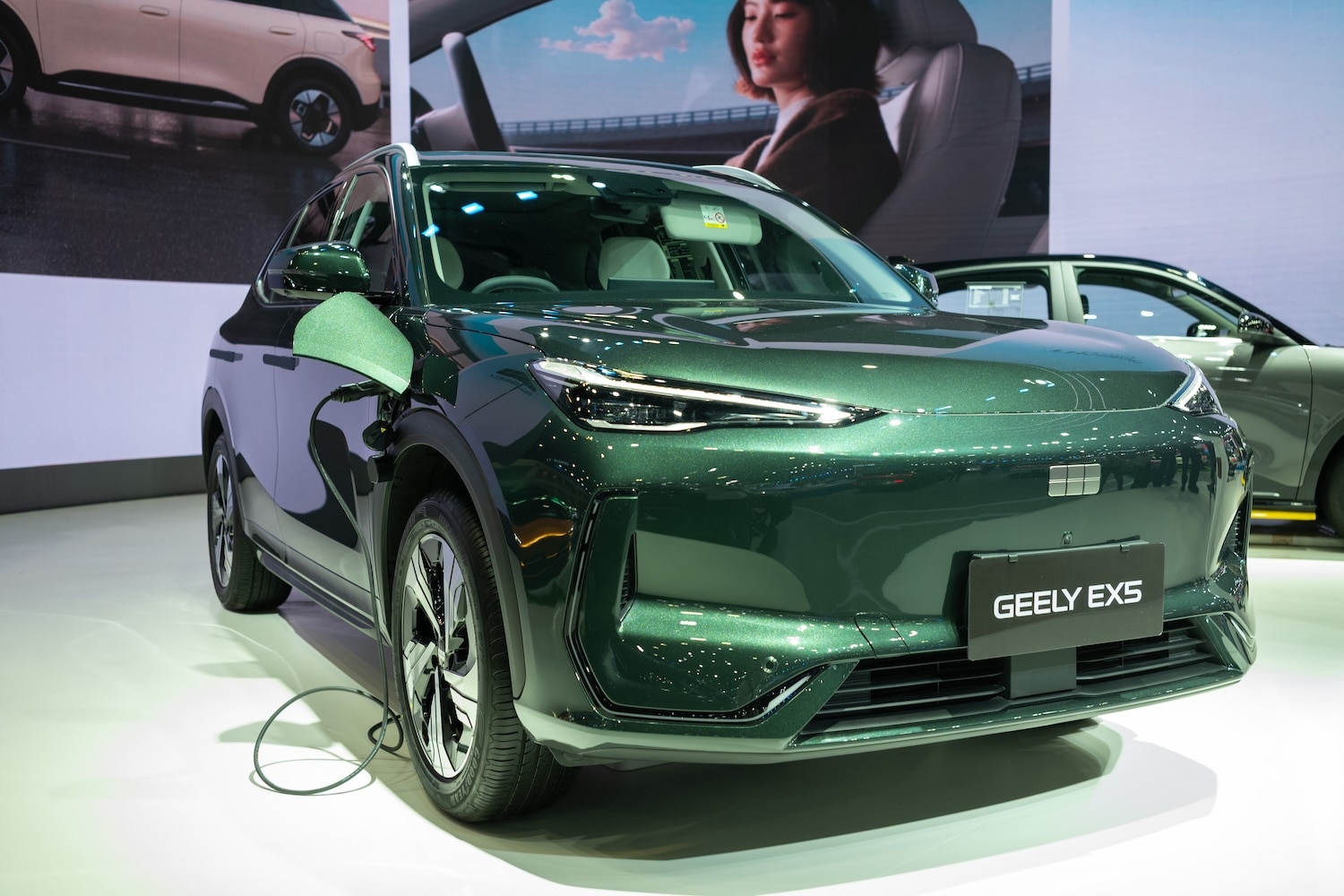
Geely’s Sustainable Experience Architecture (SEA) is a modular platform that underpins everything from luxury sports cars to compact city runabouts. This isn't just a car chassis; it's a piece of software that moves. By sharing this "brain" across all their brands, they have achieved a level of scale that makes traditional manufacturers weep.
The surge in share price is a recognition that Geely has finally solved the hardest problem in the industry: how to be big without being slow.
The Ghost in the Machine
There is a certain irony in the fact that a war involving Iran—a major oil producer—has served as the catalyst for an EV stock explosion. Usually, high oil prices are seen as a "tax" on the consumer. But in 2026, the psychology has flipped.
Higher oil prices are no longer just an inconvenience at the pump. They are a reminder of the fragility of the old world. Every time a headline flashes about a tanker being diverted or a refinery being targeted, the internal combustion engine looks less like a machine and more like a liability.
Investors aren't buying Geely because they are suddenly passionate about the environment. They are buying it because they are terrified of being left behind in a world where energy is used as a weapon.
BYD offers a solution to that fear, certainly. But Geely offers a solution with a premium leather interior and a European safety rating. In a time of crisis, people don't just want a tool. They want a brand they can trust. They want the familiarity of a Volvo with the price tag of a mass-market leader.
The Invisible Stakes
Behind the 50% gain lies a more sobering reality. This isn't just about who sells the most cars this quarter. It’s about who defines the movement of people for the next century.
The struggle between Geely and BYD is a proxy for the future of industrial power. One favors total control and domestic dominance. The other favors collaboration and global integration.
For the moment, the market has placed its bets on the collaborator.
The Iran conflict served as the ultimate stress test. It asked the global financial community a simple question: "Who do you trust to navigate a world that is falling apart?"
The answer, written in the green ink of the Hong Kong and Shanghai exchanges, was Geely.
The 50% surge is a number. But the story behind it is about the end of an era where a car company was just a car company. Today, a car company is a diplomatic entity, a technology powerhouse, and a hedge against the chaos of a changing world.
Li Shufu might still look like a man worried about his phone bill. But his competitors are finally starting to look at him with a different expression.
Fear.
The desert wind continues to blow, and the fires in the Middle East have not yet dimmed. But on the streets of London, the highways of California, and the neon-lit boulevards of Shenzhen, the quiet hum of Geely’s motors is growing louder.
It is the sound of a new giant finding its stride, while the rest of the world is still trying to find its footing in the smoke.