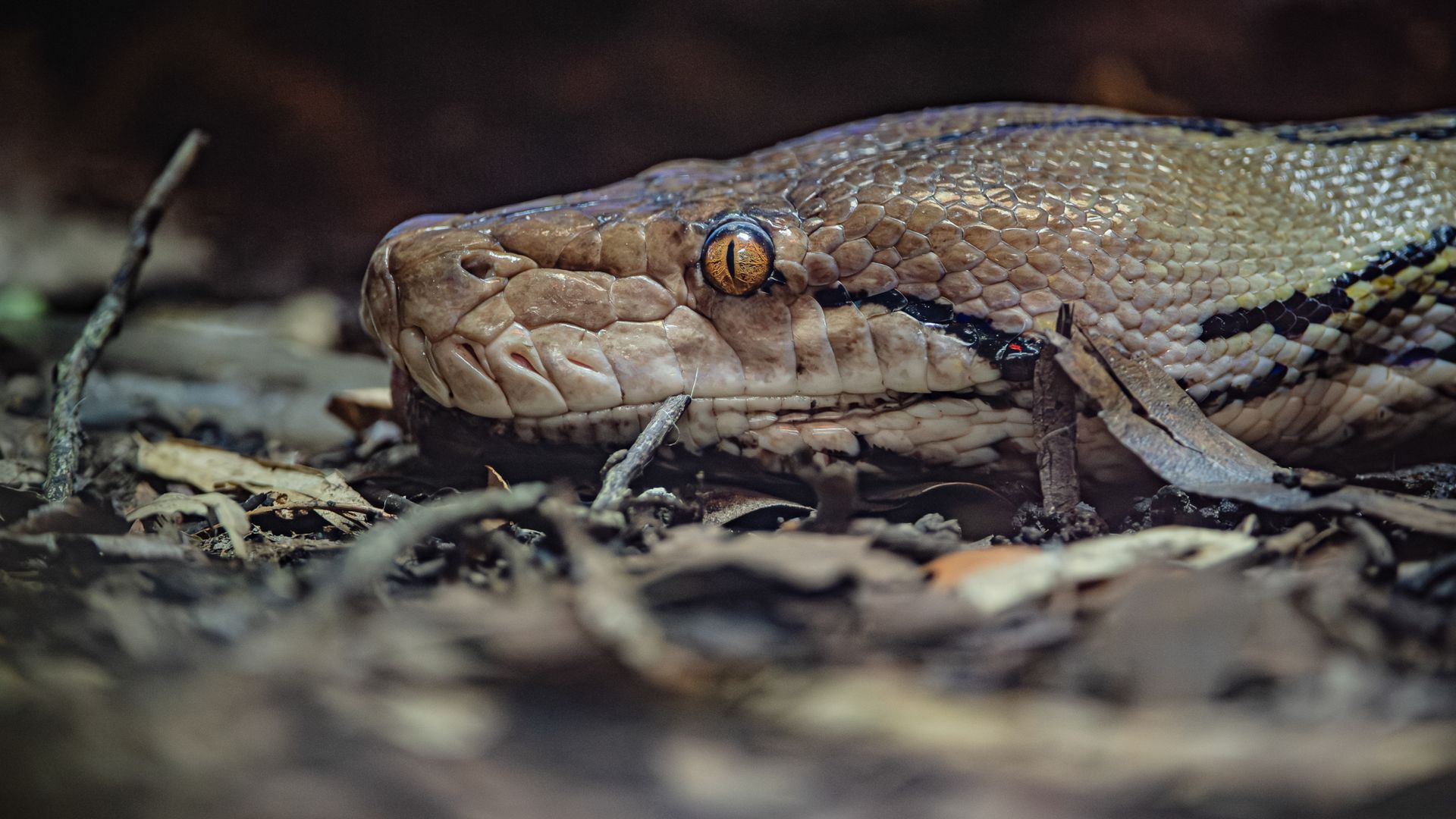
The paperwork arrived two decades ago marked with two unassuming capital letters. JF. Shorthand for juvenile female. To the staff at Chester Zoo, those initials quickly transformed into a proper moniker, attaching the name of a Hollywood icon to a creature who cared nothing for human celebrity. For twenty-three years, Jodie Foster—a reticulated python stretching fifteen feet and tipping the scales at fifty kilograms—did what her ancestors had done for millennia. She occupied space with quiet, coiled majesty. She watched the world through unblinking eyes. She ate.
Then came the silence.
Quietly, subtly, the food started going ignored. For an apex predator built to swallow prey many times the size of its own skull, disinterest in a meal is an emergency written in invisible ink. Keepers noticed the subtle shift first. The endless coiling gave way to sluggish hours, an uncharacteristic stillness in an animal defined by fluid, muscular power.
A veterinary examination pulled back the curtain on a terrifying reality. A malignant fibrosarcoma had taken root in her jaw.
Cancer does not discriminate by scale. It does not care whether its host is a human sitting in an oncology clinic or a massive reptile resting in a specialized Cheshire habitat. The tumor was carved away during an initial surgery, a temporary victory that bought time. But cancer has a cruel habit of rewriting endings. The malignant mass returned, mounting a brutal siege against her jawbone. With every passing week, eating became an agonizing endeavor. For a snake, losing the structural integrity of the jaw is a death sentence. The veterinary team, led by Ian Ashpole, faced a stark and chilling truth.
They were going to lose her.
Standard veterinary manuals offered no guidance for a fifteen-foot python suffering from an invading jaw tumor. There was no protocol. There was no blueprint. Medicine is often thought of as a fixed library of answers, but at the edges of the map, it is an improvised frontier.
Consider what happens next: a desperate cross-disciplinary alliance. The zoo veterinarians joined forces with human cancer specialists from the University of Liverpool, turning their gaze toward an emerging human medical procedure called electrochemotherapy. It was a treatment normally reserved for people, designed to deliver localized electronic pulses that temporarily render cancer cell walls permeable, allowing targeted drugs to flood the disease while sparing healthy tissue.
It had never been tried on a snake. Not once in veterinary history.
Logistics alone presented a dizzying engineering puzzle. No operating table on Earth was built to accommodate a fifty-kilogram, fifteen-foot serpent. Vets had to improvise. They pushed two separate operating tables together, anchoring them side by side to construct a makeshift platform the exact dimensions of a double bed.
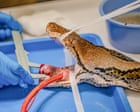
The procedure began quietly. Jodie was safely anaesthetized right inside her familiar habitat before being transported to the veterinary center. To ensure her survival under anesthesia, the team deployed heated blankets and warmed air currents, maintaining her cold-blooded body temperature with absolute surgical precision throughout the ordeal.
For ninety tense minutes, the operating room turned into a theater of crossing worlds. Ashpole performed a hemi-mandibulectomy, removing the diseased portion of Jodie's jawbone alongside the primary tumor. But surgery alone had failed before. To hunt down the microscopic ghosts left behind, the team introduced the human treatment protocol. They administered the cancer drug bleomycin, followed immediately by a series of finely calibrated electrical pulses directly into the tumor bed.
Electricity unlocked the cells. The drug poured in.
Then came the long, agonizing wait. In veterinary medicine, miracles are rarely announced by dramatic gasps; they are measured in small, mundane observations. Would she hunt again? Would her jaw hold under the crushing physics of a constrictor's strike? Pythons rely on a jaw structure that must unhinge and stretch beyond normal biological limits to survive. Losing a piece of that architecture threatened her entire existence.
Months ticked past. Observers watched her closely.
She struck. She gripped. She swallowed.
Recent medical checks delivered the final, stunning verdict. The cancer was gone. The tumor had not returned. Jodie Foster, the twenty-three-year-old python who broke medical boundaries on a double-bed operating table, is back to her old self. Bright. Feisty. Unstoppable.
The details of her procedure are now destined for formal publication, meant to guide veterinary professionals across the globe. A bridge has been built between human oncology and exotic animal care, born from a refusal to let a giant snake slip quietly into the dark.
Sometimes, saving a life requires nothing more than two operating tables, an unorthodox idea, and the stubborn belief that every breath is worth fighting for, no matter how cold the blood may be.