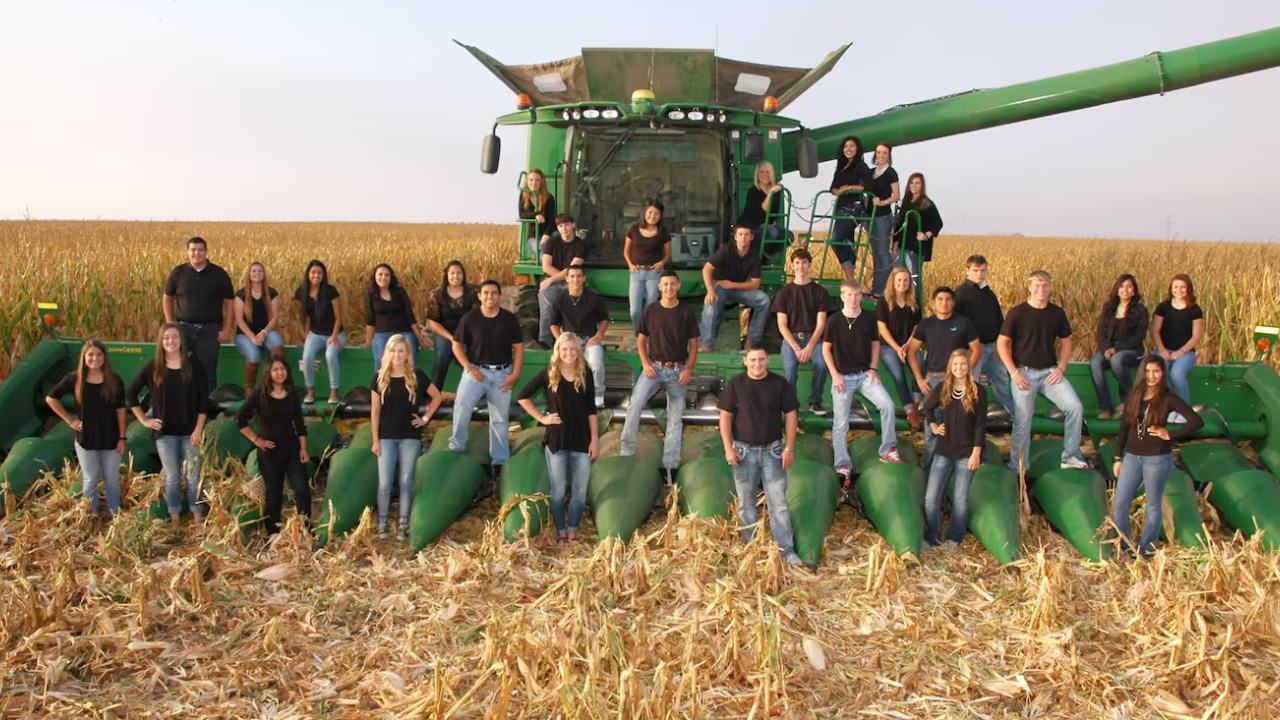
Everybody loves a feel-good story about a dead farmer leaving his dirt to the local high school.
You know the script. A generous landowner passes away, wills a few sections of Texas Panhandle scrub or Midwest cornfield to a community foundation, and suddenly every graduating senior at a tiny school like Gruver High gets a golden ticket to college. Local reporters eat it up. They interview teary-eyed administrators and first-generation college students talking about how this miracle gift changed their lives. For an alternative look, read: this related article.
It makes for great Sunday morning reading. It also ignores the brutal economic reality of rural America.
Those charitable land trusts are functioning as high-efficiency talent extraction pipelines. By liquidating agricultural yields to subsidize four-year university tuition, small towns are quite literally harvesting their own topsoil to export their brightest eighteen-year-olds to Dallas, Houston, and Austin. Forever. Further coverage on this matter has been shared by Reuters Business.
I have spent twenty years advising agricultural estates, rural community foundations, and regional economic development boards across the Plains. I have watched dozens of small towns celebrate the exact mechanism that seals their demographic collapse. They trade productive, tax-generating, wealth-building local assets for outgoing plane tickets and dorm room deposits.
If you want to understand why rural counties are dying despite record charitable endowments, you have to stop looking at the heartwarming graduation photos and start reading the balance sheets.
The Feel-Good Fallacy of Rural Endowments
The lazy consensus around rural philanthropy goes like this: small-town kids lack financial access to higher education, so pooling community wealth to send them to state universities lifts everyone up.
That premise rests on a fatal flaw. It assumes those students are coming back.
They aren't. According to data from the USDA Economic Research Service and decades of rural demographic tracking by researchers like Patrick Carr and Maria Kefalas, the "brain drain" from non-metro counties isn't an accident—it is subsidized. When a rural scholarship fund pays for a kid from Hansford County to get a degree in marketing, finance, or communications at Texas Tech or UT Austin, that student enters an urban labor market where those skills actually command a salary.
Gruver, Texas has roughly 1,100 residents. Its economy runs on cattle, wheat, corn, and oilfield services. It does not have a thriving sector for corporate brand managers or entry-level investment analysts.
So what happens? The farm pays the tuition. The kid graduates. The kid takes a job in a metroplex suburb because that is where the degree pays off. The farm continues pumping out commodity crops—often leased out to massive, consolidated corporate operators—to fund the next batch of kids leaving town.
Meanwhile, the town itself loses its future volunteer firefighters, its next generation of school board members, its local plumbers, and its young families. You cannot build a sustainable community when your primary charitable export is your own youth.
The Structural Trap of Land-Backed Trusts
To understand why these scholarships are so stubbornly inefficient, you have to look at the mechanics of agricultural endowments.
When a farmer donates land to a 501(c)(3) foundation or an independent school district trust, the asset is almost always locked in perpetuity. The board cannot sell the dirt. They can only distribute the net operating income—usually crop-share rents or cash leases.
Here is the math nobody talks about at the booster club banquet:
- Agricultural cash yields are terrible. Productive farmland in the Texas Panhandle or the Corn Belt typically generates a net cash yield of 2.5% to 4% annually after property taxes, insurance, and maintenance. If the trust holds dryland acres reliant on the depleting Ogallala Aquifer, that yield is wildly volatile. One multi-year drought wipes out the scholarship pool right when tuition inflation spikes.
- Trusts accelerate land consolidation. A foundation board isn't out there driving a combine at two in the morning. They lease the donated land to the highest bidder. Who can afford to bid the highest on cash rent? Not a twenty-four-year-old trying to start a family farm. It is the mega-operation already farming 25,000 acres with massive economies of scale.
- Opportunity cost is completely ignored. Imagine a scenario where a farmer leaves 1,280 acres—two full sections—worth roughly $3.5 million to a local scholarship fund. At a 3% net return, that land generates $105,000 a year. Split among twenty graduating seniors, that is $5,250 per kid. In 2026, $5,250 doesn't even cover a single semester of room, board, and fees at a mid-tier public university. It doesn't eliminate student debt; it just lowers the barrier to taking on more debt for a degree the student might not even finish.
Look at the completion rates for first-generation college students from rural districts. According to the National Student Clearinghouse Research Center, rural students enroll in four-year institutions at lower rates than their suburban peers, and their six-year completion rates hover around 40% to 45%.
That means more than half the time, the donated farmland is paying for two or three semesters of general education credits before the student drops out, moves back home without a credential, and works the exact same job they could have taken straight out of high school—only now they are two years behind their peers and carrying a balance on a federal loan.
Why Traditional Scholarships Are Subsidizing Tuition Inflation
There is a dirty secret in higher education finance known as the Bennett Hypothesis, named after former U.S. Secretary of Education William Bennett. The theory is straightforward: when outside money—whether federal loans or private scholarships—floods into the higher education market, universities simply raise their prices to capture it.
Private scholarships suffer from an even more immediate penalty called financial aid displacement (or "scholarship stacking" restrictions).
Let’s trace what actually happens when a low-income, first-generation student from a rural high school wins a $5,000 local farm-funded scholarship:
- The student fills out the FAFSA. Because their family income is low, they qualify for a Pell Grant and institutional need-based aid from the university.
- The student proudly reports their $5,000 hometown farm scholarship to the university’s financial aid office, as required by federal law.
- The university’s financial aid algorithm recalculates the student’s "financial need." Because the student now has $5,000 in outside resources, the university quietly reduces its own institutional grant package by $5,000.
Read that again.
In thousands of cases across the country, the farmer’s hard-earned dirt doesn't reduce the student's out-of-pocket cost by a single dime. It simply subsidizes the university's general operating budget, freeing up institutional funds for the college to spend on administrative bloat or merit aid for wealthy out-of-state students. The local foundation thinks it is helping a neighborhood kid; in reality, it is writing a blank check to a billion-dollar state university system.
Dismantling the "College for Everyone" Dogma
If you bring up these numbers in a small town, people look at you like you just kicked a puppy. They think you are arguing against opportunity. They think you want to trap poor kids on the farm.
Let’s be crystal clear: the issue isn't giving rural kids opportunity. The issue is defining opportunity exclusively as a four-year residential university degree.
When rural communities funnel 100% of their philanthropic capital into traditional academic scholarships, they send an unmistakable cultural message to their teenagers: Success means leaving. Staying here means you failed.
Meanwhile, go try to find a certified diesel mechanic in the Texas Panhandle. Try to hire a licensed master electrician, a commercial HVAC technician, an industrial welder, or a precision ag drone operator within a hundred-mile radius of Gruver.
You can’t. Those businesses are turning away work every single day because the labor pool has evaporated. A twenty-two-year-old lineman or heavy equipment mechanic in rural Texas easily clears $85,000 to $110,000 a year with zero student debt, living in a county where a three-bedroom house costs a fraction of an Austin condo.
Yet the standard farm-trust scholarship bylaws—written by estate lawyers in the 1980s or 1990s—frequently restrict payouts to accredited four-year degree programs. They won't pay for a six-month welding certification. They won't buy a $12,000 Snap-on tool chest for a kid apprenticing at the local John Deere dealership. They won't fund a commercial driver's license (CDL) or an associate degree in wind turbine maintenance.
They will gladly pay $10,000 for a kid to study sociology in a city four hundred miles away, though.
How to Actually Deploy Donated Land to Save a Small Town
If a retiring farmer wants to leave their legacy to their hometown, they shouldn't copy-paste a generic scholarship trust. They should build an economic engine that keeps wealth, talent, and ownership inside the county lines.
Here is how smart rural foundations are rewriting the playbook—and how estate planners should be structuring agricultural gifts right now:
1. Convert Pure Grants into "Forgivable Retention Loans"
Stop giving away unconditional cash. Structure the endowment as a 0% interest loan that is forgiven at a rate of 20% for every year the graduate lives and works within the county—or within a designated rural region—after completing their training.
If a student uses the farm's money to become a nurse, a teacher, a veterinarian, or an accountant and moves back home to practice, the debt vanishes completely in five years. If they take the money and move to a major metro area, they pay the loan back on a standard ten-year schedule, replenishing the fund for the next student. It aligns incentives without trapping anyone. If the city job pays well enough to justify leaving, they can afford to pay back the community that trained them.
2. Fund Capital Equipment, Not Just Tuition
Rewrite foundation bylaws to recognize that tools are capital. A graduating senior who wants to start a mobile welding rig, a fencing crew, an irrigation repair service, or a custom harvesting operation needs startup capital, not a semester of freshman English.
Allow scholarship boards to issue direct equipment grants or micro-equity investments to graduates launching local service businesses. Require a real business plan, a mentor from the local business community, and a matching sweat-equity commitment.
3. Use the Land as a Beginning Farmer Incubator
This is the most obvious missed opportunity in rural philanthropy. When a farmer donates 640 acres to a community trust, leasing it to the biggest corporate operator in the county defeats the entire spirit of the gift.
Instead, divide the donated acreage into smaller starter tracts. Lease them at below-market rates on five-year terms exclusively to local high school graduates who want to enter production agriculture. Pair the lease with a mentorship requirement from retired local producers. You still generate rental income to fund educational grants, and you actively lower the insurmountable capital barrier that keeps young people out of farming.
4. Mandate "Last-Dollar" Aid Architecture
If a foundation insists on funding traditional four-year degrees, it must strictly enforce last-dollar disbursement rules and negotiate directly with regional universities. Never send a check to a financial aid office until the university has locked in its maximum institutional grant package. Better yet, pay the student directly for non-tuition expenses—housing, groceries, reliable transportation, laptops—that financial aid offices cannot easily claw back by reducing institutional grants.
The Uncomfortable Truth About This Approach
Let’s be honest about the downsides of tearing up the traditional scholarship model.
First, it requires actual governance. Writing checks to universities is easy. A volunteer board of local bankers, farmers, and school superintendents can meet once a year, rubber-stamp twenty applications, and feel great about themselves. Evaluating local business plans, managing beginning-farmer leases, and tracking forgivable loans takes real administrative work, legal oversight, and tough decision-making. Small towns hate saying "no" to a neighbor's kid whose business plan is half-baked.
Second, this approach will irritate the local school administration. High schools love bragging about their total scholarship dollars awarded at graduation. It is a vanity metric that makes superintendents look good to the state education agency. Shifting money toward trade tools, business startups, and conditional loans makes that graduation night press release look a whole lot messier.
Third, you cannot force someone to love their hometown. Some kids are wired for cities. They want anonymity, cultural density, and industries that will never exist in a town of a thousand people. A retention loan won't keep them in rural Texas, and trying to guilt them into staying is a waste of breath.
Stop Celebrating Your Own Liquidation
The next time you read a glowing headline about a generous farmer leaving his land to fund high school scholarships, look past the sentimentality. Ask three questions:
- Are these funds going toward skills the local economy actually needs?
- Is the university just pocketing the money by cutting the student's financial aid?
- How many of these scholarship recipients live in that county ten years later?
If the answers are no, yes, and zero, that town isn't witnessing a miracle. It is watching a slow-motion liquidation sale.
Philanthropy without strategy is just expensive charity. Rural America doesn't need more money to subsidize its own exit strategy—it needs the courage to invest in the people who actually plan to stick around.