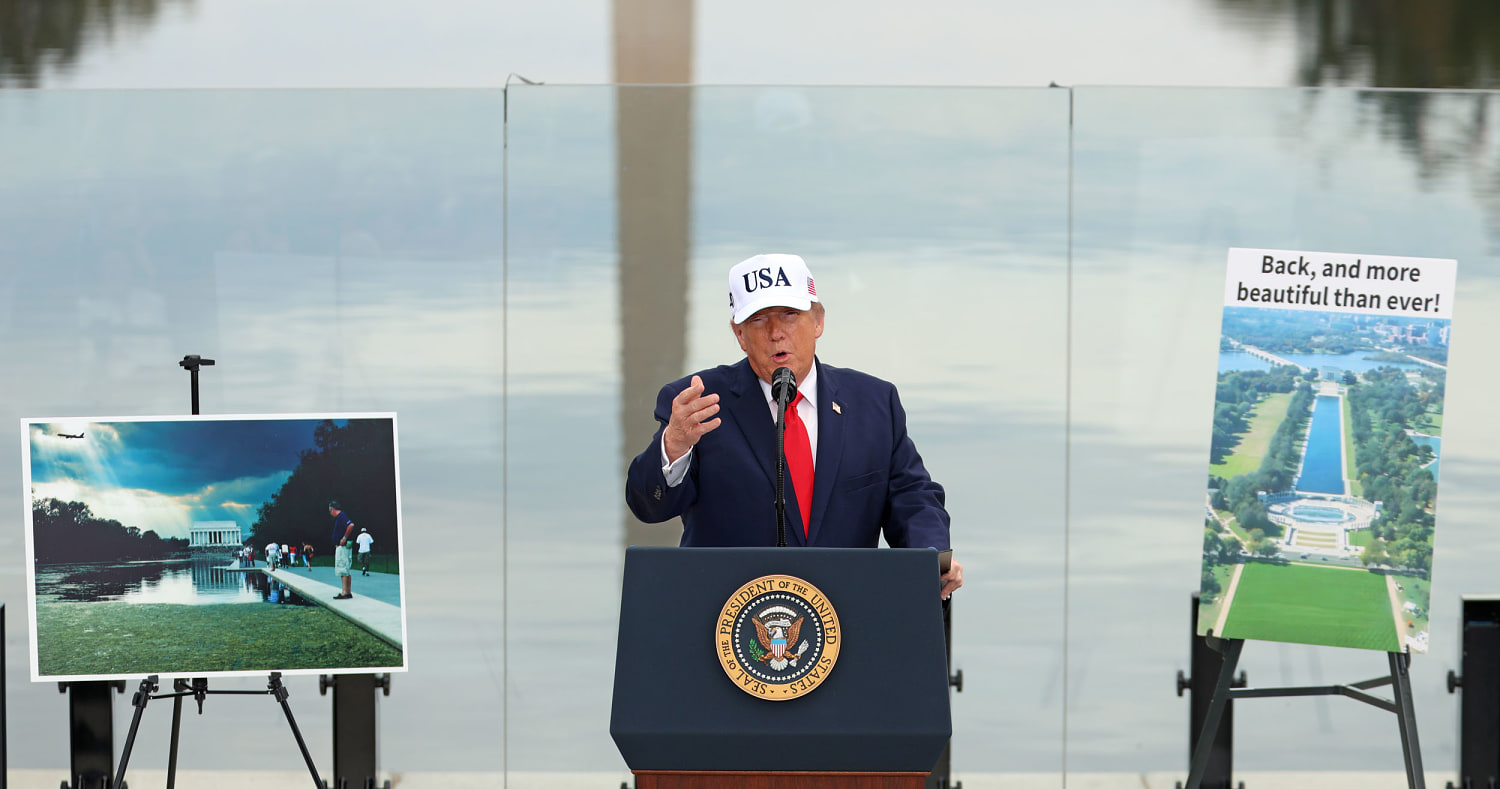
Donald Trump chose the Lincoln Memorial Reflecting Pool for his final midterm campaign address to execute a high-stakes visual strategy aimed at nationalizing local congressional races and projecting presidential authority ahead of Election Day. By staging the closing argument against the backdrop of Washington's most recognizable civic monuments rather than a traditional swing-state airport hangar, the campaign sought to elevate routine down-ballot contests into a referendum on national direction, economic stewardship, and executive strength.
Political veterans recognize this maneuver immediately. Standard midterm playbooks dictate that party leaders spend the final seventy-two hours hopping across battleground districts, shaking hands in diners, and speaking in local high school gymnasiums to juice turnout among specific congressional constituencies. Moving the finale to the National Mall breaks that convention deliberately. It trades localized retail politics for a singular, broadcast-ready visual designed to dominate cable news chyrons and social media feeds across every time zone simultaneously.
The Architecture of Political Stagecraft
Washington is a city built on sightlines, and nowhere are those sightlines more potent than the stretch between the Lincoln Memorial and the Washington Monument. Campaigns do not secure permits for this space on a whim. Navigating the National Park Service permitting process requires weeks of logistical coordination, security clearances with the United States Park Police and the Secret Service, and significant financial outlay for staging, sound engineering, and perimeter control.
When a political operation invests that kind of capital into a single location, the backdrop is doing half the talking. The Reflecting Pool offers symmetry, historical weight, and an unmistakable sense of permanence. Placing a podium there allows a speaker to borrow the visual authority of the presidency without needing to stand behind the official White House lectern. For midterm voters tuning in during the final stretch, the imagery sends an unambiguous message that the stakes extend far beyond local school boards or statehouse majorities.
Television producers love the shot. A wide angle captures the marble columns, the water, the obelisk in the distance, and a dense crowd flanking the basin. Even networks that rarely carry standard stump speeches gavel-to-gavel find it difficult to ignore a prime-time visual set on the National Mall. The setting forces media outlets to treat the event not as another routine campaign stop, but as a major national address.
Nationalizing the Midterm Ballot
Midterm elections historically punish the party in power, functioning as a delayed check on the executive branch. Yet the opposing party faces its own structural hurdle: convincing occasional voters that off-year elections matter just as much as presidential ones. Turnout drops precipitously when the top of the ticket is blank.
By positioning himself at the center of the final pitch, Trump aimed to solve that enthusiasm gap through sheer gravitational pull. The strategy relies on a straightforward political calculation. If voters view their local House or Senate race as a direct vote on Trump's agenda, base turnout surges in rural counties and exurban battlegrounds where national allegiance outweighs candidate-specific quirks.
This approach carries real risks. Nationalizing an election cuts both ways, mobilizing opposition voters in suburban districts who might otherwise stay home or split their tickets. Moderate candidates running in purple districts often prefer to keep the focus hyper-local, emphasizing infrastructure grants, property taxes, or regional healthcare costs. A massive, nationally televised rally in Washington strips away that local insulation. Every candidate down the ballot suddenly runs under the same national banner, whether they asked for it or not.
The Logistics and Friction of the National Mall
Staging a major political event on federal parkland introduces operational headaches that private venues avoid. Unlike an arena in Ohio or a fairground in Pennsylvania, where campaign advance teams control every square foot of the property, the National Mall remains public land governed by strict federal regulations.
Permits on the Mall come with rigid conditions regarding amplified sound, commercial signage, and turf protection. Heavy camera risers and press platforms require specialized weight-distribution flooring to prevent damage to the grounds. Access points are bottlenecks. Funneling thousands of attendees through security magnetometers along Constitution and Independence Avenues creates long lines that test crowd patience hours before a single word is spoken.
Weather becomes an uncontrollable variable. An open-air venue offers zero shelter from autumn wind tunnels sweeping off the Potomac River. Audio engineers have to account for wind shear distorting microphone feeds, while lighting directors battle rapidly shifting dusk conditions to keep the monuments illuminated without washing out the stage. The decision to accept these logistical burdens underscores how heavily the campaign valued the visual payoff over operational convenience.
Economic Messaging Over Local Grievances
In the final days before ballots are cast, undecided voters rarely respond to abstract ideological arguments. They look at household balance sheets. Grocery receipts, mortgage rates, energy bills, and wage growth dictate how independent voters break in the closing forty-eight hours.
A closing speech at the Reflecting Pool provides a national pulpit to hammer those kitchen-table issues at scale. Rather than tailoring remarks to the specific agricultural concerns of Iowa or the manufacturing anxieties of Michigan, a Washington address forces the message into broad, universal strokes. Inflation, border enforcement, and energy independence become the pillars of a unified national pitch.
Critics argue that speaking from Washington while campaigning against the political establishment creates an inherent contradiction. Standing amidst federal monuments while attacking federal bureaucracy requires a delicate rhetorical balancing act. Supporters, however, view the setting not as an embrace of the capital's political class, but as an assertion of ownership over the nation's civic symbols. To the base, it signals a movement claiming its place at the center of American political life rather than operating from the margins.
The Media Ecosystem and the Attention Economy
Modern campaigns no longer compete merely against rival candidates; they compete against an infinite stream of digital distractions. A traditional rally in a mid-sized market generates local television coverage and a handful of national clips. A spectacle at the Reflecting Pool hijacks the entire political media ecosystem for a full news cycle.
Digital strategists design these moments specifically for vertical video consumption. A sweeping drone shot over the water or a tight frame of a speaker framed by the Washington Monument performs exponentially better on short-form video platforms than a clip shot against a plain blue curtain in a convention center. Every visual element is engineered to stop thumbs from scrolling.
The timing of the speech also matters. Delivering the remarks late in the campaign cycle leaves minimal runway for opponents to mount a coordinated counter-narrative before polls open. Opposition strategists are forced into a reactive posture, spending valuable airtime responding to the imagery and soundbites generated in Washington rather than executing their own closing media buys in targeted media markets.
Historical Precedent on the Mall
Using the Lincoln Memorial and the Reflecting Pool as a political stage carries undeniable historical resonance, though the context has shifted dramatically over the decades. For generations, the space served primarily as a gathering ground for protest movements, civil rights demonstrations, and moments of national mourning. Leaders marched there to petition the government from the outside.
Over time, political figures recognized the power of inverting that dynamic. Inaugural committees began using the steps of the Lincoln Memorial for pre-inaugural concerts and celebrations, blending civic solemnity with partisan pageantry. Campaign operations eventually followed suit, testing the boundaries of how close partisan electioneering could get to sacred national monuments.
Each time a political figure uses the space, it sparks debate over the line between civic heritage and partisan theater. Watchdog groups routinely scrutinize permit applications and security expenditures to ensure taxpayer resources are not subsidizing campaign infrastructure. Yet the magnetic pull of the location remains undefeated. No television studio can replicate the gravitas of marble and water at twilight.
What the Closing Gamble Reveals
Ultimately, a closing rally at the Reflecting Pool is an all-in bet on centralization. It assumes that a single, dominant narrative pushed from the nation's capital will ripple outward with enough force to carry close races across dozens of diverse congressional districts.
Data from past midterm cycles shows mixed results for top-down closing strategies. In wave elections, a unified national message acts as an accelerant, sweeping out incumbents in districts that previously seemed safe. In tighter, more polarized cycles, local candidate quality and ground-game execution often prove decisive regardless of how compelling the national stagecraft appears on television.
By choosing the Reflecting Pool for the final word, Trump bypassed the traditional swing-state tour entirely in favor of one unmistakable image meant to define the election's closing hours. Whether that visual translates into down-ballot victories depends entirely on whether voters across the country view their local ballot as a neighborhood choice or a national mandate.