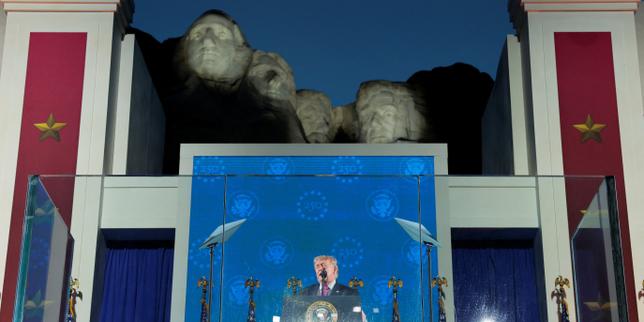
America just hit its 250th birthday, but you wouldn't know it from the mood. Instead of a unified national party, the big kickoff weekend started with a political boxing match in the South Dakota dirt. Standing right beneath the towering granite faces of Washington, Jefferson, Lincoln, and Roosevelt, Donald Trump used his prime-time Mount Rushmore address on Friday night to draw a massive line in the sand.
If you expected a traditional, warm-and-fuzzy speech about liberty and justice for all, you haven't been paying attention to American politics lately. Trump basically threw out the standard playbook. He looked out at the cheering crowd and declared that the biggest threat to the United States isn't a foreign empire or an economic collapse. It's what he calls a "resurgent communist menace" rotting the country from the inside out.
The Battle For The American Soul At Mount Rushmore
The choice of location wasn't accidental. Mount Rushmore has always been the ultimate visual shorthand for American exceptionalism. Trump leaned heavily into that imagery, praising the four presidents on the cliff as "men of action, men of ambition, men of daring." But the praise quickly shifted into a fierce defense of an American identity that he claims is under a coordinated, vicious attack.
What's driving this intense rhetoric right now? It's all about the upcoming midterm elections later this autumn. Democratic Socialists have been winning key primary races in places like New York, and the Republican strategy is clearly to brand the entire opposition party with the red scare label. Trump didn't mince words, calling this internal political shift a greater danger to American liberty than both world wars and the September 11 terrorist attacks combined.
"America will never be a communist country and we can only lose the midterms if we allow ourselves to lose the midterms." — Donald Trump at Mount Rushmore
This isn't just standard campaign trail bluster. It's a calculated effort to tie the 250th anniversary directly to a nationalist cultural defense. He aggressively took aim at progressive historians and activists, mocking those who argue that the nation exists on stolen land or that its founding heroes were merely oppressors. To Trump, these arguments aren't just historical debates. They're an active attempt to slander the future of the country.
A Birthday Plagued By Heat Wars And High Prices
Step away from the South Dakota mountainside, and the reality on the ground across the rest of the country feels incredibly heavy. The milestone anniversary arrives at a moment when everyday Americans are deeply anxious. Inflation is keeping a tight grip on everyone's wallets, gas prices are painfully high due to the ongoing U.S.-Israeli war against Iran, and a recent Pew Research Center poll shows a profoundly gloomy public outlook on the entire trajectory of the nation.
Even the logistics of the celebration are falling apart under the weight of extreme weather and partisan bickering.
- The Washington Parade Cancellation: A brutal, record-breaking heatwave forced organizers to completely cancel the main Independence Day Parade in downtown Washington D.C. on Saturday.
- The State Fair Flop: The Great American State Fair on the National Mall, featuring pavilions from all 56 states and territories, has seen sparse attendance and bad reviews over structural issues since opening last month.
- The Organizing Feud: Democrats have openly accused Trump of hijacking what should have been a bipartisan milestone after a Trump-backed group, Freedom 250, wrested control of the events away from a congressional commission.
While Trump prepares to give what he promised would be a "really long speech" on the scorching National Mall on Saturday evening just to prove he can handle the heat, alternative narratives are popping up elsewhere. In New York, Mayor Zohran Mamdani delivered a rival address surrounded by newly naturalized citizens. Mamdani took direct aim at Trump's anti-immigrant rhetoric, framing righteous dissent and the immigrant experience as the truest forms of American patriotism.
What This Means For The Next Chapter
The semantic shift in how we talk about American history isn't going away. If you're trying to make sense of where the country goes from here, look at how the federal government itself is being rebranded in real time. During his second term, Trump hasn't just spoken about nationalism; he's stamped his name and image onto federal buildings, introduced new "patriot passports," and even launched a discounted prescription drug platform called TrumpRx.
The celebratory fireworks illuminating the Black Hills might look spectacular on television, but they can't hide the deep fractures in the bedrock of the republic. We are looking at a nation celebrating 250 years of survival while actively wondering if it can survive its own internal divisions over the next four.
If you want to understand the real state of the union right now, stop looking at the official anniversary brochures. Pay attention to the local midterm primaries in your state, monitor the shifting language around immigration and public dissent, and watch how executive power is being used to reshape everyday federal institutions. The real fight for the next 250 years isn't happening on a granite mountain in South Dakota; it's happening at your local ballot box this November.