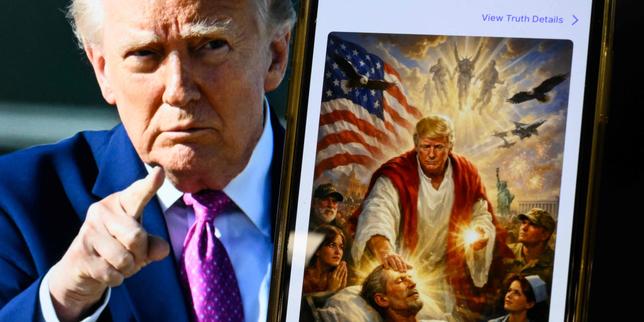
Donald Trump is currently testing the structural integrity of his most essential coalition. By launching direct rhetorical broadsides against Pope Francis and circulating inflammatory digital imagery targeting the Vatican, the former president has moved beyond simple political posturing. He is gambling on a fundamental shift in religious identity where partisan loyalty replaces denominational obedience. This strategy assumes that the American Catholic, long a swing-vote bellwether, has been so thoroughly radicalized by the domestic culture wars that they will choose a MAGA-branded populism over the leader of their own global church. It is a high-stakes play that ignores the deep, quiet institutionalism of the silent majority in the pews.
For decades, the Catholic vote has functioned as the "grail" of American presidential politics. Unlike evangelical Protestants, who have largely moved into a predictable conservative column, Catholics remain frustratingly diverse. They are evenly split, often mirrors of the national popular vote, and concentrated in the "blue wall" states of Pennsylvania, Michigan, and Wisconsin. To win, Trump needs more than just the firebrand traditionalists who frequent Latin Mass; he needs the suburbanites who view the Papacy with a baseline of respect, even if they disagree with its current occupant. By attacking the Pope, Trump isn't just picking a fight with a foreign leader. He is poking a hole in the psychological floor of his own support.
The Architecture of the Schism
The tension between Trump and the Vatican didn't emerge in a vacuum. It is the result of a multi-year divergence regarding the very definition of "pro-life" values. While the American GOP has narrowed that focus almost exclusively to the abolition of abortion, Pope Francis has consistently expanded the definition to include the treatment of migrants, the abolition of the death penalty, and the protection of the environment. This creates a friction point. When Trump shares manipulated imagery or labels the Pope’s statements as "political," he is signaling to his base that the Vicar of Christ has been compromised by "globalist" or "leftist" ideologies.
This isn't merely a Twitter spat. It is an attempt to de-legitimize the moral authority of the Church. By doing so, Trump positions himself as the true arbiter of Christian values. For the hardcore "Trad-Cath" movement, this message finds a home. These are the believers who already view Francis as a dangerous reformer. However, the American Catholic Church is a massive, bureaucratic, and deeply traditional institution. Most of its members do not spend their time in the dark corners of online liturgical debates. They see a candidate for the highest office in the land mocking a man they consider the successor of St. Peter. That creates a visceral, cultural rejection that data-driven campaign managers struggle to quantify until the ballots are counted.
The Digital Crusade and the Photomontage
The recent sharing of a photomontage—depicting Trump in a light that suggests divine or superior status compared to the Pope—is a classic tool of the populist's chest. It uses visual shorthand to suggest a new hierarchy. In this world, the political leader is the defender of the faith, while the actual religious leader is a weak, or even traitorous, figure.
Social media metrics might show high engagement for these posts, but engagement is not the same as persuasion. Within the quiet confines of the parish, this behavior looks less like strength and more like sacrilege. The risk for the Trump campaign is that this behavior alienates the "bridge" voters. These are the Catholics who might like his economic policies or his judicial appointments but are repulsed by what they perceive as a lack of basic piety or humility. Catholicism, at its core, is built on a foundation of hierarchy and respect for tradition. When Trump attacks the peak of that hierarchy, he violates the very conservative principles he claims to champion.
Pennsylvania as the Proving Ground
The geopolitical center of this crisis is the Rust Belt. In Pennsylvania alone, nearly a quarter of the population identifies as Catholic. These voters are not a monolith. They include the descendants of Polish and Italian immigrants in Scranton and Erie, as well as a rapidly growing Latino population in the eastern corridors.
The Latino Catholic vote is particularly sensitive to these optics. While Republicans have made gains with this demographic by leaning into social conservatism, those gains are fragile. Pope Francis remains an immensely popular figure among Latino Catholics, not just as a religious leader but as a cultural icon of the Global South. When Trump targets the Pope, he risks halting the momentum his party has built with Hispanic voters who were beginning to see the GOP as a viable home. You cannot court a demographic while simultaneously disparaging its most revered global representative.
The Overlooked Factor of the American Bishops
While the headlines focus on Trump versus the Pope, the real battlefield is the United States Conference of Catholic Bishops (USCCB). The American hierarchy is notoriously more conservative than the Vatican. They have often been hesitant to criticize Trump, fearing they would alienate their donor base or jeopardize their influence on the abortion issue.
However, Trump's recent escalations are forcing their hand. A bishop who remains silent while the Pope is attacked risks looking like a political operative rather than a shepherd. This creates a secondary crisis for Trump: he is losing the "soft" support of the institutional Church. If the clergy begin to signal—even subtly—from the pulpit that a candidate's behavior is incompatible with the dignity of the faith, the ground will shift. It won't be a loud protest; it will be a quiet stay-at-home movement on election day.
The Myth of the Monolithic Believer
The greatest mistake analysts make is treating "the Catholic vote" as a single block of data. It is actually three distinct groups. First, there are the "Traditionalists" who are already in Trump’s pocket and likely agree with his criticisms of the Pope. Second, there are the "Social Justice" Catholics who were never going to vote for him anyway. The third group is the "Communion Rail" Catholics—the ones who attend Mass semi-regularly, care about their local schools, and value stability.
This third group is where elections are won. They are generally older, more risk-averse, and highly sensitive to perceived instability. They remember a time when the Church was the center of the community. To them, the Pope is not a political figure to be debated on cable news; he is a symbol of a moral order that they want to see reflected in their leaders. When Trump attacks that symbol, he presents himself as an agent of chaos. For a voter seeking a return to normalcy or a protector of tradition, the sight of a politician brawling with the Vatican is deeply unsettling.
Why the GOP Strategy is Backfiring
The Trump team seems to believe they can bypass the Vatican and appeal directly to a "nativist" Catholicism. This is the idea that the American Church should be independent of the "liberal" influences of Rome. It is a bold, almost Reformation-style gambit. But Catholicism is not a congregationalist faith. It is not like the Southern Baptist Convention, where local churches can easily break away and maintain their identity.
The universal nature of the Church is its defining characteristic. By trying to "Americanize" the faith to fit a MAGA mold, Trump is asking Catholics to abandon a two-thousand-year-old identity for a political movement that has existed for less than a decade. Most people don't make that trade. They might be frustrated with the Pope's stance on climate change, but they still want him to be the Pope. They don't want a president trying to audition for the role.
The Margin of Error Problem
In a race decided by tens of thousands of votes across three states, Trump doesn't need to lose the entire Catholic vote to lose the election. He only needs to lose two percent.
A two-percent shift in the Catholic vote in a place like Macomb County, Michigan, is the difference between a victory lap and a concession speech. By engaging in this fight, Trump is spending political capital he doesn't have. He is trading the reliable, quiet votes of suburban grandmothers for the loud, digital cheers of an online fringe. It is a classic error of modern populism: confusing noise for numbers.
The historical precedent for this is thin, because no major party nominee has ever dared to make the Papacy a central target of their campaign rhetoric. Even John F. Kennedy had to go to great lengths to prove he wouldn't take orders from the Pope. Trump is doing the opposite—he is demanding the Pope take orders from him.
The Practical Consequences of the Feud
The fallout will likely manifest in the ground game. Catholic parishes often serve as the hubs for local civic engagement. When a candidate becomes "radioactive" within those social circles, the volunteer energy disappears. The Knights of Columbus and parish councils aren't going to hold rallies for a man who is actively disparaging the Holy Father.
The silence from the Trump campaign's "Catholic advisory" boards is deafening. These surrogates are now in the impossible position of having to explain away attacks on their own religious head. There is no logical way to frame "Trump vs. The Vatican" as a win for the candidate. It is a self-inflicted wound born of a total misunderstanding of how religious identity works in the American Midwest.
Religion for the American Catholic is a matter of heritage as much as it is a matter of theology. It is about the baptism of their children and the burial of their parents. It is an institution of permanence. Trump, by his very nature, is an institution-breaker. He is finding out that some institutions have deeper roots than a four-year election cycle can reach. The crisis isn't just between Trump and the Pope; it is between Trump and the reality of the people he needs most.
He is betting that the red hat is more powerful than the miter. In a few months, the exit polls in the suburbs of Milwaukee and Pittsburgh will tell us if he was right, or if he finally found the one line he couldn't cross.
Watch the swing-state bishops. If they start emphasizing the "moral character" of leadership without naming names, the game is up. Trump’s path to the White House runs through the parish hall, and he is currently setting fire to the curtains.