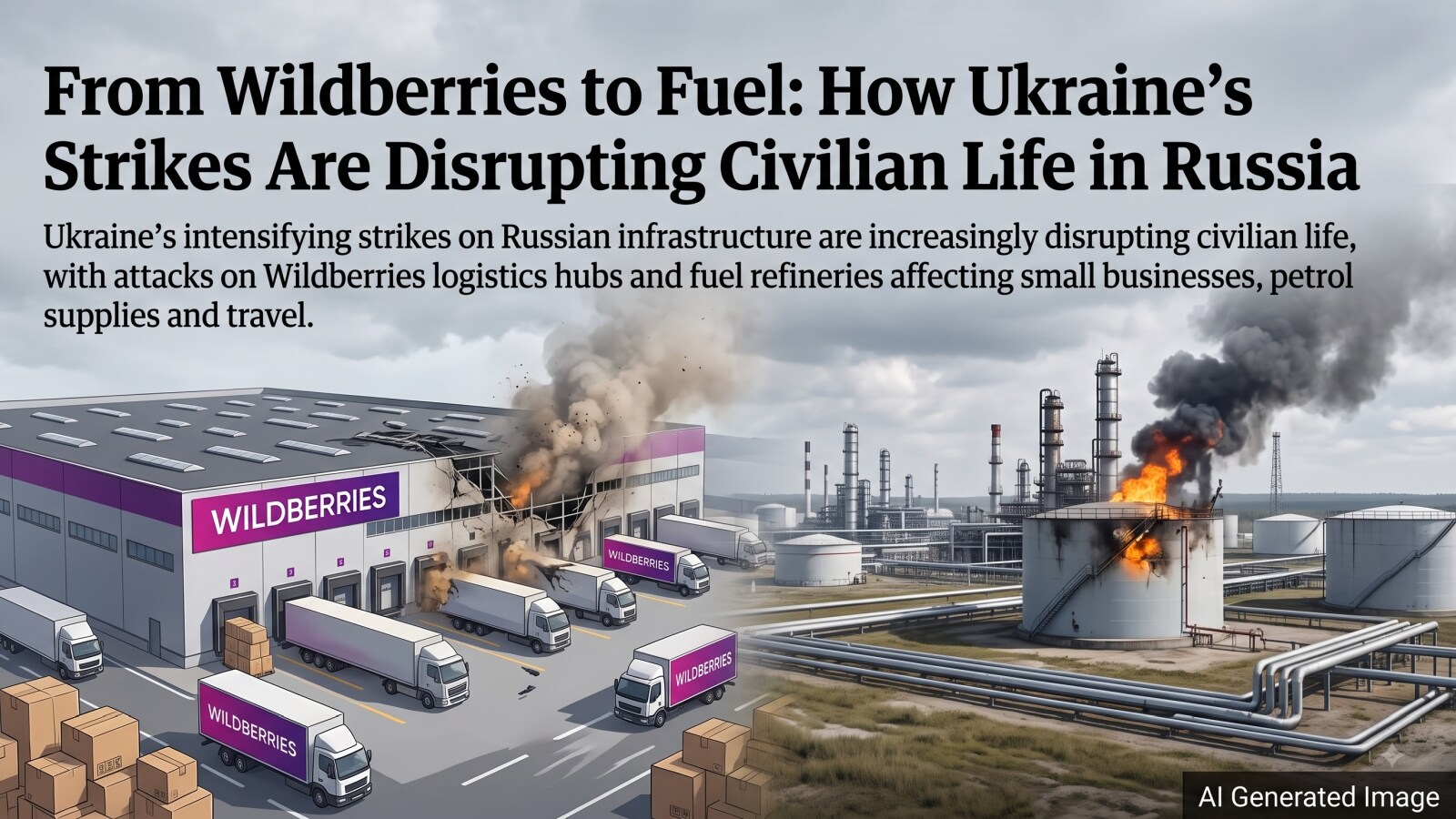
The morning air in Elektrostal smelled of frozen iron and melting plastic. Mikhail stood outside the skeletal remains of the distribution center, watching a thin column of grey smoke curl into a leaden sky that refused to offer snow. His breath fogged against his collar. Three days ago, this sprawling complex had been a roaring engine of commerce, a massive node belonging to Wildberries where hundreds of thousands of parcels—winter coats, smartphone chargers, packets of dry yeast, school notebooks—were sorted, scanned, and flung onto trucks heading toward nine time zones.
Now, the conveyor belts were twisted ribbons of scrap. The barcodes were ash.
Mikhail was not a soldier. He was a logistics manager who knew the exact cubic capacity of a Kamaz truck and the precise routing code for a regional delivery to Voronezh. He had spent ten years building a life out of predictability, believing that as long as the digital carts were filling up and the payment gateways cleared, the world outside his window would remain a distant abstraction.
That illusion burned down in twenty minutes.
It started with a low, tearing whistle that veteran security guards recognized before the younger workers even looked up from their handheld scanners. Then came the concussive thump, the shattering of twelve-foot glass panes, and the amber bloom of a fire that consumed millions of rubles worth of goods meant for ordinary apartments across the federation.
This is what happens when geopolitical friction drops out of the sky and lands directly on a Tuesday morning grocery order.
We talk about strategic strikes in terms of coordinates, altitudes, and payload capacities. Analysts in sterile rooms examine satellite imagery, measuring craters in meters and estimating the replacement cost of a transformer station. But numbers on a military briefing slide fail to capture the texture of consequence. They do not smell like scorched cardboard. They do not translate into the quiet panic of a mother in a regional town checking her banking app to find her refund delayed by thirty days because the central sorting hub that processed her order no longer has a roof.
Consider the architecture of modern vulnerability. For decades, supply chains were designed for maximum efficiency, stretching like delicate, invisible spiderwebs across continents. Every delivery app, every same-day shipping promise, every automated inventory check relied on absolute peace. When those webs are struck by long-range drones—whether targeting the sprawling fulfillment centers of online retail giants or the industrial fuel depots that keep the long-haul trucks moving—the disruption does not stay contained to the military ledger.
It trickles down into the kitchen.
In a village three hundred kilometers south of Moscow, Elena looked at her phone screen with a frown that had become permanent over the past year. The winter fuel delivery she had ordered through an online marketplace was marked as cancelled. The depot in the oblast capital, a key regional storage hub, had been hit the night before. The diesel meant to heat her home for the remaining months of frost was currently a pool of charred residue.
"They say another shipment will take two weeks," she told her neighbor, leaning against the wooden fence as the wind bit through her wool scarf. "If the roads stay clear. If the trucks can get the diesel."
There is a strange, jarring intimacy to watching a major economy contract under pressure. It is not always marked by sudden starvation or dramatic blockades. More often, it arrives as a slow erosion of convenience, a grinding friction that turns simple tasks into logistical endurance tests.
When fuel depots light up the night sky, the shockwaves ripple immediately into the transport sector. Long-haul drivers face tighter fuel rationing, soaring prices at independent stations, and hazardous detours around restricted zones. A journey that once took two days now stretches into four. Fresh produce rots in refrigerated trailers idling at impromptu security checkpoints. Spare parts for agricultural machinery sit in customs limbo or burned-out warehouses, leaving tractors silent just as the spring thaw approaches.
We often imagine conflict as a frontline—a jagged trench cutting through a muddy field far away. But in the era of automated supply chains and long-range aerial reach, the frontline is folded inward. It runs right through the center of civilian logistics. Every time a drone navigates toward a fuel terminal or an industrial park, it is testing the resilience of a complex social contract: that citizens can go about their daily labor, buy groceries, heat their homes, and receive packages without needing to think about the trajectory of an air defense interceptor.
Mikhail walked away from the smoldering ruins of the warehouse, his boots crunching on frozen glass. His phone buzzed in his pocket—not with a work schedule, but with a notification from a chat group of displaced logistics workers sharing rumors about which companies were still hiring.
The smoke in Elektrostal eventually thinned, dissolving into the gray winter clouds, but the empty spaces left behind in the supply chain remained. They grew larger, echoing in the quiet homes of people who never asked to be part of the calculation, waiting for trucks that would take a little longer to arrive, carrying fuel that cost a little more than it did yesterday.