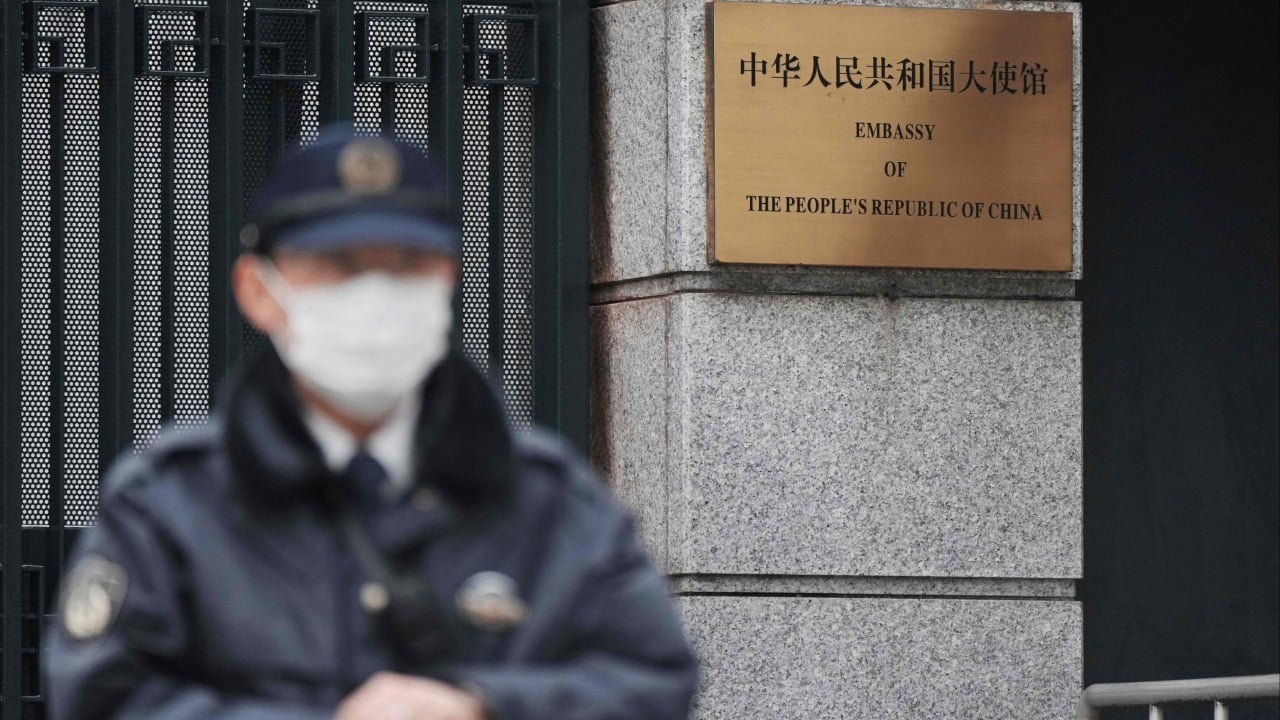
The apology from Tokyo was swift, uncharacteristic, and deeply revealing. When Japan’s senior ministers expressed "regret" over the arrest of a high-ranking military officer at the Chinese embassy, they weren't just smoothing over a diplomatic wrinkle. They were attempting to cauterize a wound in a high-stakes intelligence operation that went sideways in the heart of Beijing. This wasn't a simple misunderstanding over a visa or a lost passport. It was a calculated breach of the unspoken rules that govern the shadow war between Asia’s two largest economies.
In the world of international relations, "regret" is the currency of the compromised. When a sovereign nation apologizes for the detention of its own official on foreign soil, it usually means that official was caught doing something that cannot be defended under standard diplomatic protocols. The officer in question, a seasoned member of Japan's Self-Defense Forces (SDF) attached to the embassy, was intercepted in a manner that suggests the Chinese Ministry of State Security (MSS) had been sitting on his trail for months.
The immediate fallout is a public relations nightmare for the Kishida administration, but the structural damage goes much deeper. Tokyo is currently in the middle of a massive legislative push to overhaul its security clearance systems and expand its counter-intelligence capabilities. This arrest, and the subsequent groveling for the officer’s release, signals to the world—and more importantly, to the Japanese public—that the nation’s intelligence apparatus is still playing catch-up in a theater where the opposition has home-field advantage.
The Breach of the Red Line
Diplomatic immunity is a powerful shield, but it is not a magic cloak. The Vienna Convention provides protection for "diplomatic agents," but the gray area inhabited by defense attachés and military liaisons is notoriously thin. These individuals are expected to gather information; that is their job. However, there is a "red line" involving the handling of physical assets and the exchange of classified documents in non-secure locations.
The arrest took place during what was described as a routine meeting, but the intensity of the Chinese response suggests otherwise. This was a "sting" operation. By detaining the officer, China sent a message that they are no longer willing to look the other way regarding Japanese monitoring of their internal military developments. For years, Japan has relied on its technological edge to gather signals intelligence, but this incident highlights a desperate need for human intelligence (HUMINT) that Tokyo is clearly struggling to manage.
The mechanics of the arrest are telling. Reports indicate the officer was held for several hours, interrogated without access to legal counsel or embassy staff, and then unceremoniously dumped back into the diplomatic pool. This is a classic "catch and release" intimidation tactic. It’s designed to burn the officer’s credibility and force the home country into a humiliating public admission of guilt. Japan’s decision to express regret so quickly confirms that they had no cards left to play.
The Economic Espionage Undercurrent
While the headlines focus on military officers, the real battle is over silicon and steel. Japan is a critical node in the global semiconductor supply chain, and China is desperate to bridge the widening gap in chip manufacturing technology. The military officer’s arrest didn't happen in a vacuum; it occurred against a backdrop of tightening export controls and a Japanese government that is increasingly aligned with Washington’s "de-risking" strategy.
- Technology Transfer: The MSS is hyper-focused on Japanese breakthroughs in lithography and chemical engineering.
- Dual-Use Goods: Items that appear civilian but have direct applications in missile guidance or stealth coating.
- Supply Chain Resilience: Japan is actively moving manufacturing out of the mainland, a move Beijing views as economic warfare.
When a military officer is arrested, it is often because they were sniffing around these specific industrial intersections. The SDF isn't just worried about how many tanks China has; they are worried about the proprietary tech inside those tanks and where that tech originated. The "regret" expressed by the minister is an admission that the hunt for this information was handled clumsily. It was an amateur move in a professional’s game.
A Systemic Weakness in Tokyo
Japan’s intelligence community is a fractured mosaic. Unlike the CIA or MI6, Japan lacks a single, centralized foreign intelligence agency with a clear mandate for offensive operations. Instead, you have a mix of the Cabinet Intelligence and Research Office (Naicho), the Public Security Intelligence Agency (PSIA), and various military intelligence units. They often don't talk to each other. Information is siloed, and turf wars are common.
This lack of cohesion is what leads to disasters like the Beijing arrest. If the officer was operating under the umbrella of a unified agency with proper "deep cover" support, the operational security would have been significantly higher. Instead, you have military personnel operating in the glare of the diplomatic spotlight, trying to perform clandestine tasks with the subtlety of a sledgehammer.
The current administration is trying to fix this with the "Economic Security Promotion Act," but laws on paper don't change the culture on the ground. Japanese officials are traditionally risk-averse. When they do take risks, they lack the historical institutional knowledge of how to handle a compromise. The rapid apology is proof of a system that panics when the playbook fails.
The Shadow of the United States
We cannot talk about Japan-China relations without acknowledging the presence of the United States. To Beijing, every Japanese intelligence officer is essentially an extension of the Pentagon. This perception makes the stakes much higher. When China arrests a Japanese official, they are indirectly punching at Washington.
Japan’s "regret" is also a signal to the U.S. that they are not ready to handle the blowback of a full-scale intelligence confrontation. It is an admission of vulnerability. If Japan cannot protect its own military officers in a standard diplomatic setting, how can it be trusted to handle the highly sensitive "Five Eyes" level data that Tokyo is so eager to access?
The Cost of Diplomatic Deference
The immediate cost is the loss of a valuable intelligence asset. That officer is now "persona non grata" in all but name. They can never work in China again, and their career is effectively over. The broader cost is the chilling effect this has on other Japanese officials stationed abroad. If they know their government will apologize the moment they are caught in a squeeze, they will stop taking the necessary risks to gather the data Japan needs to survive in an increasingly hostile neighborhood.
This is the brutal reality of the 21st-century spy game. It isn't about James Bond gadgets; it's about the stomach to endure a diplomatic crisis without blinking. Japan blinked.
Rebuilding the Wall
To prevent a repeat of this embarrassment, Japan must move beyond its post-war hesitation toward robust intelligence operations. This requires more than just "regret" and diplomatic hand-wringing.
- Centralization: Create a singular foreign intelligence entity that operates outside the bureaucratic reach of the Ministry of Foreign Affairs.
- Tradecraft Training: Shift from using military attachés for HUMINT to professional intelligence officers who understand the nuances of urban survival in a surveillance state like China.
- Legal Protections: Update domestic laws to provide a clear legal framework for intelligence activities, giving officers the confidence that their government will stand behind them.
The Beijing arrest was a wake-up call that the Japanese government tried to silence with a polite apology. But the silence won't last. The competition for regional dominance is accelerating, and the country that can't keep its secrets—or protect its people—will eventually find itself sidelined.
The minister’s expression of regret was meant to close the book on this incident. In reality, it just opened a new chapter on Japan's struggle to find its footing as a serious geopolitical player in a world that no longer respects the old rules of the game.
Auditing the security protocols of every overseas mission is the only logical step left for Tokyo if they want to avoid another public humiliation on the global stage.
Would you like me to analyze the specific legislative changes Japan is currently debating regarding their new security clearance system?