Dust. That is the first thing you notice when a convoy slows down on a narrow ridge in the occupied West Bank.
Fine, chalky, sun-bleached limestone dust that coats the windshield until the wipers smear it into gray ribbons. You sit behind tinted glass with a blue or white license plate, carrying a laminated pass signed by ministries in Brussels, Paris, Berlin, or Madrid, and you tell yourself a quiet lie that diplomats and observers have told themselves for decades. Paper matters. Flags matter. Protocol means the rules of the room hold even when the room has no walls.
Then a stone hits the door. Not a whisper. A thud that vibrates right through the soles of your shoes.
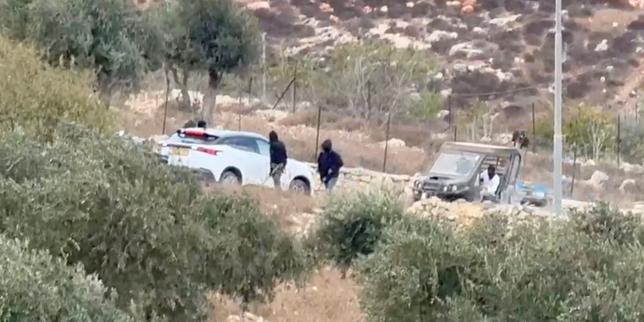
When news breaks that settlers in the occupied West Bank attacked a European diplomatic convoy and struck a French mayor, headlines tend to arrive like cold ledger entries. A location. A delegation. A clash. A shove or a blow. A diplomatic protest filed hours later in a cool, wood-paneled office thousands of miles away. People scroll past because the words sound routine, almost rehearsed, like lines from a play that has run so long everyone knows the blocking.
Yet behind every dry wire report sits a collision between two completely different realities of power. One lives inside international law, consular notes, and the polite fiction that an envoy's badge draws an invisible line around them. The other lives on the asphalt and dirt tracks of the West Bank, where everyday friction, territorial pressure, and impunity decide who gets to pass and who has to turn back.
I have spent enough time in conflict zones and tense borderlands to know how fast abstract geopolitics turns physical. You do not feel "sovereignty" when you are standing beside a stalled SUV in eighty-five-degree heat with shouting rising from a ridge above you. You feel your pulse in your jaw. You notice the exact angle of a hand coming toward your shoulder. You realize, with a jolt that stays with you for weeks, how thin the membrane is between official status and vulnerability.
To be completely honest, this entire corner of the world can feel overwhelming to follow from afar. Names of checkpoints, hills, outposts, and municipal offices blur together. Even seasoned analysts sometimes struggle to keep track of why an incident involving a French local official and European envoys matters beyond the immediate news cycle. If you feel a mix of fatigue and confusion when you read these stories, you are not alone. That fog is real, and pretending it is simple would be dishonest.
Let us clear some of that fog before we go any further.
What Is Actually Happening on Those Roads
When reporters refer to the occupied West Bank, they are speaking of territory captured by Israel in the 1967 Six-Day War and governed under a patchwork of military and civil arrangements shaped by decades of conflict and the Oslo accords. Across this terrain live millions of Palestinians alongside hundreds of thousands of Israeli settlers in settlements considered illegal or contested under much of international law, a point of fierce legal and political dispute.
Now picture a diplomatic convoy moving through that space. Often, these visits are fact-finding missions or humanitarian and development tours. European diplomats, aid coordinators, and sometimes elected local officials—such as mayors from European cities who partner with Palestinian municipalities on water, schools, health clinics, or civic exchange—travel together to see conditions firsthand. They go to inspect projects funded by European taxpayers, meet local leaders, and report back to capitals that have spent years trying to balance diplomatic ties, security concerns, and support for a two-state horizon.
When settlers confront or attack such a convoy—throwing stones, blocking vehicles, shouting abuse, or physically striking someone like a French mayor—it sends a shockwave far beyond the immediate road. For a French elected official, being struck is not just a personal assault or a rough scuffle in the dust. It is a direct physical shock to a representative of a major European state operating in a sensitive theater.
Why would attackers target people with diplomatic ties or foreign passports in the first place?
From the perspective of hardline extremists on the ground, international observers and European officials are rarely seen as neutral bystanders. They are often viewed as hostile critics, meddlers, or backers of the Palestinian side. When tension runs high—around land disputes, olive harvests, demolitions, movement restrictions, or broader cycles of violence—frustration and hostility frequently spill onto anyone perceived as an outsider inspecting the situation. Add weak or inconsistent enforcement in volatile zones, and boldness grows. People do what they believe carries little immediate cost.
A Walk Through the Dust (A Hypothetical Scenario)
To see how a routine afternoon turns into an international flashpoint, consider a hypothetical scene built from patterns well documented across the West Bank. It is not a single verified transcript of one event, so treat it strictly as a composite illustration of how these moments unfold.
Call the French mayor Marc. In real life, mayors from towns around Lyon, Lille, or Marseille often make these trips out of civic solidarity or municipal cooperation agreements. Marc has packed two notebooks, a sun hat he refuses to wear because he thinks it looks ridiculous, and a genuine desire to listen rather than lecture. Beside him in the lead vehicle sits Claire, a mid-level European diplomat who has spent twelve years reading cables and knows every nuance of protocol.
At nine in the morning, the air is crisp and the olive groves along the hillside look almost peaceful from a distance. By eleven, the sun has climbed straight overhead, turning the stone walls white and making the heat shimmer off the hood of the car.
They stop near a community project—perhaps a solar water pump or a clinic extension that a European municipality helped finance. Local residents gather to explain how road closures or access limits affect daily life. Claire takes notes carefully, asking about permits and timelines. Marc asks practical questions a mayor always asks: how do you keep services running when budgets freeze and travel takes three times as long as the map suggests?
Then the mood shifts.
A pickup truck or a small group appears near the edge of the track. Voices carry sharp and angry across the dry scrub. At first, it looks like a shouting match at a distance, the kind diplomats tell themselves will blow over if they stay calm and keep their distance.
Instead, the distance shrinks.
A stone skips across the gravel and pings off a fender. Another lands inches from a rear tire. The drivers start the engines, weighing whether to reverse slowly or push forward without hitting anyone. Doors open on one of the vehicles as someone steps out to de-escalate or check on a colleague. In a split second, bodies press close, voices overlap in Hebrew, Arabic, French, and English, and an open hand or shove catches Marc across the shoulder or side of the head.
Nobody dies that day. No shots are fired in this hypothetical afternoon. By evening, cable traffic is humming between Jerusalem, Ramallah, Paris, and Brussels.
Yet something quiet has broken.
When Marc gets back to his hotel room, his shirt is damp with sweat and dust, and his ribs or jaw ache in a way no briefing memo ever captures. A briefing memo says physical altercation. It does not capture the sudden realization that your diplomatic passport is made of paper, while the ground beneath your boots is made of rock.
Why a Shove on a Dirt Road Travels Thousands of Miles
Metaphorically speaking, a diplomatic convoy in a contested zone is like a glass thermometer dipped into boiling water. The glass does not create the heat. It simply shows how hot the water has become.
European governments have spent years crafting careful language on the West Bank. They condemn settlement expansion, criticize violent attacks against civilians, express concern over military raids and militant attacks alike, and fund aid programs while maintaining deep economic, intelligence, and diplomatic ties with Israel. That balancing act relies on a comforting assumption: that even in a deeply polarized environment, basic norms around diplomatic movement and foreign officials will hold.
When a convoy is attacked and a French mayor is struck, that assumption takes a direct hit.
Paris cannot simply shrug off a citizen—especially an elected mayor—being physically assaulted during an official or semi-official visit. Even if the injuries are minor, the political weight is heavy. Foreign ministries summon ambassadors or issue sharp public rebukes not out of theatrical habit alone, but because failing to push back signals that intimidation works. If foreign representatives can be harassed or struck without consequence, fewer eyes will go to contested areas, fewer independent accounts will reach European capitals, and local realities will become even easier to obscure.
Consider what happens next in the court of public opinion:
In Europe, stories like this sharpen an already fierce debate. Critics of Israeli policy argue that settler violence flourishes in a climate of impunity and ask how European states can talk about rules-based order if their own envoys and local leaders are manhandled on the ground. Defenders of Israel and supporters of the settlement movement often push back hard, arguing that media coverage singles out settler misconduct while overlooking Palestinian attacks, security threats, or provocative behavior by activists and visiting delegations.
Both sides see completely different films from the same reel.
That clash of narratives is part of the trap. When an incident occurs, facts often get tangled before the dust even settles. Who threw the first stone? Was there a prior confrontation? Did security forces arrive late, stand by, or intervene forcefully? Why were the vehicles on that specific route? Answering those questions takes verification, patience, and exactness—qualities that rarely survive the first hour of outrage on social media.
The Invisible Stakes Nobody Puts in the Headline
Strip away the diplomatic jargon and look at what is really at stake for ordinary people on every side of this divide.
First, there are Palestinian families living under occupation and daily restriction. When international visitors and diplomats are attacked or turned back, a vital window to the outside world narrows. Local mayors, farmers, teachers, and health workers often count on outside witnesses—not as a magic shield, because history shows foreign presence rarely stops every hardship—but as proof that their lives are not completely invisible. When intimidation pushes visitors away, isolation deepens.
Second, there are ordinary Israelis who want security, stability, and normal life, yet find their country's global standing damaged whenever violent extremists grab the spotlight. Extremism on any side pulls moderate voices into the margins. Every attack caught on camera or reported in European newspapers feeds international pressure, complicates alliances, and reinforces the image of a conflict spiraling further away from compromise.
Third, there are European diplomats and citizens trying to make sense of foreign policy. Many people in France and across Europe wonder why their governments seem perpetually entangled in Middle Eastern crises while domestic costs, housing, and public services press hard at home. When a French mayor gets caught in the middle of a West Bank confrontation, the conflict stops feeling purely distant. It taps into anxieties about national prestige, safety abroad, and whether diplomacy still has teeth.
We often treat international affairs like a chess match played by distant grandmasters. Move three, counter-move four, press release on page six.
The truth is messier and far more human. Chess pieces do not feel fear. Chess pieces do not wipe grit out of their eyes or wonder whether a stone aimed at a window was meant to scare or to hurt. Real people do.
A Pattern Older Than Today's Headlines
History rarely repeats in neat loops, yet it rhymes with unsettling regularity in contested lands.
Over the decades, tensions in the West Bank have repeatedly flared around land access, settlement growth, military operations, and political stalemate. When diplomatic tracks stall and hope for a negotiated settlement grows thin, the space in between does not stay empty. Frustration fills it. Radical actors test limits. Local clashes ignite broader diplomatic rows.
Observers who study this region have long warned about a slow erosion of norms. Norms are like mortar between bricks. You do not notice them holding the wall together until chunks start flaking out. First a road is blocked. Then a delegation is cursed at. Then someone throws a rock. Then someone gets hit. Each step nudges the baseline a little further toward disorder until what used to be shocking starts looking like Tuesday.
And yet, we should resist fatalism without falling into naive optimism.
Saying that tensions have deep roots does not mean every escalation is inevitable or identical. Accountability still matters. Clear investigations matter. Protecting diplomats, journalists, aid workers, and visiting officials is not a luxury reserved for calm places; it is one of the most basic obligations of order anywhere.
What You Can Do With a Story Like This
When you close a tab after reading about a convoy attack in the West Bank, you are not going to rewrite foreign policy by lunchtime. That is fine. You do not need to pretend you hold the levers of statecraft to read carefully and think clearly.
You can slow down before taking the first hot take at face value. Look for multiple sources once initial reports settle. Notice what details are confirmed and what details are still disputed. Pay attention not only to the dramatic clash itself, but to the quieter context around it: who has freedom of movement on that road, who is accountable for law and order there, and what happens to the communities left behind after the diplomats drive away.
Most of all, refuse to let human beings turn into cardboard cutouts. A diplomat is not just a title. A French mayor is not just a nationality. A settler, a soldier, a Palestinian farmer, a local resident—each stands inside a web of fear, belief, history, and daily survival that is far bigger than a single headline.
Late afternoon light in the hills has a way of turning everything copper and long shadows. A convoy pulls back toward a main highway, dust settling slowly over the rocks, leaving behind a quiet road, a bruised shoulder, and a cable already being drafted for a desk thousands of miles away.