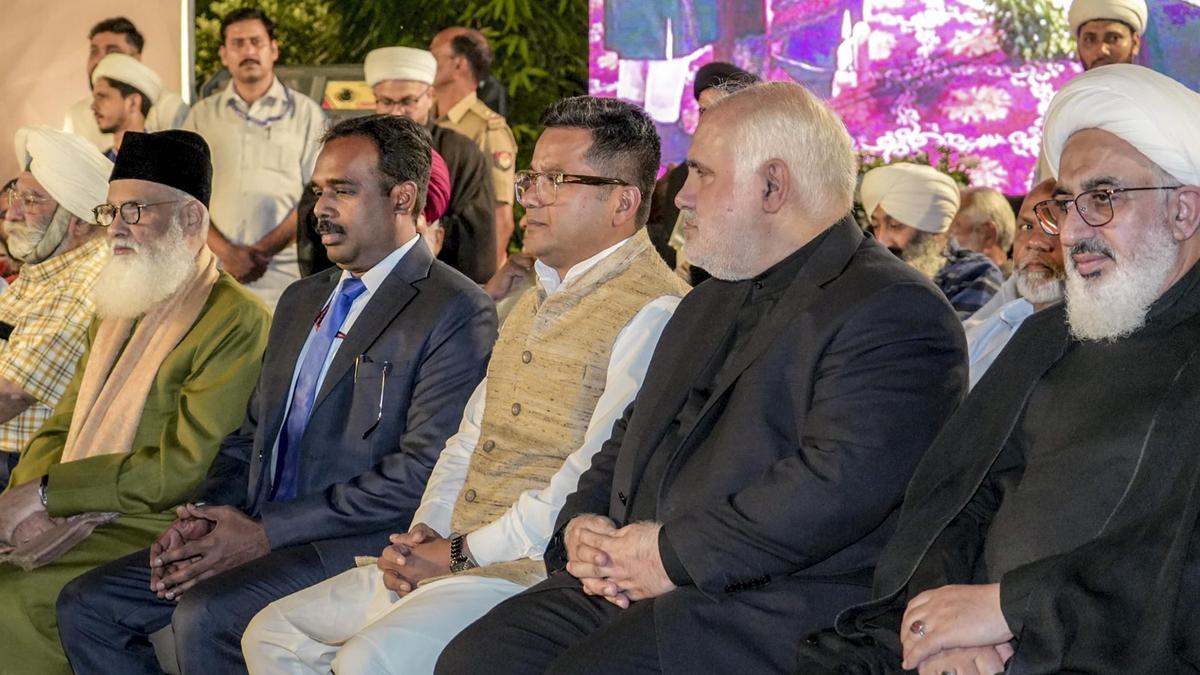
Attendance at a state funeral is not an act of solidarity. It is a data-mining expedition disguised as piety. When MoS Shobha Karandlaje (often misidentified in rushed copy as "Margherita") touched down in Tehran to pay respects for the late Iranian President Ebrahim Raisi and Foreign Minister Hossein Amir-Abdollahian, the headlines played a predictable tune. They spoke of "shared grief" and "regional stability." They focused on the optics of the black robes and the bowed heads.
They missed the point entirely.
In high-stakes diplomacy, grief is a secondary currency. The primary currency is presence—the physical occupation of space at a time of perceived vulnerability. To view these ceremonies through the lens of "mourning" is to fall for the oldest trick in the statecraft handbook. We need to stop treating diplomatic funerals as somber interruptions to business and start recognizing them as the most aggressive networking events on the planet.
The Myth of the Symbolic Gesture
The lazy consensus suggests that sending a Minister of State to a funeral is a "balanced" symbolic gesture—enough to show respect, not enough to signal a shift in alliance. This is a fundamental misunderstanding of how power vacuums work.
When a leader like Raisi disappears from the board, the internal architecture of the state doesn't just freeze in a moment of silence. It vibrates with the friction of succession. Foreign dignitaries aren't there to say goodbye to the dead; they are there to size up the living. They are scanning the periphery of the prayer rugs to see who is standing closest to the Acting President, Mohammad Mokhber. They are measuring the distance between the IRGC commanders and the civilian bureaucrats.
If you think India’s presence was about "historical ties," you’ve been reading too many press releases. It was about the International North-South Transport Corridor (INSTC). It was about ensuring that the paperwork for the Chabahar Port remains valid while the signatures on the previous contracts are still cooling.
Stability is a Polite Word for Stagnation
Mainstream news outlets love the word "stability." They treat it as a universal good. In the context of Iran-India relations, "stability" is often a euphemism for "we hope the shipping lanes don't close."
But real insiders know that these moments of transition are the only times when the ossified structures of bureaucracy actually move. A funeral is a high-pressure environment where months of formal "bilateral talks" are compressed into twenty-minute hushed conversations in marble hallways.
Imagine a scenario where a mid-level diplomat secures a verbal assurance on energy pricing while the rest of the world is watching the casket. That isn't "mourning." That’s arbitrage. You are trading on the temporary suspension of normal protocol.
The danger of the "stability" narrative is that it makes us blind to the risks of a shifting status quo. India isn't just maintaining a relationship; it is managing a hedge against Western sanctions and Eurasian shifts. By attending, India isn't saying "we agree with you." It is saying "we are still a stakeholder in your survival."
The E-E-A-T of Geopolitics: Who Really Gains?
I have watched governments burn through millions in "soft power" initiatives—cultural exchanges, food festivals, academic grants—only to see it all neutralized by one missed appearance at a funeral.
The "Expertise" here isn't in knowing the protocol of a Shia mourning ceremony. It’s in knowing the Order of Precedence. If the Chinese representative gets more face time with the Supreme Leader’s inner circle than the Indian representative, the "symbolic gesture" becomes a strategic failure.
The "Trustworthiness" of a nation in the Middle East is measured by its willingness to show up when things are messy. When the U.S. and its allies are conspicuously absent or issuing terse, legalistic condolences, the presence of a BRICS partner carries ten times the weight.
However, there is a massive downside to this contrarian approach: it locks you into a cycle of perpetual neutrality that can look like complicity. By refusing to play the "good vs. evil" game that dominates Western headlines, India risks alienating its partners in the Quad. It’s a tightrope walk where the safety net is made of razor wire.
Stop Asking if it’s "Right" and Start Asking if it’s "Working"
People often ask: "Should a democracy be honoring a leader with a controversial human rights record?"
That is the wrong question. It’s a category error.
In the realm of grand strategy, "should" is a luxury for those who don't rely on the Strait of Hormuz for their energy security. The brutal honesty is that the moral posture of the deceased is irrelevant to the functional requirements of the living.
The real question is: "Does this presence accelerate our strategic autonomy?"
If the answer is yes, the "mourning" is a success. If the answer is no, it’s just an expensive flight and a wasted afternoon.
The Logistics of Power
Let’s look at the mechanics. You don’t send a MoS for the eulogy. You send them for the sidebars.
- The Informal Audit: You get to see, in real-time, who is actually in control of the security apparatus.
- The Priority Queue: You see which nations are granted private audience rooms and which are left in the general hall.
- The Continuity Check: You verify that the "Deep State" of the host nation is still functioning.
When Shobha Karandlaje handed over the letter from PM Modi, the content of the letter was secondary. The hand-to-hand transfer was the evidence of a direct line that remains open despite the chaos.
The Illusion of the "Global Community"
The competitor article likely framed this within the context of the "global community" paying respects. There is no such thing. There is only a collection of competing interests that occasionally share an Uber to the same mosque.
To describe the Tehran ceremony as a "global" event is to ignore the stark divide between the Global South and the West. This wasn't a funeral; it was a summit of the non-aligned. It was a physical manifestation of a world that is no longer unipolar.
If you’re still analyzing these events through the lens of "international norms" or "diplomatic etiquette," you’re playing checkers while the rest of the world is playing 4D chess with oil futures and transit corridors.
The next time a state leader dies, don't look at the flowers. Look at the seating chart. That’s where the real news is written.
Stop looking for the "human story" in state funerals. There are no humans there—only representatives of interests. India’s presence in Tehran wasn't an act of kindness. It was an act of cold, calculated, and necessary preservation.
The ceremony ended. The Minister flew home. The deals remained.
That is the only "stability" that actually matters.