The blue light from a smartphone screen cast a ghostly pallor over Sarah’s face at 2:00 AM. She wasn't looking for news of the world or updates from her estranged high school friends. She was looking for a capuchin monkey in a yellow raincoat.
She found him. Within seconds, the tightness in her chest—the residue of a day spent navigating corporate spreadsheets and a failing radiator—began to loosen. The monkey was eating a grape. He peeled it with tiny, dexterous fingers that looked hauntingly like her own, but smaller, more honest. He looked at the camera with a wide-eyed curiosity that seemed to ask, Why are you watching me?
Sarah didn’t have an answer, but she felt a strange, inexplicable surge of joy.
This is the silent pact millions of us have signed with the "internet’s favorite monkey." We are a species increasingly isolated by the very tools meant to connect us, yet we find our communal heartbeat in the antics of a creature that has no idea what a "like" or a "share" is. The phenomenon isn't just about cute videos. It is about a desperate, modern search for something tactile in a world made of glass and pixels.
The Mirror in the Palm of Your Hand
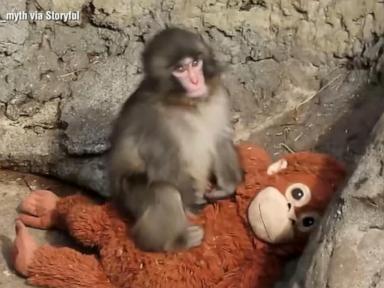
Biologically, we are cousins. That much is schoolroom science. But the psychological tether goes deeper. When we watch a monkey interact with a human world—sitting at a miniature table, wearing a striped sweater, or meticulously opening a cardboard box—we are watching a distorted reflection of our own absurdity.
Consider the "Uncanny Valley," a concept usually reserved for robots that look too much like people and creep us out. Monkeys occupy the opposite space. They are the "Endearing Valley." They perform our domestic rituals without our baggage. A monkey doesn't worry about the mortgage while it drinks from a teacup. It is entirely present. In an era where "mindfulness" is a billion-dollar industry sold to us via apps, the monkey is a master of the craft for free.
But there is a tension here. A friction.
We see a video of a macaque grooming a kitten and we feel a warmth that we might not even extend to our neighbors. This isn't because we’ve lost our humanity; it’s because the monkey represents a version of humanity that is stripped of ego. There is no subtext. There is only the grape, the raincoat, and the moment.
The Architecture of a Viral Heartbeat
The "Internet’s Favorite Monkey" is rarely just one animal. It is a rotating cast of characters—George, Pesto, or various unnamed capuchins—who become vessels for our collective neuroses. Their rise to fame follows a predictable, almost mathematical arc.
It starts with a fluke. A thirty-second clip of a primate reacting to a magic trick. The algorithm, that cold and calculating god of the digital age, notices a spike in retention. It sees that people aren't just clicking; they are re-watching. They are sending it to their mothers.
Why? Because the primate’s reaction is a universal language. You don't need to speak English, Mandarin, or Spanish to understand the confusion of a monkey when a ball disappears from under a cup. It is the purest form of storytelling. Conflict, mystery, and resolution, all packed into a file size small enough to travel around the globe in a heartbeat.
The numbers are staggering. We are talking about billions of views. If these monkeys were a nation, they would be the most influential superpower on earth. They command more daily attention than most world leaders, and they do it without ever uttering a word.
The Invisible Stakes of the Screen
There is a cost to our obsession that we rarely discuss. While we find solace in the big eyes and tiny hands of these animals, we are participating in a complex ethical web.
Imagine a hypothetical sanctuary worker named Elena. Elena spends her days cleaning enclosures and preparing specialized diets for rescued primates. To her, the "internet’s favorite monkey" is a source of constant anxiety. She knows that every time a video of a pet monkey goes viral, the demand for exotic pets in the real world spikes.
"People see the sweater," Elena might say, "but they don't see the canine teeth that had to be removed. They don't see the psychological distress of a social animal kept in a studio apartment."
This is the shadow side of our digital kinship. Our love for the character often blinds us to the needs of the creature. We want the monkey to be a small, hairy human because that makes us feel less alone. But the monkey is a wild being. Its "cuteness" is often a stress response that we misinterpret through our own cultural lens. When a monkey "smiles," it is frequently a display of submission or fear. We see a grin; they feel a threat.
Yet, we keep scrolling. We keep liking. The emotional payoff is too immediate to ignore. In a world that feels increasingly cold and algorithmic, the monkey feels alive.
The Loneliness of the Long-Distance Scroller
To understand why the internet is currently obsessed with these primates, you have to look at the state of the human heart in the mid-2020s. We are living through what sociologists call a "loneliness epidemic." We spend more time alone than any generation in recorded history. Our interactions are mediated by interfaces that strip away tone, scent, and touch.
Then comes the monkey.
The monkey is sensory. You can almost feel the texture of its fur through the screen. You can hear the rhythmic clicking of its tongue. It offers a bridge back to the biological world. For a person living in a high-rise in Tokyo or a basement flat in London, the monkey is a tiny, chaotic representative of the Great Outdoors.
It is a form of digital voyeurism that feels innocent. Unlike the polished lives of influencers or the bitter debates of political Twitter, the monkey content feels safe. It is the last neutral ground on the internet. You can find a thread of people arguing about tax policy, but the comments under a video of a monkey eating a strawberry are almost universally filled with "heart" emojis.
It is our campfire. We gather around it not to share stories of the hunt, but to share a moment of uncomplicated wonder.
A Primal Recognition
There is a specific video that often makes the rounds. A monkey is given a mirror. At first, it tries to fight the "other" monkey. It displays its teeth and makes its body look large. But then, a shift occurs. The monkey begins to poke at its own face. It looks behind the mirror. It realizes that the image is itself.
This is the moment of recognition. It is the same thing that happens to us when we watch them.
We are poking at our own faces. We are looking behind the screen to see if there is something real back there. We are checking to see if we are still capable of feeling something that hasn't been focus-grouped or marketed to us.
The monkey is not the performer. We are. We are performing the role of the appreciative audience, desperately trying to signal to the universe that we still have a pulse. We use the monkey to prove we are still human.
The Unending Cycle
Tomorrow, there will be a new video. Maybe the monkey will be wearing a tiny cowboy hat. Maybe it will be "helping" its owner bake a cake. The cycle of content is relentless, a conveyor belt of dopamine that never stops moving.
We will click. We will feel that brief, warm spark. We will share it with a friend as a way of saying, I am thinking of you, and I hope this makes you smile.
In that small act of sharing, the monkey has done its job. It has bridged the gap between two lonely people. It has used its tiny, primate hands to pull us just an inch closer together.
The tragedy and the beauty of it are the same: the monkey will never know. It will go back to its grape, its blanket, or its cage, blissfully unaware that it is carrying the emotional weight of a crumbling civilization on its narrow shoulders. It will continue to capture hearts because it is the only thing on our screens that isn't trying to sell us a version of ourselves. It is just being. And in a world that demands we be everything, all the time, just being is the most radical act of all.
Sarah puts her phone down. The room is dark again. She feels a little better, a little more grounded, even if she knows the feeling won't last until morning. She closes her eyes and imagines the yellow raincoat, the small hands, and the quiet, honest logic of a creature that doesn't need a reason to exist.