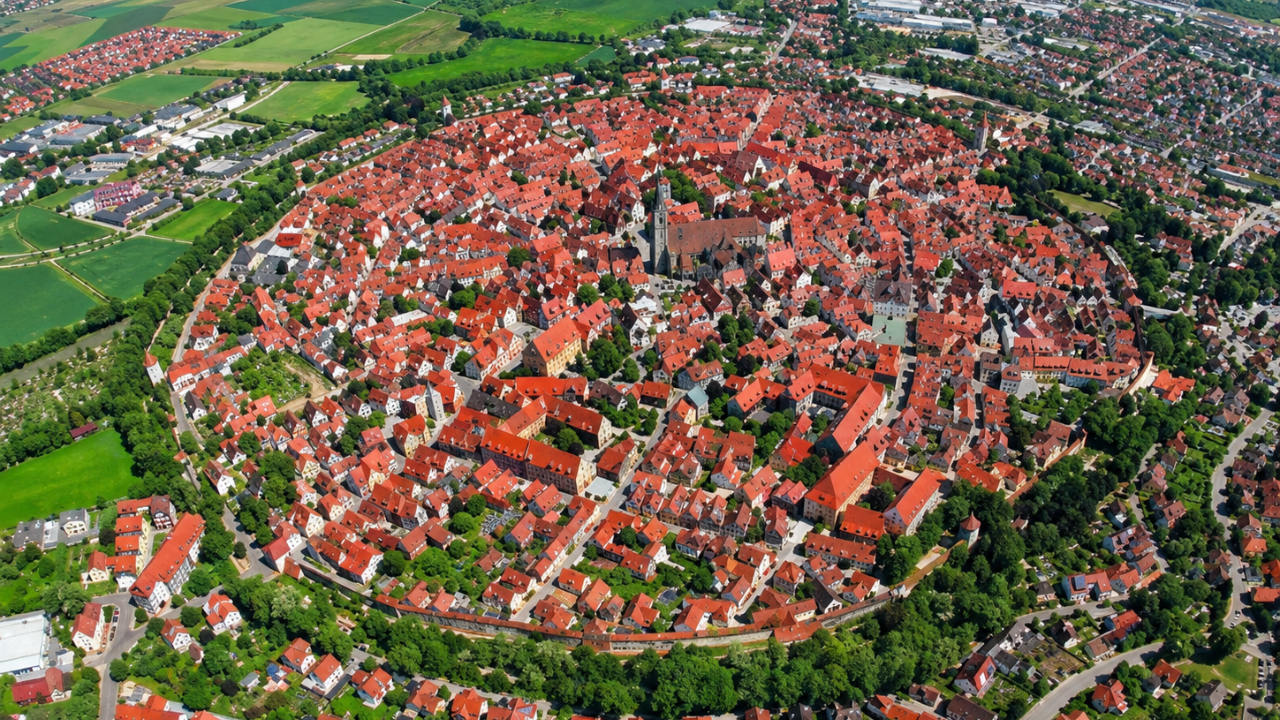
Nördlingen does not look like a battlefield. From the top of Saint George’s Church, the view is of a peaceful Bavarian settlement defined by orange-tiled roofs and a perfectly circular medieval wall. But the ground beneath these houses holds a secret of violent origins that redefined our understanding of the solar system. This town sits inside the Ries crater, a 26-kilometer-wide depression formed 15 million years ago by a massive asteroid strike. The sheer force of that impact didn't just dent the Earth; it transformed local graphite into an estimated 72,000 tons of microscopic diamonds and created a unique rock called suevite. It was this rare geology that brought NASA’s Apollo 14 and 16 astronauts here in 1970, because Nördlingen is the closest thing to a lunar landscape found on the European continent.
The Violent Birth of a Bavarian Icon
For centuries, the residents of the Ries plain believed they were living in the mouth of an extinct volcano. The logic was sound for the time: the basin was circular, and the stone used to build their homes was riddled with bubbles and glass, typical of volcanic activity. It wasn't until 1960 that American geologists Eugene Shoemaker and Chao Edward identified the presence of coesite.
Coesite is a form of quartz that only forms under staggering pressure. To create it, you need the kind of kinetic energy that a volcano simply cannot produce. The discovery proved that Nördlingen was the site of a cataclysmic impact. An asteroid traveling at roughly 20 kilometers per second slammed into the Earth, vaporizing instantly and sending shockwaves through the bedrock.
The heat and pressure were so intense that they triggered a molecular metamorphosis. The local carbon deposits were crushed into billions of tiny diamonds. You cannot see them with the naked eye; they are mostly smaller than 0.2 millimeters. Yet, they are embedded in the very walls of the town's buildings. The church of Saint George alone contains millions of these microscopic gems, making it perhaps the most valuable—and abrasive—structure in Germany.
Why NASA Came to Germany
By 1970, the Space Race was in its final, most demanding phase. NASA knew that if they were going to send men to the Moon, those men needed to be more than just pilots; they had to be amateur geologists. The Moon is essentially a record of billions of years of impacts. To understand the lunar surface, the astronauts had to understand "impact geology," and Nördlingen was the premier classroom.
Alan Shepard and Edgar Mitchell of the Apollo 14 mission, along with the crew of Apollo 16, descended on the town. They weren't there for the beer or the timber-framed architecture. They were there to learn how to identify suevite.
Suevite is a "breccia," a rock composed of fragmented shards of glass, crystal, and mineral held together by a fine-grained matrix. Because the Moon lacks an atmosphere, it is constantly pelted by space debris, meaning its surface is almost entirely composed of various forms of impact breccia. By hiking through the quarries of Nördlingen, the astronauts practiced picking out significant samples from the rubble. They learned to distinguish between rocks that had been melted by heat and those that had been shattered by shock.
The Training Ground of the Ries Crater
The training was grueling and clinical. The astronauts carried heavy packs and utilized the same tools they would eventually deploy in the Fra Mauro highlands and the Descartes Highlands of the Moon. Local geologists led them through the quarries, pointing out the subtle gradients in the stone that indicated the direction and intensity of the prehistoric blast.
This wasn't a PR stunt. The expertise gained in this Bavarian crater directly influenced which rocks were brought back to Earth. When you look at the lunar samples currently stored at the Johnson Space Center, you are looking at the results of lessons learned in a German quarry. The astronauts discovered that the "crater-hop" method of exploration required a specific eye for detail that only field experience could provide.
The Diamond Myth vs the Hard Reality
While headlines often scream about a "town made of diamonds," the reality is more industrial than sparkling. If you tried to mine Nördlingen for its riches, you would go bankrupt. The concentration is too low, and the crystals are too small for jewelry. Their only real value is scientific.
The presence of these diamonds confirms the extreme physics of the Ries event. The impact pressure exceeded 30 gigapascals. To put that in perspective, that is roughly the pressure of 1,000 elephants standing on a single postage stamp. This intensity is what makes the town a "terrestrial analogue"—a place on Earth that mimics the conditions of another world.
The town has leaned into this identity, but not in a way that feels like a tourist trap. The Ries Crater Museum, housed in a 16th-century barn, holds a genuine moon rock on loan from NASA as a "thank you" for the hospitality and the education provided to the Apollo crews. It is a rare instance where the debt between a small town and a space agency is acknowledged with a piece of another world.
Structural Integrity of a Meteorite Town
Living inside a crater has shaped the town's development in ways that go beyond geology. The circular wall of Nördlingen, one of only three intact medieval city walls in Germany, follows the natural contours of the inner crater ring. The town grew inward, constrained by the geography of the impact.
The stone used for the wall and the main buildings—the diamond-flecked suevite—is surprisingly porous. It weathers differently than the granite or limestone found in other parts of Bavaria. This has created a constant cycle of preservation and repair. Local masons have to be experts in the specific properties of impact rock, maintaining a tradition of craftsmanship that is as much about physics as it is about aesthetics.
The Hidden Risks of Impact Zones
Geological history is rarely a one-time deal. While the Ries impact happened 15 million years ago, the study of the crater has opened up debates about the frequency of such events. Astronomers and geologists use Nördlingen as a benchmark to calculate the potential damage of future "near-Earth objects."
The crater isn't just a relic; it’s a data set. By mapping the distribution of the suevite and the "ejecta blanket" (the debris thrown out by the strike), scientists can model how a modern impact would affect European infrastructure. It’s a sobering reminder that the peaceful fields surrounding the town were once the site of a planetary trauma that would have wiped out everything within a hundred-mile radius in seconds.
Beyond the Apollo Legacy
While the NASA connection remains the town's biggest claim to fame, the scientific community continues to flock there. Modern planetary scientists use the site to test rovers and autonomous sensors designed for future Mars missions. The variety of terrain—ranging from flat basin floors to steep, rocky ridges—provides a perfect testing ground for the navigation algorithms that will guide the next generation of space explorers.
The "diamond town" label is a useful hook, but the true wealth of Nördlingen is its accessibility to the deep past. You can touch a wall that contains the history of a cosmic collision. You can walk the same paths where men prepared to leave the planet.
The town stands as a bridge between medieval human history and the cold reality of astrophysics. Every time a resident leans against a suevite wall, they are coming into contact with a material that spent millions of years as deep-earth carbon before being pulverized by a rock from the void. It is a place that proves the most alien landscapes are often right beneath our feet, disguised as a quiet village in the countryside.
To visit Nördlingen is to realize that the Earth is not a static rock, but a target in a very crowded shooting gallery. The diamonds in the walls are the scars of a hit we survived long enough to build a civilization inside.