The transition from the inner sanctum of political power to public civilian life exposes individuals to a distinct reputational vacuum. When Victoria Starmer walked the runway at Edeline Lee’s London Fashion Week presentation at Haverstock School, the event functioned as a strategic maneuver in persona management rather than a routine social engagement. Observers frequently misinterpret such appearances as spontaneous entries into high culture. In structural terms, public-facing figures exiting high-stakes administrative environments utilize calculated aesthetic positioning to regain narrative control. This analysis deconstructs the mechanics of runway participation, the semiotics of political chic, and the underlying cost functions of reputational rehabilitation in contemporary British public life.
The Architecture of Post-Office Visibility
Public figures who exit executive offices face an immediate depreciation in mandatory attention. While in tenure, visibility is sustained by institutional machinery, daily policy outputs, and continuous media coverage. Upon departure, that institutional engine halts. To maintain cultural relevance without an active legislative platform, individuals must substitute institutional authority with visual equity.
The choice of Edeline Lee as the vehicle for this transition is not incidental. Lee occupies a precise market quadrant: British-based, favored by establishment figures including the Princess of Wales, and defined by structured, clean silhouettes that project competence and restraint. For an incoming civilian navigating the aftermath of political scrutiny—specifically the parliamentary investigations regarding wardrobe donations and donor financing through figures like Lord Alli—the aesthetic requirement is precise. The attire must signal understated sophistication while avoiding overt luxury signaling that invites populist criticism.
By stepping onto a runway constructed within a secondary school gymnasium rather than a traditional Mayfair salon, the presentation inverted standard luxury hierarchies. Haverstock School, carrying personal resonance as a familiar local institution, grounded the spectacle in accessibility. This juxtaposition achieves a dual objective: it retains elite fashion capital while neutralizing accusations of detachment from ordinary social realities.
Semiotic Signaling and the Sisyphus Motif
Edeline Lee’s collection drew explicit inspiration from the Greek myth of Sisyphus, utilizing performance art elements—such as synchronized swimming-inspired dancers in red costumes and live fitting processes exposed to the audience—to comment on endurance and repetitive exertion. Within the framework of political adjacency, this thematic choice operates as a subtle commentary on the relentless pressures endured during a tenure at the helm of government.
Semiotic analysis of runway participation reveals three distinct layers of communication:
- The Disruption of Backstage Secrecy: Exposing the mechanical preparation of models—hair, makeup, and adjustments executed in full view of spectators—destroys the illusion of effortless perfection. By aligning herself with a process characterized by visible labor, the subject mirrors the exhausting mechanics of public scrutiny where every seam of a private life is inspected under harsh lighting.
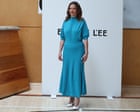
- Color Theory and Kinetic Control: The deployment of structured garments, such as the bright turquoise knitted midi dress worn during the presentation, utilizes high-saturation chromatic choices to command visual space without relying on ornate embellishment. High-contrast colors anchor the viewer's gaze, ensuring the participant is read as an active agent rather than a passive prop.
- Spatial Recontextualization: Placing high fashion within a municipal school environment creates cognitive dissonance. Viewers are forced to reconcile elite design with utilitarian architecture, altering the perceived accessibility of the wearer.
These elements combine to construct a narrative of resilience. The underlying message is calculated: the subject remains composed, structurally sound, and forward-moving despite the turbulence of prior political cycles.
The Economic and Reputational Cost Function
Every public appearance carries an implicit cost function measured in public sentiment, media cycles, and regulatory friction. For spouses of former political leaders, the margin for error is narrow. The intersection of fashion patronage and political donations created significant vulnerability during the preceding administration, where luxury items and personal styling services became subjects of formal parliamentary inquiries.
When calculating the utility of a runway appearance, strategists weigh the risk of drawing renewed attention to past financial controversies against the long-term benefit of establishing an independent public identity. The functional equation can be expressed through three variables:
- Media Saturation Rate ($S$): The volume of coverage generated versus the control over narrative framing. A controlled runway appearance limits opportunistic tabloid intrusion by providing authorized, high-resolution imagery.
- Association Transfer ($A$): The transfer of equity from an established, respected designer brand to the individual. Aligning with an independent female designer reinforces themes of female entrepreneurship and professional autonomy.
- Regulatory Exposure ($R$): The probability that the event triggers renewed scrutiny regarding gifts, hospitality, or commercial endorsements. Because the appearance was framed as an artistic collaboration within a conceptual show rather than a commercial endorsement contract, regulatory exposure was effectively minimized.
When $S$ and $A$ are maximized while $R$ is constrained, the intervention yields a net positive shift in public perception, moving the narrative away from administrative scandal toward cultural patronage.
The Mechanics of Controlled Exposure
Traditional political PR relies on scripted interviews and controlled photo opportunities. These methods frequently fail because modern audiences detect artificiality with high precision. Runway participation bypasses verbal communication entirely, relying on kinesics—body language, posture, and spatial navigation.
Walking a runway requires maintaining a rigid posture, steady pacing, and an impassive facial expression. These physical constraints serve a defensive purpose in media training. By refusing to smile excessively or engage in conversational banter, the participant projects dignity and emotional detachment from past controversies. This stoicism acts as a barrier against journalistic probing. The media cannot misquote a presence that relies solely on visual execution.
Furthermore, the integration of overhead drone filming and performance artists transformed a static walk into a multi-dimensional artistic installation. This diverted journalistic critique from personal politics to aesthetic interpretation. Reviewers spent column inches analyzing the choreography, the Sisyphus theme, and the designer's structural tailoring rather than interrogating the political legacy of the participant's spouse.
Strategic Forecast and Long-Term Positioning
The transition from political spouse to independent cultural figure requires a sustained sequence of low-risk, high-prestige alignments. Single-instance appearances generate temporary spikes in visibility, but lasting reputational stabilization depends on institutional anchoring.
Future developments in this trajectory will likely involve formalized roles within cultural institutions, design boards, or arts charities. By embedding oneself within the British fashion ecosystem—an industry contributing billions to the national economy and projecting soft power globally—the individual secures a professional domain entirely distinct from party politics.
The runway appearance at Haverstock School was not a conclusion, but a calibrated pivot. By utilizing the grammar of high fashion, structured performance, and controlled exposure, the subject successfully established an independent operational footprint, transforming former political vulnerability into cultural capital.