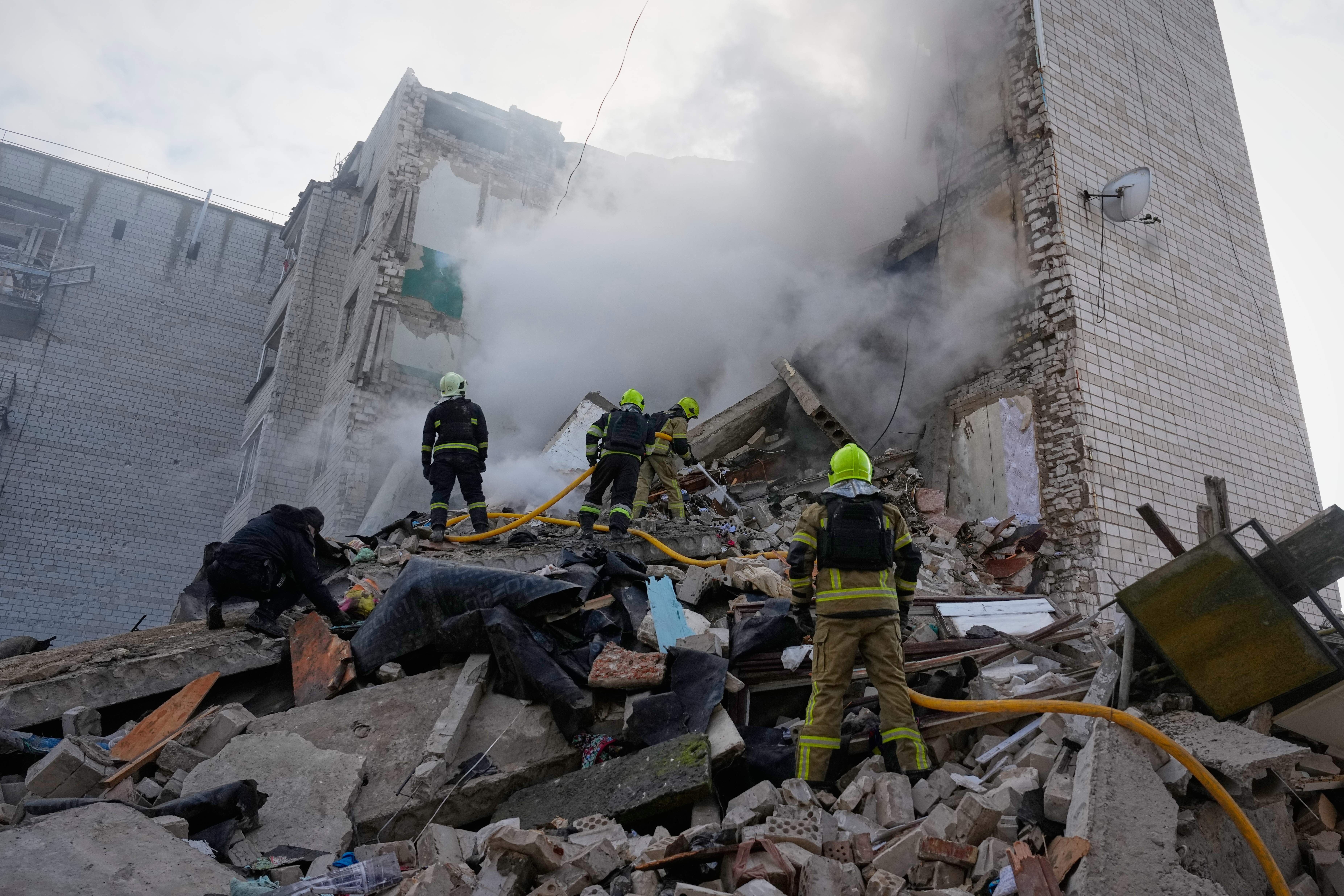
Two people are dead after a Russian strike hit a residential apartment building outside Ukraine's capital, and if you only read the breaking wire alerts, you missed the real story. Wire reports treat these strikes like isolated tragedies. A headline flashes across your screen, you feel a brief pang of horror, and you scroll on.
That's a mistake. When Russian missiles or long-range drones slam into civilian housing on the outskirts of Kyiv, it isn't random collateral damage or a simple navigation error. It's a calculated, evolving campaign designed to break Ukraine's air defense network and exhaust the people living behind it.
I've spent years analyzing air defense deployments, open-source OSINT crater reports, and strike patterns across Eastern Europe. When you look closely at what happens in the Kyiv Oblast—the sprawling ring of towns, suburbs, and commuter hubs surrounding the capital—a very clear operational picture emerges. Let's break down what actually happens during these suburban strikes, why the outskirts of Kyiv take so much punishment, and what the data says about how this air war is shifting.
Why Russian Strikes Target the Outskirts of Kyiv
Most people assume air defense works like a giant glass dome sitting neatly over a city. You put Patriot batteries in the center, and everything inside the circle stays safe.
Real life doesn't work that way. Air defense is layered, messy, and constrained by physics.
Kyiv itself is one of the most heavily defended cities on the planet right now. Between Western-supplied Patriot and IRIS-T systems, mobile fire groups armed with heavy machine guns, and electronic warfare jammers, getting a missile or a Shahed-type drone into the city center is brutally difficult. Russian planners know this. They track interception rates just as closely as Western intelligence agencies do.
So they adjust. Instead of aiming straight for government buildings in central Kyiv, strike packages frequently target the surrounding Kyiv region—places like Brovary, Irpin, Bucha, Vyshhorod, and Fastiv.
Here's why those suburban apartment blocks sit directly in the crosshairs:
- The edge of the umbrella: Air defense batteries have specific engagement envelopes. Outer suburbs often sit right on the seam between long-range area defense and short-range point defense, giving incoming munitions a slightly wider window before interception.
- Proximity to critical infrastructure: Soviet-era urban planning didn't separate residential zones from industrial and energy nodes the way Western suburbs do. Electrical substations, rail junctions, and logistics warehouses sit right next to nine-story panel apartment buildings.
- Debris physics: Even when Ukrainian air defense scores a direct hit, a falling cruise missile or a drone carrying a 50-kilogram warhead doesn't just vanish into thin air. Gravity takes over, and the wreckage drops onto whatever housing complex sits underneath the flight path.
Honestly, calling the aftermath of an intercepted missile "debris" is one of the most misleading terms in modern war reporting. When several tons of burning aviation fuel and high explosives fall from ten thousand feet onto a concrete apartment block, the people inside don't care whether the warhead detonated on impact or broke apart mid-air. The result is collapsed stairwells, blown-out load-bearing walls, and civilian fatalities.
The Anatomy of a Suburban Apartment Strike
To understand why two people died in this strike—and why rescue workers spend hours digging through concrete slabs with hydraulic cutters—you have to look at how residential buildings in the Kyiv region are constructed.
Most suburban housing around the capital falls into two categories. First, you have the classic Soviet-era panelki—prefabricated reinforced concrete apartment blocks built between the 1960s and 1980s. Second, you have modern mid-rise brick and monolithic-frame complexes built during the suburban boom over the last fifteen years.
Neither was built to survive a direct hit from a modern warhead.
When a strike hits one of these buildings, the damage follows a predictable, terrifying sequence. The initial blast wave shatters windows across a radius of several hundred meters, turning ordinary glass into high-velocity shrapnel. Almost simultaneously, the overpressure blows out interior partition walls and lifts roof slabs off their bearings.
If the impact strikes a load-bearing corner or a central stairwell, progressive collapse kicks in. Upper floors pancake onto lower ones. Fires start immediately from ruptured natural gas lines—which are still standard for heating and cooking in thousands of Ukrainian apartments—and burning household furniture.
Emergency crews from the State Emergency Service of Ukraine (DSNS) arrive within minutes, often while air raid sirens are still wailing. That's one of the deadliest parts of their job. Russian forces routinely use "double-tap" tactics, firing a second munition at the exact same coordinates twenty to forty minutes later, specifically timed to hit paramedics, firefighters, and neighbors pulling survivors from the rubble.
Rescuers have to balance speed against structural collapse. Heavy cranes can't just start lifting concrete panels without risking a shift that crushes someone trapped in an air pocket below. Instead, crews use acoustic sensors, search dogs, and thermal cameras during mandated "minutes of silence," where every generator and engine on the block is shut off so rescuers can listen for tapping or faint voices under the concrete.
What Most Coverage Misses About Russia's Strike Tactics
If you read standard news summaries of strikes outside Kyiv, you'll usually see a brief mention of "overnight shelling" or "drone and missile attacks." That language flattens a very sophisticated, multi-layered military operation into background noise.
Russia doesn't fire single missiles at random apartments just to be cruel, though terrorizing the civilian population is undeniably a core objective. They use complex, multi-vector strike packages designed to overwhelm human operators and exhaust interceptor stockpiles.
A typical overnight wave targeting the Kyiv region follows a deliberate choreography:
- The decoy wave: Cheap, low-flying drones—often unarmed foam-and-plywood decoys like the Gerbera alongside Shahed-136/Geran-2 drones—enter Ukrainian airspace hours before dawn. They fly erratic, zigzagging routes around the capital to force mobile air defense teams to turn on their radars, burn fuel, and expend ammunition.
- Electronic warfare probing: While the drones circle, Russian reconnaissance assets monitor how Ukrainian air defenses react, mapping radar emissions and identifying gaps in coverage around the suburban ring.
- The kinetic punch: Once defenses are saturated or distracted, ballistic missiles (like the Iskander-M) or air-launched cruise missiles (like the Kh-101) streak in at high speed. Ballistic missiles are especially lethal for Kyiv's suburbs because their flight time from launch sites near the border is measured in minutes, leaving residents almost no time to reach a basement shelter after the alert hits their phones.
This is why attrition matters so much. Every time Russia launches fifty drones and ten missiles at the Kyiv area, Ukraine has to expend expensive, finite surface-to-air missiles to stop them. Even a 90 percent interception rate means five or six munitions get through—or crash down onto residential neighborhoods after being hit. Over months and years, that 10 percent leakage rate translates into steady, grinding civilian casualties and destroyed housing.
How Civilians and First Responders Adapt on the Ground
Living in the towns outside Kyiv means living with a strange, exhausting kind of split reality. During the day, coffee shops are open, commuters catch marshrutka minibuses into the city, and construction crews repair damaged storefronts. At night, everyone checks Telegram channels tracking drone trajectories.
You quickly learn that traditional safety advice often clashes with human psychology.
Official civil defense guidelines tell residents to head to the nearest underground bomb shelter or metro station the second an air raid alert sounds. In central Kyiv, the deep Soviet-era metro stations double as massive, virtually indestructible bunkers.
Out in the suburbs, there is no metro.
Many residential apartment blocks only have shallow basements with a single exit—which can become a death trap if the building collapses on top of the doorway. After years of nightly alerts, exhaustion sets in. People have to work in the morning. Parents don't want to wake up toddlers at 3:00 AM every single night for an alert that might pass twenty miles away.
So residents rely on the "two-wall rule"—a survival standard widely promoted by Ukrainian emergency services when reaching a proper bunker isn't possible. You put at least two solid walls between yourself and the outside street. The first wall absorbs the direct blast and shrapnel; the second wall catches flying glass and crumbling masonry from the first wall. In practice, that means dragging a mattress into an interior hallway or a windowless bathroom and waiting out the explosions.
It isn't foolproof. A direct hit from a heavy warhead will punch straight through two interior walls without slowing down. Still, in dozens of documented strikes across the Kyiv Oblast, that single rule has been the difference between walking away with dust in your hair and becoming another fatality statistic in a morning news brief.
The Bigger Strategic Picture Behind Civilian Casualties
Stepping back from the immediate tragedy of two lives lost outside Kyiv, we have to ask what these strikes actually achieve strategically.
History gives us a pretty clear answer, and it isn't the one Moscow wants. From the London Blitz to modern air campaigns, bombing civilian apartment buildings rarely breaks a population's political will. If anything, it hardens public resolve and destroys whatever lingering cultural or historical sympathy might have existed before the war.
Where these strikes do have a tangible strategic effect is in resource allocation and economic strain.
Every damaged apartment building outside Kyiv forces the Ukrainian government to divert money, construction crews, and materials away from front-line fortifications and toward emergency housing repairs. Displaced families need temporary shelter, medical care, and financial assistance. Meanwhile, Kyiv's diplomats have to spend political capital constantly lobbying Western partners for more air defense interceptors—interceptors that are already in short supply globally.
The United Nations Human Rights Monitoring Mission in Ukraine (HRMMU) has documented thousands of civilian deaths and tens of thousands of damaged residential structures since the full-scale invasion began. Their verification methodology is famously conservative, counting only cases where observers can physically inspect the site or cross-verify with multiple independent sources. That means the real human toll in the towns ringing Kyiv is consistently higher than the official floor reported in international briefings.
When you read that Russia struck an apartment building outside Ukraine's capital and killed two people, don't file it away as just another repetitive headline from a long war. Look at what it represents: an ongoing, high-tech duel between offensive saturation tactics and layered air defense, played out directly over the roofs of ordinary families trying to sleep through the night.
If you want to track these developments accurately without getting misled by sensationalized social media claims or vague wire summaries, change how you read war reporting. Cross-reference initial casualty numbers with verified reports from the UN Human Rights Monitoring Mission in Ukraine and official briefings from the Ukrainian Air Force Command, which break down exact munition types and interception ratios. Follow open-source analysts who geolocate impact sites rather than relying on unverified Telegram videos, and pay close attention to Western aid announcements specifically mentioning air defense interceptors—because those shipments are the only thing standing between suburban apartment blocks and the next overnight strike.