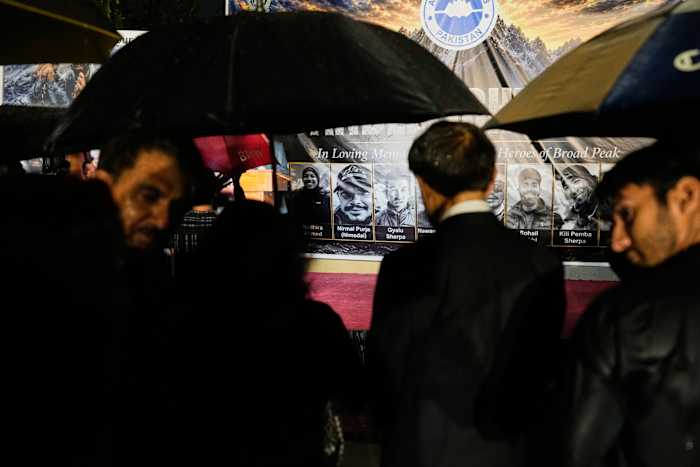
Mountaineering deals in currency that ordinary society refuses to acknowledge. The price of ambition on an eight-thousander is paid in frostbite, oxygen depletion, and sometimes, the finality of an unmarked grave beneath shifting ice. Years after an avalanche swallowed American climber Ryan Sean Davy and his Pakistani high-altitude partner Ahmed Farhan on Broad Peak, recovery teams finally brought closure to a bitter chapter of Karakoram history.
Search and rescue specialists located and recovered the remains of the climbers from Broad Peak, the brutal 8,051-meter giant situated in Pakistan's Gilgit-Baltistan region. The retrieval closes an agonizing loop for families who spent years staring at a wall of bureaucratic inertia, logistical nightmares, and the sheer hostility of high-altitude geography. Yet, the successful recovery does little to settle the broader reckoning over how the climbing industry treats risk, responsibility, and the dead who are left behind on the world's most dangerous slopes.
The Anatomy of a Karakoram Tragedy
Broad Peak is often marketed as the most accessible of the five Pakistani eight-thousanders. That designation is a marketing lie whispered by commercial outfitters to fill slots on expedition rosters. There is nothing accessible about an 8,000-meter vertical maze of loose rock, blinding glare, and winds capable of stripping a grown human from a knife-edge ridge.
Ryan Sean Davy arrived in Pakistan with a singular, unyielding focus. Independent, self-funded, and operating outside the safety net of major commercial teams, Davy embodied a dying breed of alpinism. He was not paying six figures for Sherpa support, bottled oxygen caches, and fixed ropes maintained by an army of hired hands. He was climbing on his terms, which also meant he was assuming a multiplier of risk that few commercial clients ever comprehend until it is too late.
When the avalanche struck during the 2017 season, it did not care about independence or budget sheets. It simply swept down the mountain, rewriting the geography of the route and burying both Davy and Farhan under tons of wind-slab debris. For years, the mountain kept its secret. The bodies remained entombed in the glacial ice, moving slowly downward with the creep of the glacier, entirely out of reach of standard search operations.
Recovery at those altitudes is a nightmare of physics and finance. Helicopters cannot operate effectively above 6,000 meters in the erratic winds of the Karakoram. Ground teams face the constant threat of secondary avalanches, crevasse falls, and pulmonary edema. To pull a body off Broad Peak requires a coalition of hardened local porters, elite climbers willing to risk their lives for a recovery rather than a summit, and deep pockets to fund the operation.
The Economics of Abandonment
The return of these remains highlights a darker truth about modern high-altitude mountaineering. Thousands of climbers flock to the Himalayas and Karakoram every year, paying massive fees to local governments and tour operators. Yet, when disaster strikes outside the sheltered bubble of commercial groups, the infrastructure for rescue and recovery evaporates.
Local high-altitude porters and alpine specialists carry the physical burden of these operations. Men like the legendary Ali Sadpara and his peers have risked their lives countless times to drag injured or deceased foreigners off frozen walls, often for meager wages relative to the danger involved. The international climbing community loves to romanticize the brotherhood of the mountains, but that brotherhood has a distinct economic hierarchy.
Independent climbers like Davy occupy a peculiar space in this ecosystem. Commercial operators often view them as loose cannons who strain local rescue resources without contributing to the fixed-rope funds or infrastructure budgets managed by big agencies. Conversely, independents view commercial clients as tourists who buy their way up mountains they lack the technical autonomy to climb safely. When tragedy strikes an independent, the state apparatus of Pakistan is left scrambling to coordinate private efforts, donations, and familial pleas.
The successful recovery operation on Broad Peak was not the result of a well-funded government rescue service. It was born from persistent pressure, local expertise, and the refusal of families and regional insiders to let the missing become forgotten statistics.
The Changing Face of the Karakoram
Broad Peak is changing. Climate alteration is destabilizing the high mountain environment at a terrifying pace. Permafrost melts, releasing loose rock from anchor points that have held steady for centuries. Avalanches occur with less predictability, triggered by temperature spikes that turn firm snow slopes into unstable slurry.
As the mountains grow more dangerous, the tolerance for error shrinks to zero. The romantic era of Himalayan exploration, where men could vanish into the white void and leave their bones as permanent monuments to human hubris, is colliding with a modern demand for accountability and closure. Families want answers. They want remains returned. They want graves they can visit.
This shift places an impossible burden on the local infrastructure of Gilgit-Baltistan. Pakistan wants to foster a booming adventure tourism economy to rival Nepal, yet the safety architecture remains fragile. A single major season with multiple high-altitude incidents can paralyze the limited pool of rescue assets available.
When the remains of the American climber and his Pakistani partner finally descended from the heights of Broad Peak, it served as a stark reminder of what is hidden beneath the pristine snow. The summit photographs tell a story of triumph. The glaciers tell the rest of the story.
The mountain has relinquished its prisoners, but the debt has been paid in full. As the climbing community looks toward the next season, the ghosts of Broad Peak will remain a part of the landscape, watching from the ice, waiting to see who ignores the warnings next.