Death isn't the end. At least, not in astrophysics.
For decades, mainstream astronomy taught a simple, depressing story about stellar evolution. When a Sun-like star runs out of hydrogen fuel, it swells into a red giant, incinerates its inner planets, shakes off its outer layers, and collapses into a dense, glowing ember known as a white dwarf. Game over. The system is dead, frozen, and empty. Also making headlines in related news: The Pentagon Finally Admits Kinetic Missiles Cannot Stop a Drone Swarm.
Except the universe refuses to follow tidy textbooks.
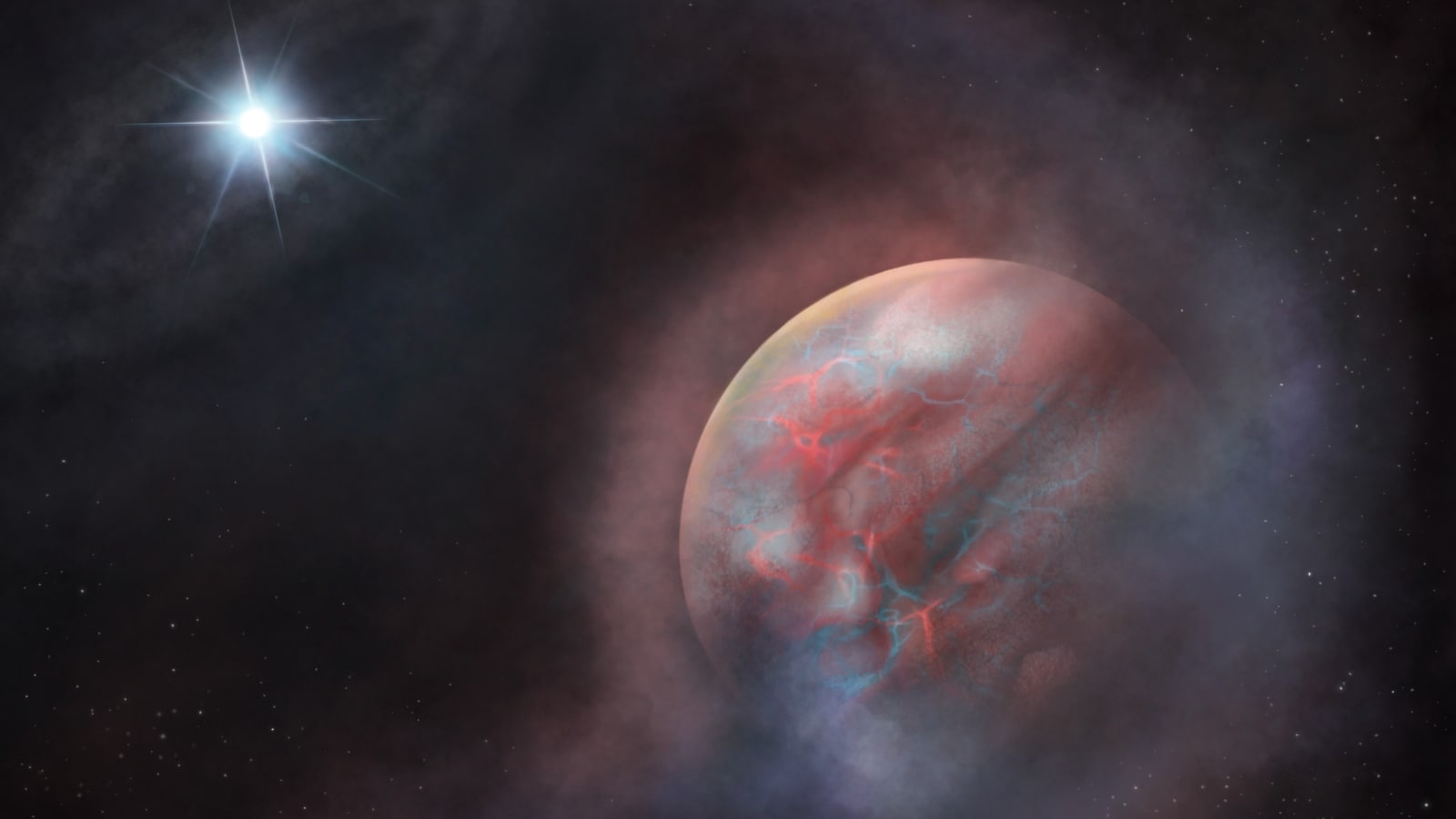
Recent discoveries have shattered that neat narrative. Astronomers now have concrete evidence of planets orbiting white dwarfs—and even stranger, worlds born entirely from the ashes of dead stars. This isn't science fiction. It is happening right now, a few dozen light-years away from your backyard. More information on this are detailed by The Next Web.
If you want to understand where planetary science is heading, you have to look at the corpses of stars. They aren't cosmic graveyards. They are incubators.
The Misconception of Cosmic Finality
Think about what happens when a star dies. Our Sun will follow this exact script in about five billion years. It will bloat into a red giant, swallowing Mercury and Venus. Earth will likely get scorched down to a lifeless, molten rock, even if it manages to avoid complete ingestion.
Astronomers long assumed that any planets surviving this violent upheaval would simply drift in eternal cold. The intense radiation, the massive mass-loss phases, and the chaotic gravitational shifts should scatter everything into deep space.
Yet reality is far messier and far more interesting.
When you study white dwarfs, you notice something weird. Their light spectra often show heavy elements like iron, silicon, and magnesium. Pure white dwarfs should consist almost entirely of carbon and oxygen covered by a thin layer of hydrogen or helium. They shouldn't have rocky debris polluting their atmospheres.
Where does that pollution come from? It comes from rocky bodies—asteroids, comets, and entire planets—getting ripped apart by the intense tidal forces of the white dwarf. These objects don't just fall in by accident. They are nudged by gravitational interactions with other bodies in the system. That means planetary systems survive. They persist long after the host star dies.
Second Generation Worlds
Surviving an old system is one thing. Building a brand-new planet from scratch around a dead star is entirely another.
Stars shed a tremendous amount of mass during their death throes. Gas and dust billow outward, forming magnificent planetary nebulae. Much of that material escapes into the interstellar medium. But a fraction of it remains trapped in orbit around the newly formed white dwarf, swirling into a dense circumstellar disk of heavy elements, carbon, and dust.
For a long time, theorists doubted these disks could coalesce into planets. The radiation pressure, the intense UV flux, and the strange dynamics of white dwarf systems seemed hostile to accretion.
Nature didn't care about the theorists' doubts.
Using advanced space- and ground-based telescopes, researchers have identified candidate worlds and planetary building blocks embedded within these debris rings. These are second-generation planets. They didn't form when the star was young and bright. They formed out of the recycled ashes of the star's former self.
Imagine standing on the surface of a world born from stellar debris. The sky overhead is dominated by a white dwarf—a tiny, fiercely hot sphere roughly the size of Earth, glowing with a ghostly blue-white light. The temperature is regulated not by nuclear fusion in a massive core, but by the slow, cooling embers of a stellar ghost. It's a completely alien environment governed by physics that defy our standard expectations of star-planet systems.
How We Find Ghost Planet Systems
Detecting a planet orbiting a white dwarf is exceptionally difficult. White dwarfs are tiny. They are roughly the size of Earth, even though they pack the mass of an entire star.
When a typical planet transits a normal Sun-like star, it blocks about one percent of the light. When a planet transits a white dwarf, it blocks nearly all of it. A Jupiter-sized object passing in front of a white dwarf blocks almost 100 percent of the starlight.
That massive transit signature is actually what gave away the game.
Back in 2020, researchers analyzing data from the Transiting Exoplanet Survey Satellite noticed a weird dip in light around a white dwarf designated WD 1856+534. The dip was deep, regular, and rapid. A giant planet was orbiting the dead star every 34 hours, skimming safely past the tidal destruction zone.
Subsequent observations confirmed that planets can maintain stable orbits close to white dwarfs. More importantly, spectroscopic analysis of polluted white dwarfs revealed that these aren't isolated anomalies. Up to twenty-five to fifty percent of white dwarfs show signs of planetary pollution.
The universe is littered with the remnants of ruined solar systems. And where there is rubble, gravity eventually goes to work.
What This Means for Earth
It's easy to look at these discoveries as distant astronomical curiosities. But astronomy is ultimately a mirror.
Our Sun is a middle-aged yellow dwarf. It's stable, predictable, and life-giving. But its fate is written. Four and a half billion years from now, humanity's descendants—or whatever intelligent species replaces us—will face the red giant phase.
Does life have a second act?
The existence of second-generation planets proves that stellar systems are remarkably resilient. Matter is conserved, recycled, and repurposed. The carbon in your bones and the iron in your blood were forged in the hearts of ancient stars that exploded long before the solar system formed.
Now we know that planets themselves can be born from the cremated remains of stars. The cycle of cosmic recycling goes deeper than we ever imagined. Stars die so that new worlds can rise from their ashes.
This changes how we think about the search for habitable worlds. For decades, astrobiologists focused exclusively on main-sequence stars—G, K, and M-dwarfs. We looked for the Goldilocks zone where liquid water can pool on a rocky surface.
We might need to expand our search parameters. A white dwarf cooling zone can remain habitable for billions of years. Because white dwarfs burn through their remaining thermal energy at a glacial pace, planets orbiting close to them can stay in a stable temperature zone for eons. A dead star can offer a longer stable lifespan than a living one.
The Road Ahead for Planetary Astronomy
We are only at the beginning of this shift in perspective.
Next-generation instruments are coming online. Ground-based giants and orbital observatories are pushing the limits of infrared spectroscopy and direct imaging. Researchers are actively mapping the composition of circumstellar disks around white dwarfs, looking for the telltale atmospheric signatures of water, methane, and complex organics.
The technical hurdles are steep. Separating the faint thermal glow of a cool planet from the blinding glare of a white dwarf requires extreme contrast techniques. Yet every year, observational astronomy gets sharper.
You don't need to be a professional astrophysicist to appreciate the poetry of this science. Look up at the night sky. Many of the visible points of light will one day collapse into white dwarfs. Their present is our future, and their ruins will be the foundation for worlds yet unborn.
Stop thinking of stellar death as a full stop. It's just a semicolon.
Keep an eye on the journals over the next few years. The next major breakthrough in exoplanet discovery won't come from finding a duplicate Earth around a sun-like star. It will come from the smoldering ruins of a dead star, proving once again that creation and destruction are two sides of the same cosmic coin.


