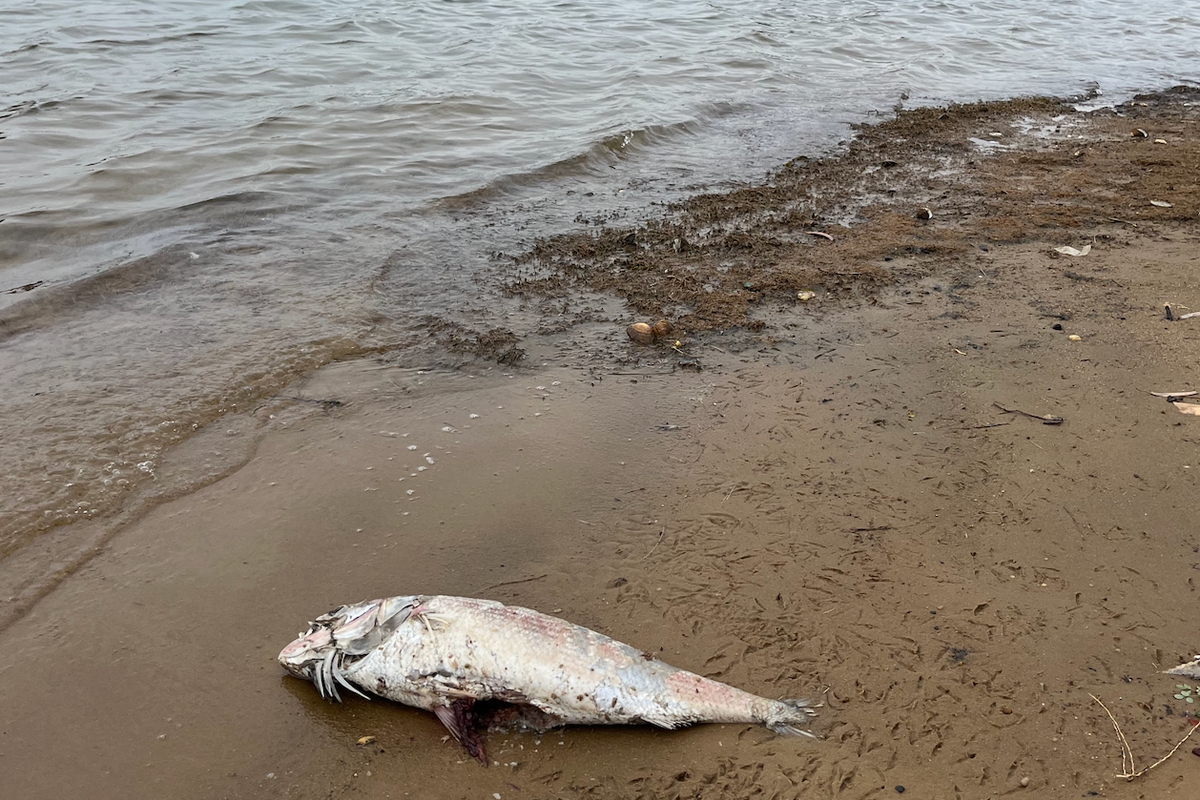
The first thing that leaves you is the smell.
Anyone who has spent their life near the coast knows the sharp, clean sting of salt water mixed with drying kelp. It is a comforting scent. It means life. But on a Tuesday morning along the southern coast of Australia, the ocean smelled like an open grave.
I walked down to the shoreline where the surf usually thumps against the limestone shelves. There was no thumping. The water was unnaturally heavy, thick as syrup, and dyed an eerie, bruised shade of reddish-brown. And then I saw them.
Not one or two fish washed up by a rough tide. Thousands.
Silver-bellied bream, giant cuttlefish with their iridescent skin faded to a dull chalky white, and penguins tangled in the sea-grass. Even the crabs, creatures that survived the harshest storms by digging deep into the sand, were scattered across the rocks, completely motionless. The silence was absolute. No gulls were wheeling overhead. They knew better than to touch the feast.
We have a habit of treating nature’s catastrophes as statistics. We read about a percentage drop in biodiversity or a metric ton of biomass lost, and we nod, insulated by the numbers. But you cannot nod when you are standing ankle-deep in the sudden, violent erasure of an ecosystem.
The culprit behind this devastation wasn't an oil spill. It wasn't plastic choking the waterways. It was something far smaller, entirely invisible to the naked eye, and infinitely more lethal.
The Microscopic Assassin
To understand how an entire coastline can die in forty-eight hours, you have to look at Alexandrium catenella.
It is a dinoflagellate, a single-celled organism that floats suspended in the water column. Under normal conditions, it is just another face in the oceanic crowd. But when the water temperature ticks upward by just a fraction of a degree, and when runoff from the land feeds it a sudden feast of nutrients, Alexandrium does something terrifying.
It blooms.
It multiplies exponentially, turning the water into a toxic soup. This isn't just any toxin. It produces saxitoxin, a neurotoxin so potent that it sits on the highest tier of global chemical weapon watchlists. It is roughly one thousand times more lethal than cyanide.
Consider how it works. A microscopic organism is eaten by a mussel or an oyster. The shellfish filters the water, oblivious to the poison, concentrating the saxitoxin inside its flesh. A larger fish eats the shellfish. A seabird dips down to scoop up the fish.
The toxin does not cause a slow, lingering illness. It goes straight for the nervous system. It blocks the sodium channels in the cells, effectively cutting the wires between the brain and the muscles. The lungs forget how to expand. The heart forgets how to beat.
For a human who eats a contaminated oyster, the condition is known as Paralytic Shellfish Poisoning. For the marine life off the coast of Australia, it was simply an execution.
The Empty Boats of San Remo
To truly understand the stakes, you have to leave the beach and sit in the pubs where the fishermen gather. Take a man like Tom, a fictional composite of three different commercial divers I spoke with, whose families have worked these waters for three generations.
Tom doesn't look at the ocean as a scenic backdrop for a vacation. It is his bank account, his identity, and his children's future.
"You look out there," Tom told me, pointing a thick, calloused finger toward the empty horizon, "and you realize everything you know is gone overnight. We aren't just talking about a bad season. We are talking about a dead zone. The abalone are rotting in their shells on the sea floor. You can’t harvest them. You can’t sell them. You can’t even go into the water without risking your own skin."
The economic fallout of a toxic algal bloom is swift and merciless. Fisheries close instantly. Seafood markets go dark. Tourism, the lifeblood of these small coastal towns, evaporates as the warning signs go up along the sand: DO NOT TOUCH THE WATER. DO NOT CONSUME FISH.
The financial loss is easy to calculate in millions of dollars. What is harder to measure is the psychological toll. When your entire life is built around the predictability of the tides, a sudden betrayal by the sea leaves a vacuum that numbers cannot fill. The community doesn't just lose its income; it loses its anchor.
The Blind Spot in Our Science
We are remarkably good at reacting to disasters after they occur. We can deploy containment booms for oil, and we can clean up debris after a cyclone. But how do you fight an enemy that is part of the water itself?
The terrifying reality of the Australian bloom is that it caught almost everyone off guard. For years, the prevailing wisdom was that these massive, apocalyptic blooms were anomalies, rare events triggered by a perfect storm of bizarre weather patterns.
We were wrong.
The oceans are changing. They are warmer, more stratified, and heavily laden with agricultural runoff. We have essentially turned our coastal waters into a massive, global petri dish, perfectly optimized for the world's most toxic algae.
The science community is scrambling to catch up. Monitoring programs use satellite imagery to track the color shifts in the ocean, trying to spot a bloom before it hits the coast. But by the time the water turns red, the trap is already sprung. The toxin is already in the food chain.
I asked a marine biologist if we could ever truly eradicate Alexandrium. She looked at me with a mixture of pity and exhaustion.
"You don't eradicate something that has been here since before the dinosaurs," she said. "You learn to stop feeding it."
What Lingers in the Sand
The red tide eventually recedes. The waves will turn blue again, and the sun will bake the remaining bones on the beach until they turn to dust. To a tourist driving through next summer, the coast will look pristine, a picture-postcard paradise of white sand and rolling surf.
But the locals will know.
They will know that beneath that beautiful, glittering blue surface, the sea floor is a graveyard that will take decades to fully recover. They will know that the microscopic killers are still down there, dormant in the sediment, waiting for the water to warm just enough to wake them up again.
The ocean is not a resilient, infinite void that can absorb every chemical, every degree of heat, and every ounce of pollution we throw at it. It is alive, it is fragile, and right now, it is choking.
The next time you stand on a beach and listen to the roar of the waves, don't take the noise for granted. Listen closely. Because the worst thing that can happen to the sea isn't a storm.
It is the silence.


