Silence.
That is the first thing you notice when a mountain creek dies, not the cracked mud or the bleached stones, but the sudden absence of that low, metallic chatter water makes when it still has somewhere to go.
I grew up beside a high-country stream in the American West, and I still remember the summer the trout simply vanished from the bends behind my grandfather’s fence. One July the pools were cold enough to ache your ankles; two Augusts later, the gravel lay hot and dry as a skillet, and the willows along the bank hung like grey rags. We blamed the heat. We blamed the snowpack. What none of us understood—not then, anyway—was that the creek had not died of thirst. It had died of eviction.
Decades earlier, trappers and angry landowners had stripped the watershed of its sharpest-toothed engineers, and without them, the mountain could no longer hold onto its own rain.
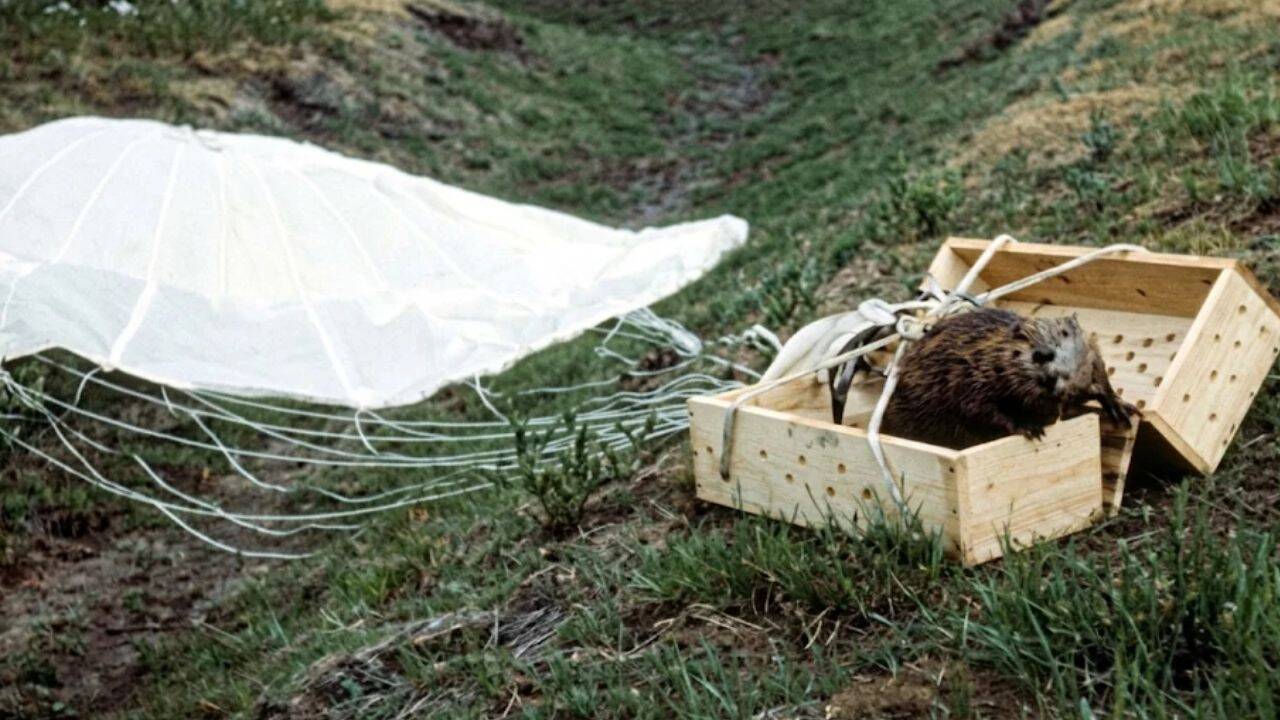
Long before satellite maps and restoration budgets, one stubborn biologist in Idaho stared at that exact problem and arrived at an answer so absurd it sounds like a barroom tall tale. In the autumn of 1948, Elmo Heter packed seventy-six live beavers into wooden crates, strapped them to surplus World War II parachutes, and pushed them out the door of a twin-engine Beechcraft over the roadless wilderness of central Idaho.
Every single one of them survived.
When Suburbia Met the Sawtooths
To understand why a grown man with a state paycheck would hurl forty-pound rodents out of an airplane, you first have to smell the mud of Payette Lake in late August 1948.
Postwar America was booming, and people with fresh paychecks and new sedans were pouring into the lakeside town of McCall, Idaho, building summer cabins along the water’s edge. The beavers, who had occupied those coves for ten thousand years without filing a single deed, treated the newcomers like noisy neighbors who had left lumber lying around. They chewed down prize ornamental aspens. They plugged culverts until pristine gravel driveways turned into shin-deep marshes. They dammed irrigation ditches that ranchers depended on to keep hay fields green.
Phone lines at the Idaho Department of Fish and Game rang off the hook. Trappers were hired, and for a while the department did what wildlife agencies had always done: haul the animals out in burlap sacks on the backs of mules, miles up into the granite ridges of the Frank Church–River of No Return Wilderness, where millions of acres of burned-over forest desperately needed wetlands.
There was just one problem. Mules hate beavers.
Think about what a beaver actually is. It is not a cute cartoon mascot with buck teeth; it is a sixty-pound torpedo of muscle, grease, and wet fur armed with four orange chisels that self-sharpen against each other every time the jaw closes. Put two of them in canvas panniers on either side of a pack mule in August heat, bounce them over twelve miles of switchbacks, and the animals begin to overheat, panic, and thrash. Horses bolted. Mules kicked crates to splinters on narrow granite ledges. Nearly half the beavers died on the trail before they ever smelled mountain water.
Heter, a wildlife conservation officer who knew the backcountry better than most men knew their own living rooms, stood watching another exhausted pack string limp out of the timber and realized the math did not work. The wilderness needed water storage. The valleys needed the beavers gone. And the trail between them was a death sentence.
So he looked up.
The Cardboard Box and the Silk Canopy
If you have never built anything under pressure with scrap lumber and stubbornness, it is hard to appreciate how thin the line is between genius and a coroner’s inquest.
Heter had a warehouse full of leftover war surplus—specifically, canvas cargo parachutes that the military had used to drop rations and ammunition to troops behind enemy lines. The chutes were cheap, plentiful, and designed to lower heavy loads without shattering them. What Heter did not have was a box that could hold a panicked beaver during a three-hundred-foot drop and then release the animal once it hit the dirt, without any human being on the ground to unlatch the door.
If the box stayed shut, the beaver would suffocate or cook in the sun. If the box opened too early, a terrified rodent would drop like a furry anvil onto the granite.
Working in a shed behind the McCall hatchery, Heter sawed and hammered through prototype after prototype. He finally settled on a simple wooden suitcase—two slatted halves hinged at the bottom with strips of rawhide and held closed at the top by heavy rubber bands cut from old truck inner tubes. When the parachute caught the air, the shroud lines pulled taut, keeping tension on the box so it stayed shut all the way down. The instant the crate thudded into the mountain meadow and the silk canopy collapsed into the grass, the slack in the lines let the rubber bands pull the hinged sides apart.
Imagine the silence after the plane’s engines faded over the ridge. A wooden box sits crooked in a patch of sagebrush. Slowly, the lid yawns open. A wet nose twitches, tests the high-altitude air, and waddles toward the nearest trickle of water.
Before risking a single wild beaver, Heter needed a test pilot.
Geronimo
Every bold idea needs someone—or something—willing to go first before the math is proven.
In the McCall holding pens lived an older male beaver who had been trapped and relocated so many times he practically knew the staff by name. Heter named him Geronimo. Again and again, Heter loaded Geronimo into the hinged box, climbed into the Beechcraft, and pushed the crate out over an open field while cameras whirred below.
Again and again, Geronimo drifted down beneath the white silk, bumped onto the turf, stepped out of his wooden clamshell, and waited calmly to be scooped up and flown back to town for another round. By the time the real mission launched in the cool air of October 1948, Geronimo had survived so many practice jumps he had earned himself a permanent retirement—the last beaver out of the plane, dropped into a lush valley creek with three young females as his reward.
I sometimes wonder what that first flight felt like inside the cabin. Picture a crisp autumn morning at the McCall airstrip, breath frosting in the prop wash, crates stacked along the stripped-out fuselage like luggage for a bizarre convention. No telemetry. No GPS coordinates. Just a pilot reading topographic contours off a paper map, banking low over jagged canyons, and Heter braced by the open doorway, timing the drop so the wind would carry a forty-pound box onto a soft meadow instead of a lodgepole pine.
Seventy-six times, a crate tumbled into the slipstream. Seventy-six times, a white canopy snapped open against the blue Idaho sky.
When ground crews hiked into Chamberlain Basin months later to check the drop zones, they did not find broken boxes or bones. They found dams. They found ponds backing up into dry gullies. They found willow shoots sprouting where dust had blown the summer before.
What a Beaver Actually Builds
We tend to think of rivers as pipes—channels meant to move water cleanly from mountain snowfields down to the sea. That is an engineer’s fantasy, and it is slowly drying out the American West.
To understand what Heter’s seventy-six parachutists actually accomplished, picture a bathtub with the drain plug pulled out. That is a stream without beavers. Snow melts in May, roars down the canyon in a muddy torrent for three weeks, and by August the tub is empty. Now picture stuffing a dozen heavy wool blankets across the bottom of that tub. The water does not stop moving, but it slows down. It spreads out. It soaks into the walls.
A beaver dam is that wool blanket, woven from alder branches, river stones, and creek mud.
When beavers settle into a barren mountain draw, they do not just build a pond; they rebuild the plumbing of the entire valley. The backed-up water seeps sideways into the soil, raising the underground water table like a sponge soaking up a spill. That cool groundwater slowly bleeds back into the creek all through July and August, keeping trout alive when neighboring streams turn into dry gravel beds.
Even more remarkably, those soggy meadows act like firebreaks. When wildfire sweeps through drought-parched western timber, it races up dry canyons like a blowtorch—until it hits a beaver complex. Green sedges, saturated peat, and open ponds refuse to burn. Decades after Heter’s flights, researchers studying western wildfires began noticing eerie emerald ribbons surviving untouched inside blackened burn scars, stitched together by the descendants of relocated beavers.
One man with surplus silk and inner tubes had not merely solved a nuisance complaint in McCall. He had planted an irrigation system that maintained itself, repaired its own leaks, and worked through the night without ever asking for overtime.
The Long Shadow of a Crazy Idea
For nearly seventy years, Heter’s airborne operation lived mostly in wildlife agency folklore, a charming footnote people brought up at conservation banquets between the roast beef and the slideshow. Then, in 2015, an archivist sorting through dusty cans of 16-millimeter film in the basement of the Idaho Department of Fish and Game stumbled across a reel labeled Fur for the Future.
When the footage was digitized and posted online, millions of people watched grainy mid-century footage of wooden crates drifting out of a propeller plane and popping open on mountain meadows. It looked whimsical, almost slapstick—a relic from an era before environmental impact statements and liability lawyers.
Yet beneath the charm sits a quiet indictment of how modern institutions often work.
Today, we spend millions drafting feasibility studies to restore degraded watersheds while water levels across the West drop lower every decade. We build concrete check-dams that crack in ten winters and dredge channels that silt back up in five. Meanwhile, the most effective hydrological engineer on the North American continent works for bark and twigs, asks for nothing except tolerance, and still gets shot or trapped the moment it floods a culvert near a subdivision.
Heter had no computer models to prove his boxes would open. He had no guarantee that seventy-six animals dropped from the sky would survive the landing, let alone turn dry valleys into living sponges. What he had was an intimate feel for the land, the humility to see that a rodent knew more about storing mountain water than any civil engineer in Boise, and the nerve to look foolish in order to save a watershed.
The next time you stand beside a western stream in late August and hear the cold, steady rush of water over mossy stones, look closely at the willows along the bank for the clean, angled bite of an orange chisel. Somewhere upstream, a flat tail slaps the surface, sending ripples across a pond that nobody built with concrete, and the mountain holds onto its rain for one more season.