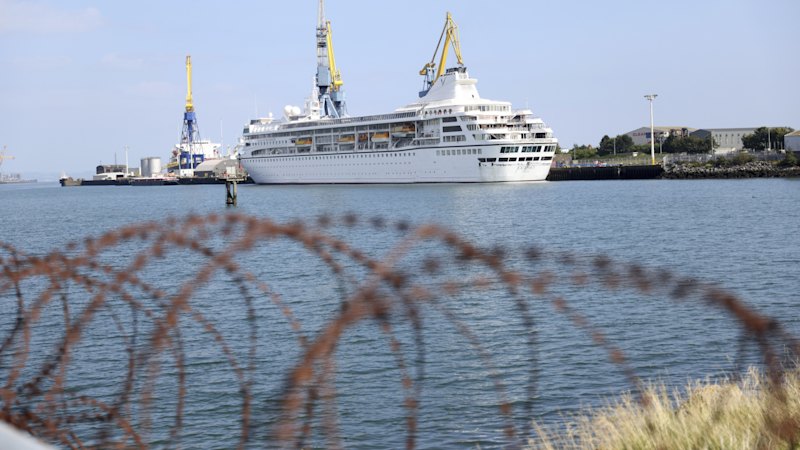
The air conditioning died first.
Not all at once, and not with the dramatic groan of a failing turbine, but with a slow, humid surrender that crept through the carpeted hallways of Deck 7 just after midnight. By three in the morning, the sheets felt like damp sails. By six, the coffee machines in the buffet were cold, and the giant digital map mounted near the purser’s desk had frozen on a blue expanse of the Gulf of Thailand, a tiny white ship icon hovering motionless just off the coast of Sihanoukville, Cambodia.
Stranded.
It is a word we reserve for mountaineers caught in whiteouts or motorists broken down on desert highways. We do not associate it with floating resorts equipped with three swimming pools, a Broadway-style theater, and a midnight chocolate fountain. Yet, when global maritime fuel prices spike past the breaking point of a cruise operator’s balance sheet, a luxury liner ceases to be a vessel of leisure. It becomes a very large, very expensive steel box tethered to a dock it cannot afford to leave.
To understand how hundreds of vacationers found themselves trapped in a Cambodian port town because diesel became too costly to burn, you have to stop looking at the brochure and start looking at the math beneath the waterline.
The Invisible Ledger Beneath the Lido Deck
Consider a hypothetical couple—let’s call them Arthur and Miriam, retired teachers from Ohio who spent three years saving for a bucket-list Southeast Asian itinerary. When Arthur booked their cabin, he saw a single price tag. He saw port fees, taxes, and perhaps a modest fuel surcharge buried in the fine print. He assumed, quite reasonably, that his ticket bought the fuel required to carry him from Singapore to Bangkok, with a pleasant afternoon stop in Sihanoukville.
Arthur did not know he was buying a derivative contract on the global energy market.
Modern cruise ships are marvels of brute-force engineering, which is a polite way of saying they are staggeringly thirsty. A mid-sized cruise vessel burns roughly 150 to 250 tons of marine fuel every single day. That is not the gasoline you pump into a sedan; it is heavy fuel oil or ultra-low-sulfur marine gasoil, thick, volatile commodities traded in global hubs from Rotterdam to Singapore. When geopolitical shocks, supply chain bottlenecks, or sudden refining shortages send marine bunker prices surging by 30, 40, or 50 percent in a matter of weeks, the economics of a voyage collapse overnight.
For a massive conglomerate with dozens of ships and billions in liquidity, a fuel spike is a quarterly earnings headache. They hedge their fuel costs years in advance, locking in prices like a homeowner securing a fixed-rate mortgage.
Smaller operators, charter lines, and regional cruise companies do not have that luxury. They buy fuel on the spot market—paying the retail price at the pump, so to speak, every time they pull into port. And when the price at the pump jumps from $600 a metric ton to nearly $1,000, a seven-day voyage stops generating profit and starts hemorrhaging cash with every nautical mile.
In Sihanoukville, the math simply ran out. The vessel pulled into the deep-water port, dropped its lines, and could not buy the bunker fuel required to reach its next scheduled stop. The local suppliers demanded upfront payment in hard currency at the new, punishing market rate. The cruise line’s credit lines, stretched thin by post-pandemic debt and operating margins razor-thin enough to shave with, snapped.
Life Inside the Floating Waiting Room
I have spent enough time reporting on maritime logistics and stranded travelers to know that the worst part of being stuck isn't the discomfort. It is the information vacuum.
When a ship stops moving, the crew is always the first to know something is wrong, and the last to be allowed to say it. You can see it in the way the junior officers walk the promenade—too fast, eyes fixed just above the horizon, avoiding the gaze of passengers holding half-empty cocktail glasses. At first, the announcements over the PA system are smooth, rehearsed, and entirely fictional. A minor technical inspection. A delay in port clearance. A slight adjustment to our departure schedule to ensure your continued comfort and safety.
Meanwhile, down in the engine room, the chief engineer is watching the sounding tubes—the gauges that measure how much fuel remains in the double-bottom tanks. You never run a ship dry; you must keep enough fuel to run the auxiliary generators. Without those generators, there is no water desalination, no sewage pumping, no refrigeration for the tons of perishable food in the galley, and no air conditioning in eighty-five-degree tropical heat.
On the passenger decks, the mood curdles slowly.
Imagine sitting on your private balcony, looking out at the cranes and shipping containers of Sihanoukville’s industrial port. Yesterday, you were photographing ancient temples and eating fresh mango. Today, you are watching cargo trucks kick up red dust on the pier while your phone battery drains and your return flight home from Bangkok—booked separately, non-refundable—ticks closer by the hour.
The questions start simple and turn desperate. Can we just get off and take a taxi? Sihanoukville to Bangkok is over five hundred miles across an international border, requiring visas many passengers didn't obtain because cruise ship transit rules waived them. Who pays for our flights if we abandon the ship? You do, at last-minute walk-up fares that cost more than the entire cruise. What happens if the ship’s bank seizes the vessel?
That last question is the one nobody wants to ask out loud, yet it is the exact mechanism that turns a fuel shortage into a diplomatic crisis.
The Maritime Trap Nobody Reads in the Contract
When a shipping company fails to pay its fuel suppliers, maritime law enters a ruthless, centuries-old territory. Under international admiralty law, a fuel supplier who hasn't been paid doesn't just send a nasty letter to corporate headquarters. They file a maritime lien against the vessel itself.
In plain terms, the ship gets arrested.
Port authorities chain the vessel to the dock—sometimes literally, more often legally—preventing it from sailing until a court settles the debt or the owner posts a massive bond. Suddenly, the passengers aren't customers anymore. They are collateral damage in a commercial foreclosure.
If you have never read the passenger ticket contract you click "Agree" on when booking a cruise, do it tonight. Buried beneath paragraphs of legalese about arbitration and luggage weight is a clause granting the carrier the absolute right to alter itineraries, cancel ports, or terminate a voyage entirely due to "economic impracticability," fuel shortages, or force majeure. Their legal obligation to you shrinks dramatically the moment the company’s solvency comes into question.
Travel insurance, the safety net millions of travelers rely on, often snaps under this exact weight. Standard policies cover medical emergencies, lost bags, and hurricanes. Many explicitly exclude "financial default of the travel supplier" unless you purchased a specific, expensive rider before the company showed signs of distress.
So Arthur and Miriam sit in the main dining room, eating the last of the thawed chicken breasts because the prime rib requires too much oven power to roast, realizing that the thousands of dollars they spent on peace of mind bought them a front-row seat to a corporate liquidation.
How Global Energy Shocks Hit the Vacation Economy
It is easy to dismiss a stranded cruise ship as a rich-person problem, a minor drama playing out on the margins of global tourism. That is a mistake. What happened on that pier in Cambodia is an early warning tremor of a structural shift in how the world moves.
For decades, global travel ran on a quiet subsidy: cheap, predictable energy. Airlines, cruise lines, and tour operators built business models assuming that fuel, while volatile, would always revert to a manageable mean. They priced tickets years in advance, locking in revenue long before they locked in costs.
That era is over.
We are living through a period where refining capacity is tight, shipping routes are regularly disrupted by regional conflicts, and environmental regulations—like the International Maritime Organization’s strict sulfur caps—have forced ships to burn cleaner, significantly more expensive fuels. The margin for error in the transport industry has evaporated.
When fuel prices spike today, airlines cancel thin routes and raise fares instantly. Cruise lines cannot raise fares on passengers who already paid eighteen months ago. They are trapped between fixed revenue and exploding variable costs. The biggest players survive by passing the pain on quietly—shrinking portion sizes, cutting port times to slow-steam at fuel-saving speeds, or tacking on "environmental fees" after booking. The weakest players simply run out of cash at the dock.
What Actually Gets You Home When the Ship Won't Move
Eventually, these standoffs end, though rarely cleanly.
Sometimes a sovereign wealth fund or a private equity backer steps in with an emergency wire transfer to avoid the public relations nightmare of thousands of stranded tourists sleeping in port terminals. Sometimes embassies intervene, organizing charter buses across borders and negotiating emergency transit visas with local ministries while consular officers hand out water bottles on the tarmac. Often, the passengers themselves pool credit cards, book frantic blocks of commercial flights, and fight their credit card companies for months under chargeback laws for "services not rendered."
The ship itself? It usually sits at anchor for weeks, a rusting monument to bad hedging, until a salvage buyer purchases it at auction for pennies on the dollar, paints over the funnel logo, and puts it back to work under a different flag.
If you are planning to step onto a ship, a plane, or a cross-continental train in an era of volatile energy, the lesson from Sihanoukville isn't to stay home. It is to stop confusing a luxury brochure with financial stability.
Book with operators who have the balance sheet to weather a storm on the commodities exchange, not just a storm at sea. Buy the travel insurance that explicitly covers carrier insolvency, and buy it the day you put down your deposit. Keep enough available credit on a physical card to buy a one-way flight home from the farthest port on your itinerary. And always, always pay attention when the air conditioning starts to blow warm.
Because out on the open water, hospitality is only ever as deep as the fuel in the tanks.


