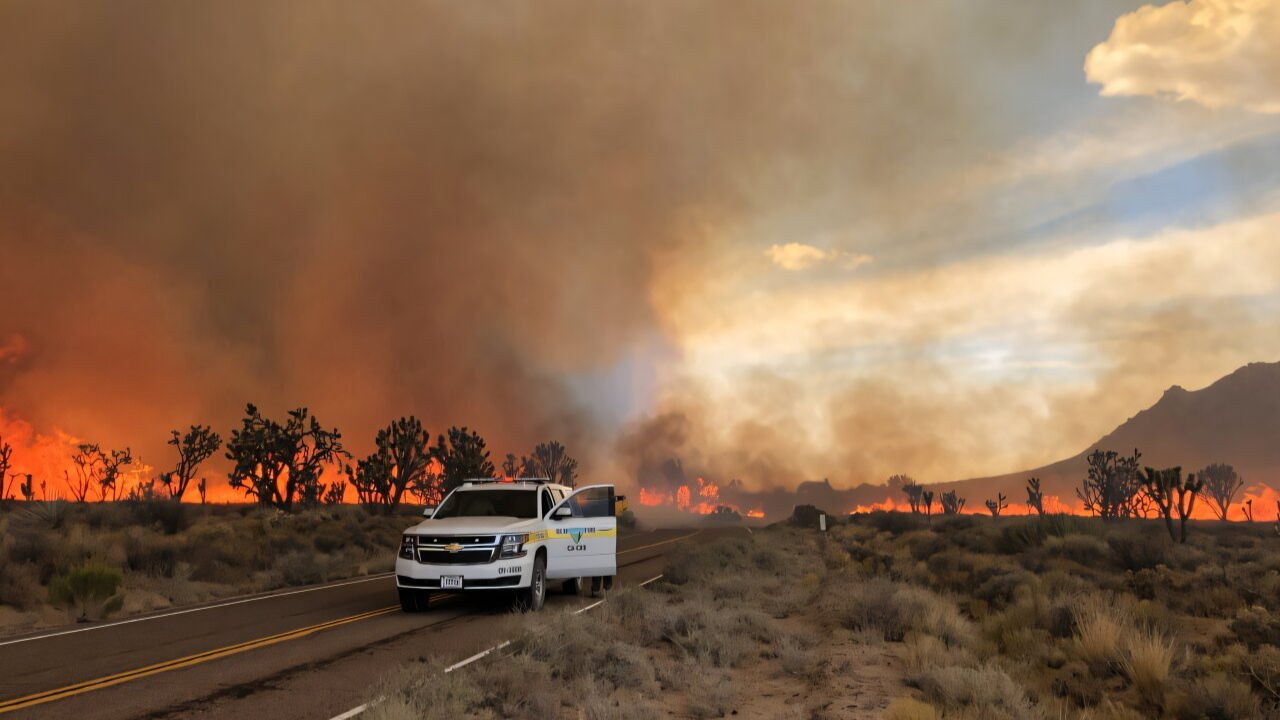
Heat does not merely arrive in the Mojave; it flattens the air until breathing feels like swallowing hot wool. Stand out there in mid-summer, and you realize the wind is not cooling anyone. It is a blowtorch running low on gas, licking across miles of creosote and baked alkali flats.
For centuries, the Joshua tree stood in defiant caricature against that violence. They look like characters dropped out of a Dr. Seuss book by way of a geology textbook—twisted, shaggy limbs raised upward in permanent supplication or panic, depending on how the light hits their spiked silhouettes. Botanists call them Yucca brevifolia. To anyone who has ever driven the empty stretches of Interstate 15 between Los Angeles and Las Vegas, watching them march away from the pavement in stiff, silent battalions, they are simply the anchor of the high desert. They are the landmarks that tell you you have left the city behind and entered a place that belongs to deep time.
Then came August 2020.
Lightning flickered over the Cima Dome inside the Mojave National Preserve. A dry storm, all fury and no mercy. It ignited a blaze that would become the Dome Fire.
If you have never watched a fire move through a Joshua tree forest, erase every mental image you have of orange flames chewing through towering pines. This fire was different. It moved low, fast, and insidiously through the understory of dead grasses and dried shrubs, but it found its fuel in the oily, fibrous hearts of the yuccas themselves. When a Joshua tree catches, it does not just burn. It chars from the inside out, turning into a smoking torch that collapses into a heap of smoldering charcoal.
By the time the smoke cleared and the satellite tallies were finally tallied, the math was staggering. Scientists estimate that up to 1.3 million Joshua trees vanished in a matter of days.
One million three hundred thousand.
Numbers like that numb the brain. They sound like ledger entries in a corporate bankruptcy or distant casualty reports from a war half a world away. But pause for a moment and translate that statistic back into flesh and wood. Imagine an entire city—say, San Diego or Dallas—suddenly stripped of every mature tree, every park, every piece of shade, leaving behind only ash and scorched earth. Except these were not street maples planted fifty years ago by a city council. These were elders. Many of them had stood since the Middle Ages. They had weathered centuries of drought, wind, and freezing winter nights, only to be wiped out in an afternoon because our climate had crossed an invisible threshold.
To understand why this loss cuts so deeply, you have to look closer at what a Joshua tree actually is. It is not a true tree at all. It is a monocot, a giant succulent relative of asparagus and agave. It has no annual growth rings, which means reading its age requires forensic patience. It grows slowly, sometimes less than an inch a year, pushing its heavy green pom-poms skyward only when conditions allow.
And those conditions are vanishing.
For a Joshua tree to exist, it needs a delicate conspiracy of geography and biology. It needs freezing winter temperatures to trigger blooming. It needs moisture at just the right moment to sprout seeds. And, most crucially, it needs a partner: the yucca moth.
The relationship between the Joshua tree and the yucca moth is one of nature’s most exquisite, fragile dependencies. The female moth collects pollen from one flower, rolls it into a tiny sticky ball, flies to another flower, lays her eggs inside the ovary, and deliberately stuffs the pollen into the flower's stigma to ensure seeds will grow. The caterpillars will eat some of those seeds, but enough are left over to plant the next generation. It is a precise, ancient contract. If the climate gets too hot, the moths shift their ranges or fail to emerge synchronously with the blossoms. If the trees burn down, the moths have nowhere to lay their eggs.
Break one link in that chain, and the whole machinery of the desert stumbles.
Walk through the burn scar at Cima Dome today, and the silence is different than it used to be. It is not the peaceful hush of a sleeping wilderness. It is a hollow, haunted quiet. Where sprawling, whimsical giants once stood, you see skeletal black posts sticking out of the sand like broken teeth. The soil is powdery and gray. Invasive grasses like red brome, fueled by nitrogen from the fires and decades of urban exhaust drifting out from the basin, have carpeted the gaps. These grasses burn even hotter and faster than the native brush, creating a vicious cycle: fire breeds grass, grass breeds hotter fire, and the yuccas—which have no natural mechanism to resprout from roots after a severe blaze—die forever.
We tend to think of climate change as a slow-motion catastrophe. We picture melting glaciers inching back over decades, or sea levels rising by fractions of an inch each year. We think we have time to adapt, to debate policies, to adjust our habits in comfortable increments.
The Dome Fire proved us wrong.
The desert didn't change over a century. It changed over a weekend.
Consider what happens when a landscape is pushed past its breaking point. Nature does not gently slope downward into decline; it often hits a cliff. The loss of 1.3 million trees in the Mojave is not just a localized tragedy for park rangers or desert hikers. It is a warning flare sent up from the front lines of a warming planet. If plants as tough as the Joshua tree—species specifically engineered by evolution to spit in the eye of desiccation and heat—cannot survive our current century, what hope is there for ecosystems built on margins that are actually fragile?
Yet, out among the black spikes, something stubborn is happening.
If you look very closely at the base of a charred trunk, past the soot and the drifted sand, you will occasionally spot a tiny, defiant spear of green. A seedling, dropped by a passing bird or surviving a stray pod, pushing upward through the ash. It is an infinitesimal speck of life in an ocean of ruin.
It will take that seedling three hundred years to look like the ancestors that fell around it. It will have to survive droughts we cannot yet forecast and heatwaves that have no historical precedent. It is a gamble against staggering odds.
We drove those odds up. We loaded the dice. And every time we look out across the empty, burning stretches of our changing world, we are left staring at the bill. The elders are gone, but the desert is still trying to speak. The question is whether we are finally ready to listen.