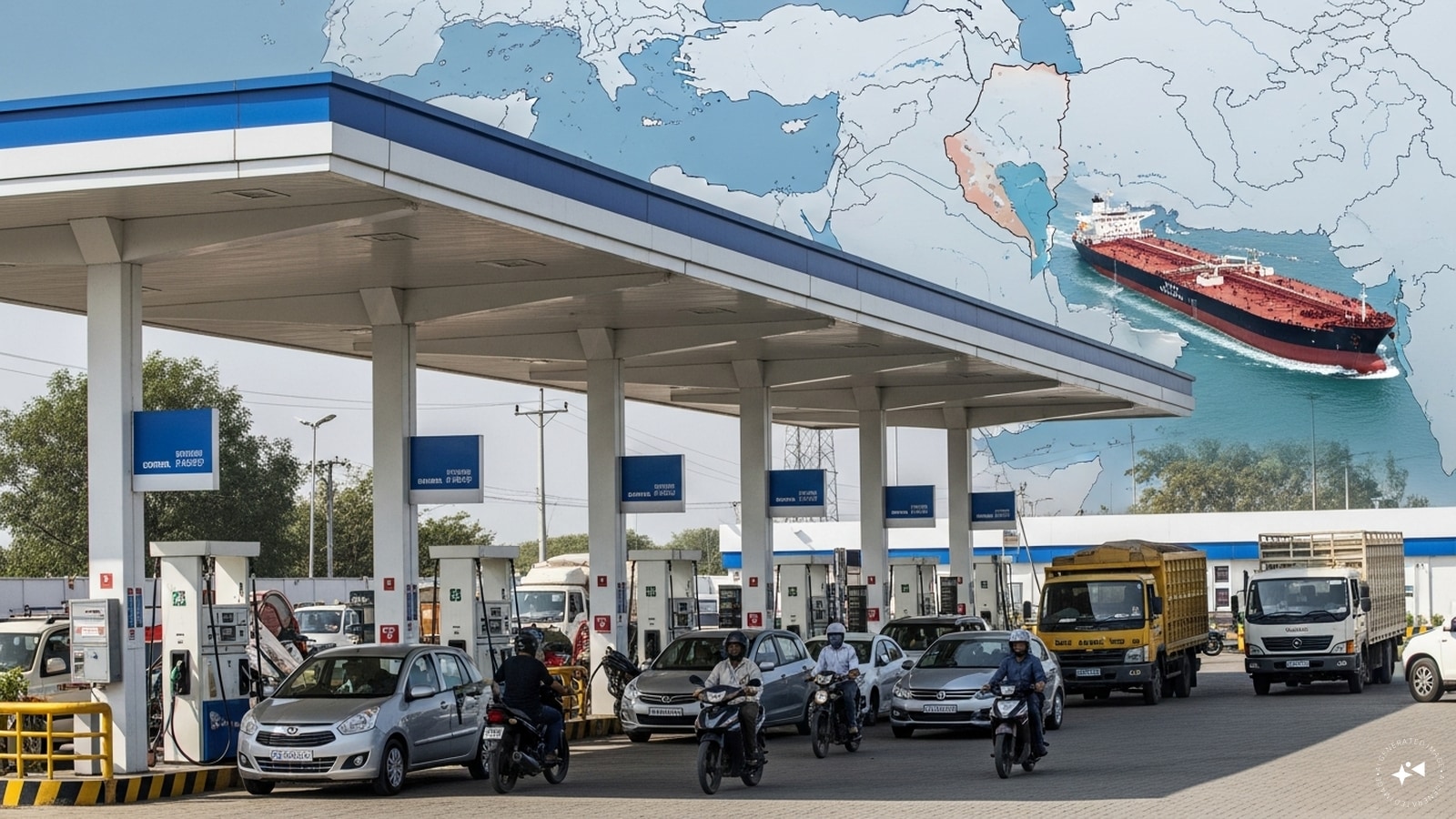
India’s energy security is currently dictated by a high-stakes geographic rebalancing of the global oil trade. While escalating kinetic conflict in West Asia threatens the stability of traditional supply lines—specifically the Strait of Hormuz and the Bab el-Mandeb—the fundamental risk to India is not a physical shortage of molecules, but a volatility-driven expansion of the landed cost of crude. The structural shift toward Russian Urals as a baseline supply represents a pragmatic hedge against Middle Eastern supply shocks, yet this pivot introduces secondary risks related to shipping insurance, G7 price cap compliance, and the "shadow fleet" logistics chain.
Understanding the current threat to India’s oil supply requires deconstructing the energy ecosystem into three distinct variables: Geopolitical Transit Risk, Refinery Complexity Coefficients, and The Sanctions-Arbitrage Mechanism.
The Geopolitical Transit Risk: Bottlenecks and Freight Premiums
The primary threat to Indian energy stability is not the depletion of oil wells, but the vulnerability of the maritime chokepoints through which that oil must travel. India imports approximately 85% of its crude requirements. Historically, the proximity of the Persian Gulf provided a freight advantage that is now being eroded by war risk premiums.
- The Hormuz Dependency: Approximately 30% of India's total crude imports transit the Strait of Hormuz. Any Iranian-led interdiction or accidental escalation in this 21-mile-wide waterway would trigger an immediate force majeure on Iraqi and Saudi contracts. For India, this would necessitate a rapid drawdown of Strategic Petroleum Reserves (SPR), which currently hold roughly 9.5 days of net imports.
- The Red Sea Reroute: Attacks by Houthi rebels in the Bab el-Mandeb have forced a significant portion of Russian and European-bound crude to divert around the Cape of Good Hope. This adds 10 to 15 days to the voyage and increases freight costs by $1.00 to $1.50 per barrel. While India sits east of these attacks, the global contagion effect raises the cost of Suezmax and VLCC (Very Large Crude Carrier) charters across all routes.
- The Insurance Surcharge: When a region is declared a "Listed Area" by the Joint War Committee in London, additional war risk premiums are applied. These costs are passed directly to the Indian refiners, narrowing the gross refinery margins (GRMs).
The Refinery Complexity Coefficient: Why Quality Matters
India possesses some of the most sophisticated refining clusters in the world, particularly the Reliance Jamnagar complex and Nayara Energy’s Vadinar refinery. These facilities are designed with high Nelson Complexity Indices (NCI), meaning they can process "sour" and "heavy" crudes that simpler refineries cannot.
This technical capability is the silent enabler of India’s current strategy. West Asian crude (like Arab Light or Basra Medium) and Russian Urals share similar chemical profiles—specifically, high sulfur content and medium API gravity. Because Indian refineries are "tuned" for these grades, they can switch between Middle Eastern and Russian supply with minimal operational friction.
If West Asian supply is throttled, the "Russian Gap" is not merely a political choice; it is a chemical necessity. The ability to process Urals—which often trades at a discount to Brent—allows Indian refiners to maintain domestic price stability even as global benchmarks rise.
The Sanctions-Arbitrage Mechanism: Russian Crude as a Strategic Buffer
Since 2022, Russia has ascended from a marginal supplier (less than 2% of Indian imports) to the primary source of Indian crude, often exceeding 35% of the total mix. This shift was driven by the G7 price cap of $60 per barrel. India’s refusal to join the price cap coalition has allowed it to act as a massive "sink" for Russian molecules that are no longer welcome in Europe.
However, the "Russian Gap" is not a bottomless well. Several constraints limit its effectiveness as a total replacement for West Asian oil:
- The Payment Bottleneck: Transacting in non-USD currencies (Dirhams, Rupees, or Yuan) creates friction. Russia has accumulated billions in "trapped rupees" within the Indian banking system that it cannot easily repatriate or use for global trade, leading to occasional demands for payment in Chinese Yuan or UAE Dirhams.
- The Shadow Fleet Constraint: To bypass Western sanctions and insurance bans, a significant portion of Russian oil travels on the "shadow fleet"—older vessels with opaque ownership and questionable insurance. As the US Treasury tightens "secondary sanctions" on these specific vessels (e.g., the Sovcomflot fleet), the pool of available tankers shrinks, driving up the cost of Russian barrels.
- Logistical Latency: Shipping oil from the Russian ports of Primorsk or Novorossiysk to India takes significantly longer than shipping from Basra or Ras Tanura. This increased "oil on water" time ties up more capital and makes the supply chain more sensitive to sudden shifts in demand.
Analyzing the Cost Function of a Supply Disruption
To quantify the impact of a West Asian war on India, we must look at the fiscal math. For every $10 increase in the price of a barrel of crude, India’s Current Account Deficit (CAD) typically widens by approximately 0.5% of GDP.
The relationship between global prices and Indian domestic stability is governed by the following feedback loop:
- Direct Inflation: Higher crude prices increase the cost of logistics and fertilizers, leading to food price spikes.
- Currency Depreciation: As India buys more USD to pay for oil, the Rupee weakens. A weaker Rupee makes subsequent oil imports even more expensive, creating a self-reinforcing inflationary cycle.
- Fiscal Slippage: While the government has deregulated petrol and diesel prices, significant spikes often lead to the reintroduction of subsidies or the reduction of excise duties to shield the consumer, which depletes the capital available for infrastructure spending.
The Strategic Play: Hardening the Energy Architecture
The current crisis underscores that "energy independence" is a misnomer for India. The goal is "energy resilience." To achieve this, the strategic focus must shift from merely securing molecules to optimizing the entire value chain.
- Aggressive SPR Expansion: The current 5.33 million metric tonne capacity is insufficient for a prolonged West Asian conflict. Phase II of the SPR program, adding 6.5 MMT in commercial-cum-strategic facilities, must be accelerated to provide a 30-day buffer.
- Diversification Beyond the Russia-OPEC+ Axis: India must leverage its refining complexity to source more heavy crudes from the Western Hemisphere, specifically Brazil, Guyana, and a sanctioned-relaxed Venezuela. This creates a "Buyer’s Option" that forces OPEC+ to compete on price.
- The Integration of Midstream Assets: Indian state-run firms (IOCL, BPCL, HPCL) should move toward owning more of the tanker fleet rather than relying on spot charters. Controlling the hardware of the trade—the ships—is the only way to mitigate the "war risk" premiums imposed by third-party insurers.
The tactical move for India is to maintain its "neutrality arbitrage"—buying discounted Russian crude while maintaining deep technical and security ties with Middle Eastern producers. This is a delicate balancing act that requires the constant recalibration of shipping routes and currency settlements. The real danger is not a lack of oil, but the lack of a diverse enough logistics network to bring that oil home when the primary gates are under fire.
In the immediate term, expect India to prioritize long-term "term contracts" over spot market purchases. By locking in volumes with Saudi Arabia and the UAE while simultaneously maximizing spot-purchase discounts from Russia, India creates a hybrid supply model. This model ensures that if one source is physically cut off by kinetic action, the other is already integrated into the refinery schedule. The objective is clear: ensure that the internal combustion of the Indian economy never starves for fuel, regardless of the fires burning in the Levant or the Gulf.