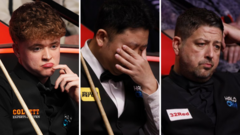
If you think your driving test was stressful, you’ve never stood in the silence of the Crucible Theatre. Shaun Murphy once famously said that the pressure of playing at snooker's most iconic venue is 50 times worse than trying to earn your license. He’s right. When you’re in a car, you’re worried about a parallel park or a stalled engine. When you’re at the Crucible, you’re worried about your entire career collapsing under a single spotlight while millions of people watch your hands shake.
The World Snooker Championship isn't just another tournament. It’s a psychological meat grinder. It lasts 17 days. It destroys sleep patterns. It exposes every technical flaw you’ve spent a lifetime trying to hide. Most professional athletes talk about being "in the zone," but at the Crucible, the zone feels more like a panic room.
The silence that actually screams
Most sports are loud. Football has chanting. Tennis has the rhythmic "thwack" and applause. Snooker has silence. It’s a heavy, claustrophobic silence that amplifies the sound of your own heartbeat. You can hear a spectator shifting in their seat from forty feet away. You can hear the cameraman’s breathing.
When a player sits in their chair while their opponent is on a break, they aren't just resting. They’re rotting in their own thoughts. You have too much time to think. In a driving test, you’re constantly reacting to the road. In snooker, you sit for twenty minutes watching someone else dictate your fate. That’s when the mental demons start talking.
Professional snooker players often describe "the twitch." It’s a literal involuntary muscle spasm that happens right at the moment of delivery. Imagine trying to thread a needle while someone is screaming in your ear. Now imagine doing it while nobody is making a sound at all. That’s the Crucible.
Why the driving test comparison actually makes sense
Murphy’s comparison isn't just hyperbole for the sake of a headline. He’s talking about the physiological response to high-stakes evaluation. During a driving test, your palms get sweaty because an authority figure is judging your every move. You’re afraid of failure and the cost of retaking the exam.
Now, scale that up.
At the Crucible, the "examiner" is the global audience. The "test" lasts for over two weeks. If you fail, you don’t just book another slot next month. You wait a full year for another shot at glory. The financial stakes are massive too. A first-round exit can be the difference between a profitable season and a year in the red.
The physical toll is also underrated. Most people don't realize that a long match at the World Championship can last over ten hours across multiple sessions. Maintaining the fine motor skills required to hit a cue ball with millimeter precision after eight hours of intense concentration is biologically exhausting. Your brain runs out of glucose. Your eyes start to play tricks on you.
The legendary collapses that prove the point
We've seen the best players in history fall apart in Sheffield. Think about the 1985 final between Steve Davis and Dennis Taylor. 18.5 million people watched that match in the UK. When it came down to the final black ball, the pressure was so immense that Davis—one of the most clinical players to ever pick up a cue—missed a cut he would normally make in his sleep.
That wasn't a lack of skill. That was the weight of the building.
More recently, we’ve seen top-tier players like Judd Trump or Ronnie O'Sullivan talk openly about the "suffocating" nature of the one-table setup. When the curtain goes up for the semi-finals and the arena opens into one giant space, the atmosphere changes. It gets colder. It feels lonelier.
Dealing with the mental load
How do they do it? It isn't just about practicing long pots. Players now spend as much time with sports psychologists as they do at the table. They use visualization techniques to normalize the pressure. They try to treat the Crucible like their local practice club, even though they know that's a lie.
- Box breathing to lower the heart rate between shots.
- Strict routines to keep the mind occupied during the long walks around the table.
- Mental resets after a missed ball to prevent a "spiral."
If you lose your cool for five minutes in a best-of-19 match, you can lose four frames. You can't afford a single mental lapse. In a driving test, a small mistake might be a minor fault. At the Crucible, a small mistake is usually the end of your tournament.
The technical reality of the table
The tables at the Crucible are prepared to a standard that is frankly terrifying. The cloth is brand new and incredibly fast. The pockets are tight. The heaters under the slate are cranked up to make the balls react more predictably, but this also means the balls drift more if your hit isn't perfectly clean.
It’s a setup designed to reward perfection and punish anything less. If your hand is shaking even a fraction of a millimeter, the table will tell everyone in the room. You can't hide.
Stop underestimating the grind
People love to joke that snooker isn't a "real" sport because there’s no running involved. Tell that to a player who has just lost five pounds of body weight over a three-day match due to sheer stress and nervous energy. The physical demands are different, but the exhaustion is real.
The next time you're feeling nervous about a presentation at work or a parallel park, remember the guys in the waistcoats. They’re performing a feat of incredible physical precision while their brains are telling them to run out of the fire exit.
To survive the Crucible, you don't just need a good backswing. You need a nervous system made of tempered steel. If you want to understand what true pressure looks like, stop looking at the scoreboard and start looking at the players' hands when they reach for the bridge. That’s where the truth is.
If you’re a fan or an aspiring player, the best way to handle your own high-pressure moments is to accept that the nerves are coming. Don't fight the shake. Work with it. Understand that even the world champions are feeling 50 times worse than you are. Focus on your breathing, keep your eyes on the object ball, and don't let the silence get inside your head.