There is a specific kind of quiet that settles over an arena when history is being rewritten.
It is not the deafening roar of thirty thousand screaming voices, nor is it the bass-heavy thud rattling the floorboards through the soles of your shoes. It is the breath held collectively in the chest of a crowd that realizes they are no longer just watching a show; they are watching an anchor drop into the timeline.
You can feel it in the air before you see it. The sudden shift in posture. The way security guards stop looking at the frantic edges of the pit and turn their eyes toward the stage. Someone next to you spills their drink, completely unaware, their gaze locked onto a single figure walking toward a microphone.
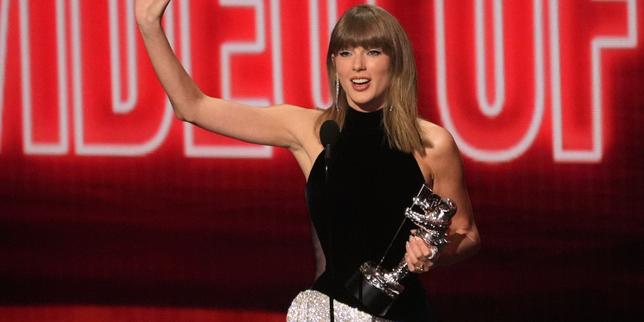
Taylor Swift did not just win another Moon Person at the MTV Video Music Awards; she absorbed it into a legacy that is expanding faster than the industry can build fences to contain it. With yet another sweep, the record books had to be pulled out, dusted off, and rewritten with a pen that refuses to run dry. But the number of trophies sitting on a shelf tells only half the story. The real story lives in the tension between what pop music used to be—disposable, fleeting, manufactured in a boardroom and discarded by Monday morning—and what it has become under her steady, calculating stewardship: an intricate, multi-year puzzle box where every single piece is accounted for.
We have spent decades treating pop stardom like a Roman candle. Bright, explosive, beautiful for three seconds, and then tumbling back to earth as cold, dead ash. The music business loves a fast burn because ash is easy to sweep up and replace with something fresh.
Madonna taught us that reinvention could be a armor.
When Madonna stepped onto that same stage, decades after shocking the establishment in a wedding dress and lace gloves, the applause took on a different frequency. It wasn't the frantic, teenage screech of brand-new fandom. It was reverence. It was the sound of a room acknowledging the woman who laid the railroad tracks over the mountain so others could simply drive the train.
Consider what happens when two titans from entirely different eras of cultural dominance occupy the same room. To the casual observer, it is just a photo opportunity for the morning algorithms. To anyone who understands the machinery of fame, it is a seismic collision. Madonna built her empire on provocation, daring a conservative culture to look away and daring herself to push past the boundary line first. Swift built hers on confession, turning diary entries into global anthems that millions of strangers scream back at her in unison, word for word, tear for tear.
Different playbooks. Same relentless hunger.
If you stood backstage in the damp, electric dark of the wings, the contrast was staggering. The modern pop machine moves at the speed of a fiber-optic cable. A lyric drops on TikTok; a trend is born by lunchtime; the culture pivots before dinner. Swift operates at this breakneck pace while simultaneously planting oak trees that won't bear fruit for fifty years. Re-recording her entire catalog wasn't just a clever legal maneuver or a middle finger to corporate ownership; it was a masterclass in sovereign autonomy. It taught an entire generation of artists that you do not have to lease your own history. You can buy the deed.
Yet, sitting in the audience, watching the flashbulbs catch the silver and gold of yet another award, a strange melancholy creeps in.
We demand so much permanence from people whose art is designed to capture fleeting moments. We want our pop stars to be immortal, but we also want them to bleed publicly enough for our entertainment. We want the record-breaking triumph, but we also want the vulnerability that makes us feel like they are just like us—even when their private jet leaves a carbon footprint the size of a small island and their net worth crosses into comma-heavy territory that defies human imagination.
The paradox of modern celebrity is that the more accessible they become through Instagram lives and hidden Easter eggs in lyric videos, the more isolated they must grow to survive the fishbowl.
Think about the sheer physical toll. Two hours and forty-five minutes of non-stop cardio, costume changes, emotional heavy lifting, and vocal acrobatics, night after night, stadium after stadium, across continents. By the time the applause fades and the arena lights snap on to reveal empty plastic cups and discarded light-up bracelets rolling down the concrete steps, the silence must feel deafening.
That is when the awards stop mattering.
The silver statuettes are heavy, cold, and ultimately inanimate. They cannot keep you warm when the adrenaline crashes and the highway outside your hotel window hums with the anonymous rush of a city that doesn't know your name and wouldn't care if it did.
Madonna knew this truth decades ago. That is why she never stopped moving, never stopped shocking, never allowed the culture to pigeonhole her into a nostalgia act. She understood that if you let them define you, they will eventually bury you in your own past. Swift is reading from that same dog-eared playbook, translated for an age where every misspoken word is clipped, analyzed, weaponized, and beamed to millions of smartphones before you even make it off the stage.
When the history of our current cultural moment is written, we will talk endlessly about the numbers. The stadium capacities. The streaming billions. The economic impact on host cities that rivals the Super Bowl. We will quote the chart statistics like holy scripture.
But the numbers are just the scaffolding.
The human core of this phenomenon is about control in a world that feels increasingly unhinged. It is about a young woman sitting on her bedroom floor in Hendersonville, guitar in hand, writing words she was too afraid to say out loud to the boys who ignored her, and watching those exact words become the soundtrack to millions of lives she will never meet. It is about a little girl in the nosebleed section screaming until her throat is raw, feeling, for three hours, like she matters just as much as the girl on the gold-plated stage.
The record books will duly note who won what on a Tuesday night in New Jersey. They will tally the statues and compare the heights of the pedestals.
Yet, long after the gold has tarnished and the stage lights have been unbolted and packed into semi-trucks rolling down the interstate toward the next horizon, the only thing that remains is the echo.
A single voice, cutting through the dark, reminding us why we needed the music in the first place.