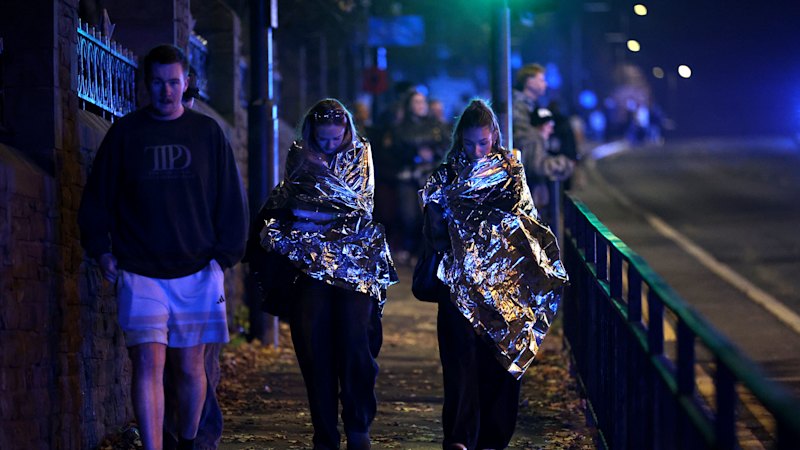
Mass evacuations triggered by suspected airborne chemical irritants—such as the incident at the Manchester concert venue where thousands of attendees were forced to exit—are rarely failures of structural capacity; they are failures of information latency, aerosol dispersion dynamics, and behavioral contagion. When a pressurized canister of
The Physics and Physiology of Enclosed Aerosol Dispersion
Standard news coverage treats "suspected tear gas" as a uniform cloud that instantly fills a room. In reality, handheld self-defense sprays—typically containing
When discharged in an indoor concert hall or arena, the irritant follows a three-stage dispersion profile:
- Primary Ballistic Plume: Within the first 1 to 3 seconds, the propellant ejects micro-droplets in a directional cone extending 2 to 5 meters. Individuals inside this zone experience immediate nociceptor activation, triggering involuntary
Involuntary, tight closure of the eyelids caused by muscle spasms. , acute bronchospasm, and copious lacrimation. At this stage, the threat is strictly localized, yet the vocal and physical reactions of the primary victims act as the initial acoustic signal of danger to the surrounding crowd. - Secondary Thermal Buoyancy and Eddies: Concert venues generate significant thermal plumes due to body heat—roughly 100 to 150 watts per stationary person, rising to over 300 watts during active dancing—and stage lighting rigs. Warm air rises toward the ceiling return vents, pulling aerosolized particles upward before horizontal air currents distribute them across upper tiers or adjacent sections.
- HVAC Recirculation vs. Exhaust: If a venue’s building management system (BMS) operates in an energy-saving recirculation mode rather than 100% outside-air purge, the filtration system—typically rated at MERV 8 to MERV 13 for standard commercial venues—fails to capture sub-micron chemical vapors. The ventilation network inadvertently becomes a distribution manifold, carrying trace irritants to zones entirely disconnected from the point of origin.
The physiological response to these trace concentrations creates a diagnostic bottleneck for security and medical teams. Low-level exposure produces coughing, throat irritation, and ocular stinging that mimic acute anxiety or hyperventilation. During the Manchester evacuation, the ambiguity between direct chemical exposure and psychogenic symptom mirroring complicated triage protocols at the perimeter.
The Information Latency Gap in Venue Operations
The critical failure point in mass venue evacuations is the temporal gap between the initial sensory trigger and the issuance of an authoritative public address announcement. This latency window—often lasting between 90 seconds and 4 minutes—dictates whether an exit remains an orderly egress or degrades into a high-risk crush event.
In a standard live music environment, ambient sound pressure levels routinely sit between 95 and 105 decibels. Visual visibility is deliberately compromised by low-lux house lighting, theatrical haze, and strobe effects. Under these baseline conditions, three operational breakdowns occur simultaneously:
- Signal Masking: The hiss of an aerosol canister and the initial coughing of affected patrons are completely masked by the audio system. Security personnel positioned at the stage barrier or perimeter rely on visual cues, which are obstructed by crowd density.
- Decentralized Threat Assessment: Floor stewards observe localized movement—a sudden radial void opening in the standing area as patrons recoil from the irritant—without knowing the cause. Because modern venue protocols train staff to treat sudden crowd voids as potential indicators of a bladed weapon attack, firearms incident, or structural collapse, early responders must assume a worst-case kinetic threat until verified otherwise.
- Command Chain Friction: Floor staff radio their sector supervisors, who relay unverified reports to the venue control room. The event safety officer must then corroborate the report via CCTV—often obscured by theatrical fog—before instructing the front-of-house audio engineer to mute the performance and activate emergency lighting.
During this latency window, the crowd conducts its own decentralized risk assessment. Relying on incomplete local data, attendees observe neighbors coughing, covering their faces, and pushing toward the perimeter. Without an authoritative counter-narrative from the stage or PA system, the crowd defaults to self-preservation movement.
Behavioral Contagion and Egress Bottlenecks
Once self-evacuation initiates, the primary hazard shifts from chemical toxicity to crowd dynamics. Decades of pedestrian flow research, notably the work of Dirk Helbing on panic dynamics, demonstrate that high-density crowds transition from fluid-like movement to turbulent, stop-and-go waves when density exceeds 4 to 5 persons per square meter.
At the Manchester concert, moving thousands of people out of the bowl or floor area required channeling high-velocity human traffic through fixed architectural bottlenecks: vomitories, concourse doors, stairwells, and exterior turnstiles.
The mechanics of egress degradation follow a predictable sequence:
- The Faster-Is-Slower Effect: As perceived urgency rises, individuals attempt to move faster toward exit portals. When converging streams of pedestrians meet at a constriction point—such as a concourse corridor narrowing into an exterior stairwell—the physical friction between bodies increases. Arching effects occur across the doorway, paradoxically reducing the overall flow rate (measured in persons per meter per second) below what would be achieved during a calm, unhurried exit.
- Asymmetric Exit Utilization: Attendees exhibit a strong cognitive bias toward familiarity, attempting to exit through the exact entry gates they used to enter the venue. Emergency fire exits, despite being illuminated and closer to the standing floor, remain underutilized unless actively directed by high-visibility staff equipped with megaphones or acoustic hailers.
- Sensory Impairment in Transit: Victims experiencing active OC or CS exposure suffer from temporary functional blindness. In a moving crowd, a blinded individual stops abruptly or clutches onto adjacent pedestrians, creating stationary obstacles within a high-momentum flow. Every stationary obstacle reduces effective corridor width and increases the probability of tripping cascades on stairwells.
Forensic Attribution and Perimeter Security Limitations
Suspected tear gas incidents expose a structural vulnerability in modern entertainment security screening: the gap between metallic threat detection and chemical threat detection.
Following major terrorist attacks on European entertainment venues—most notably the 2017 Manchester Arena bombing—venue operators heavily invested in walk-through metal detectors (WTMDs), handheld wands, and bag-size restrictions. However, these countermeasures are calibrated for ferrous and non-ferrous mass thresholds associated with firearms and large bladed weapons.
A standard 15ml to 50ml self-defense spray canister presents a minimal metallic signature. The canister body is frequently constructed from thin-walled aluminum or reinforced polymer, containing a spring mechanism with less metal mass than a standard belt buckle or set of keys. Consequently, canisters routinely pass through WTMDs set to standard sensitivity thresholds without triggering an alarm.
Physical bag searches remain the primary defense against non-metallic or low-metal contraband, yet they suffer from severe throughput constraints. When processing 10,000 to 20,000 attendees within a 90-minute door-to-show window, security personnel have roughly 3 to 5 seconds per bag. A cylindrical canister concealed inside a coat lining, footwear, or hygiene pouch is statistically likely to bypass manual inspection without triggering a secondary search.
Furthermore, once discharged inside the venue, attribution is notoriously difficult. Unlike firearms, which leave gunshot residue and ballistic trajectories, or knives, which remain at the scene, a small aerosol canister can be dropped into a crowd of thousands and kicked beneath seating risers or trampled into debris. By the time law enforcement secures the empty floor, the physical evidence is either destroyed, contaminated, or indistinguishable from standard venue refuse, while the perpetrator has exited alongside thousands of evacuees.
The Economic and Regulatory Cost Function
For venue operators, promoters, and municipal authorities, a suspected chemical irritant evacuation triggers a severe multi-tiered cost function that extends far beyond the immediate night of the event.
- Direct Operational Losses: Immediate ticket refunds, rescheduled production logistics, and overtime deployment for municipal emergency services (police, fire, and hazardous materials units) erode event margins. For mid-sized venues operating on thin net margins of 8% to 15%, a single aborted show can wipe out the quarterly profitability of the calendar.
- Medical and Hazardous Materials Remediation: An unconfirmed chemical release requires specialized decontamination protocols. Until a HAZMAT team identifies the substance via
An analytical technique used to separate and identify ionized molecules in the gas phase based on their mobility in a carrier buffer gas. orA technique used to obtain an infrared spectrum of absorption or emission of a solid, liquid, or gas to identify chemical compounds. , the venue must be treated as a potential chemical weapons crime scene. Post-clearance remediation requires industrial air scrubbing, wipe-downs of all non-porous surfaces, and laundering or replacement of soft furnishings to prevent secondary contact dermatitis at subsequent events. - Regulatory and Licensing Scrutiny: In the United Kingdom, incidents of this scale trigger immediate review under the Licensing Act 2003 and align closely with the impending statutory requirements of the Terrorism (Protection of Premises) Act—widely known as Martyn’s Law. Licensing boards evaluate whether the venue’s crowd management plan, CCTV coverage, and staff-to-patron ratios were sufficient to prevent both the smuggling of the device and the subsequent egress friction. Failure to demonstrate documented, tested evacuation protocols can result in capacity reductions, mandatory imposition of costly third-party security audits, or temporary license suspension.
Operational Limitations of Current Countermeasures
No security architecture eliminates the risk of covert aerosol deployment in mass-gathering spaces without rendering the venue economically and logistically unviable.
Deploying millimeter-wave body scanners—standard in aviation—across concert arenas would extend ingress times from 90 minutes to over 6 hours, destroying the commercial model of live entertainment. Similarly, installing chemical sniffer sensors throughout an arena bowl is operationally flawed; high concentrations of theatrical fog (glycol-based aerosols), vaping clouds, perfume, and spilled alcohol generate massive false-positive rates, leading to alert fatigue or unnecessary evacuations.
Even post-incident ventilation purging carries trade-offs. Activating maximum exhaust fans immediately upon an unverified report clears airborne irritants faster, but the sudden acoustic roar of industrial fans and the drop in ambient air pressure can disorient crowds further and interfere with verbal PA instructions.
Strategic Mandates for Venue Operators
To mitigate the operational impact of indoor chemical irritant incidents, venue operators and event safety directors must shift investment from front-of-house detection—which faces diminishing returns against small canisters—to rapid internal verification, automated BMS integration, and asymmetric egress control.
- Decouple PA Override from Central Command: Eliminate the multi-step radio verification chain for emergency lighting and audio muting. Equip sector supervisors on the floor with direct-to-control-room priority radio channels and pre-programmed digital alert triggers. Within 30 seconds of a confirmed crowd void or respiratory distress cluster, house lights must ramp to 100% and stage audio must cut to an automated, calm directive instructing patrons to move away from the affected quadrant rather than rushing main entry doors.
- Program Automated HVAC Purge Modes: Configure the venue’s Building Management System with a single-button "Airborne Contaminant Mode." Upon activation, this protocol must immediately close all return-air dampers to prevent cross-zone recirculation, maximize roof exhaust fans, and positively pressurize adjacent concourses and stairwells to keep egress routes free of migrating aerosols.
- Deploy Acoustic Direction at Secondary Exits: Counteract the cognitive bias toward main entry gates by positioning dedicated egress teams at emergency fire exits equipped with directional acoustic hailers and high-lumen strobes. During an evacuation, these teams must actively intercept crowd flow before it reaches primary concourse bottlenecks, splitting the human stream into parallel, lower-density exit channels.
- Integrate Rapid Field Identification into Medical Triage: Equip venue medical leads with portable chemical detection strips and handheld ion mobility spectrometers. Distinguishing between a benign pepper spray discharge and a toxic industrial chemical within 5 minutes of evacuation prevents unnecessary mass hospital transports, protects municipal emergency room capacity, and accelerates the handover of the building back to venue management for remediation.