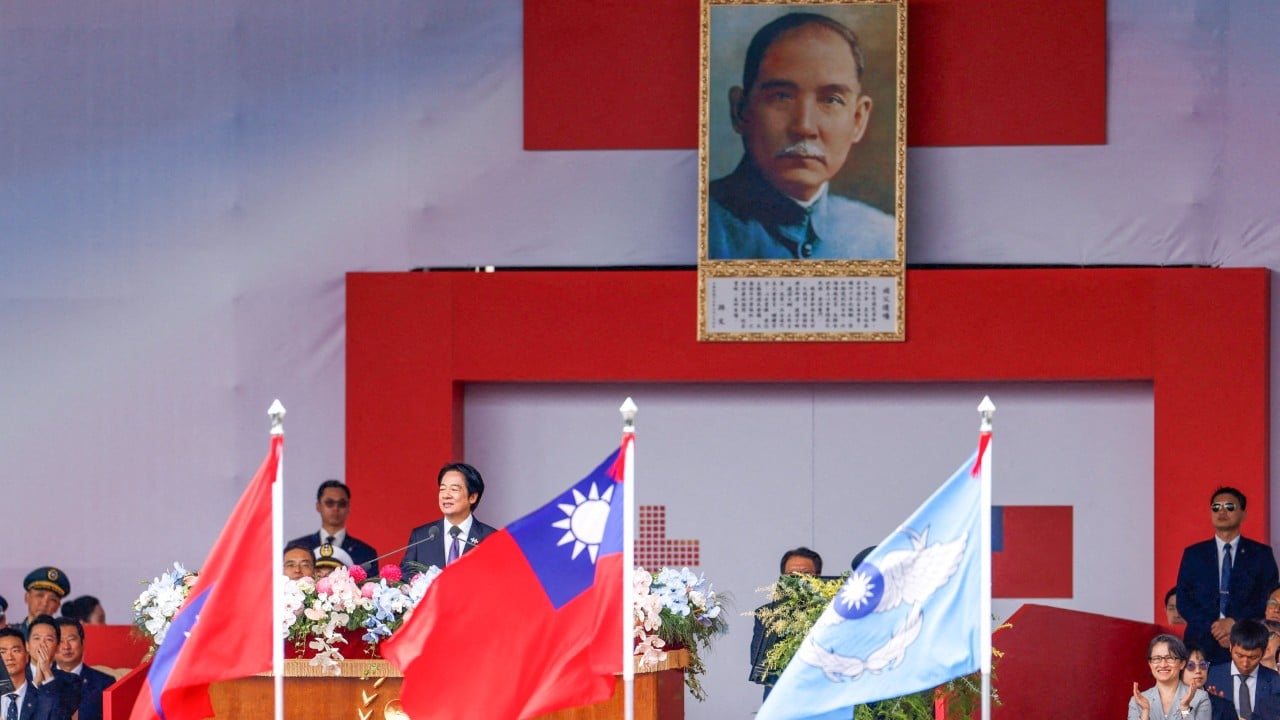
When Taiwan's Mainland Affairs Council (MAC) barred covered personnel from traveling to mainland China for official events marking the 160th birth anniversary of Sun Yat-sen, the move exposed a high-stakes contest over historical legitimacy rather than a routine border restriction. Standard wire coverage treats this clash as a tit-for-tat exchange: Taipei restricts travel, and Beijing condemns the Democratic Progressive Party (DPP) for betraying history. That framing misses the strategic architecture underneath. Both governments claim lineage from the 1911 revolution that ended imperial rule, yet each uses Sun Yat-sen to anchor mutually incompatible political orders.
A rigorous analysis requires separating known policy actions from analytical hypotheses, mapping the political incentives of both capitals, and evaluating the operational limits of travel restrictions in a contested information environment.
The Legitimacy Asymmetry Framework
Historical symbolism in cross-strait politics operates as an asymmetric contest over sovereignty and political genealogy. Sun Yat-sen occupies a unique position because both the Republic of China (ROC) constitution in Taiwan and the People's Republic of China (PRC) state narrative claim him as a foundational figure. Yet the two systems extract opposite political conclusions from the same biography.
Beijing frames Sun Yat-sen as a revolutionary patriot whose unfinished project of national rejuvenation and unification culminates under Chinese Communist Party (CCP) leadership. Commemorative ceremonies on the mainland—especially major milestone anniversaries—serve as state-managed stages where visiting Taiwanese officials, local leaders, or civic figures can be visually integrated into a narrative of one China and anti-independence unity.
Taipei views those same ceremonies as instruments of political influence rather than neutral cultural remembrance. In its October 2026 policy guidance, the MAC argued that Beijing's portrayal departs from historical accuracy and functions to advance unification narratives and united front work inside Taiwan. Restricting travel for designated personnel under existing cross-strait rules is Taipei's mechanism for denying Beijing staged legitimacy while signaling domestic political discipline.
The Four Pillars of Cross-Strait Symbolic Leverage
To understand why a commemorative anniversary triggers sharp diplomatic friction, evaluate the dispute across four operational pillars:
- Audience Signaling: Beijing directs ceremonial coverage both toward domestic audiences in mainland China and toward political factions in Taiwan, showing receptivity to figures who engage with mainland frameworks while isolating those who refuse.
- Institutional Gatekeeping: Taipei relies on administrative permit controls and statutory oversight—such as prior-permission requirements for designated categories of officials and public personnel—to raise the friction of participation without requiring sweeping new legislation for every event.
- Factional Wedge Dynamics: Travel bans do not affect all Taiwanese political actors equally. Opposition figures, local executives, and civic groups often hold different views on historical identity and cross-strait engagement than the ruling party, creating domestic friction over where state security ends and political speech begins.
- Narrative Framing: Each side contests the vocabulary of the dispute. Beijing characterizes restrictions as a denial of shared heritage and historical duty, while Taipei frames participation in state-run mainland ceremonies as echoing political narratives that erode ROC sovereignty and civic cohesion.
Known Facts Versus Educated Hypotheses
Separating confirmed policy mechanics from strategic inference prevents overreading ceremonial rhetoric.
Known facts include the MAC's October 2026 directive advising against attending or co-organizing mainland events for Sun Yat-sen's 160th birth anniversary, denying travel applications for covered personnel seeking to attend official ceremonies, and warning against echoing CCP narratives. It is also a matter of record that Beijing has historically used major Sun Yat-sen anniversaries—including the 150th anniversary a decade earlier—to deliver high-profile political speeches framing cross-strait relations.
Educated hypotheses center on why Taipei escalated from general warnings to an explicit administrative block at this specific juncture. One plausible hypothesis is that Taipei sought to preempt high-visibility attendance by local officials or opposition intermediaries that Beijing could amplify around a major milestone speech. A second hypothesis is that ruling-party strategists wanted to sharpen the boundary between democratic self-rule in Taiwan and CCP historical framing ahead of domestic political debates over national security and cross-strait exchange. Both hypotheses align with observable behavior, but neither can be proven from public statements alone.
Cause-and-Effect Chains Missed by Surface Coverage
Surface-level reporting often treats a travel ban and a sharp Beijing rebuttal as a closed loop. In practice, each move alters incentives downstream across three linked chains.
First, administrative travel denials create an visibility trade-off. Blocking officials or designated personnel prevents them from appearing on stage in Beijing, yet the ban itself generates news coverage that highlights the dispute over Sun Yat-sen's legacy. If Taipei's enforcement appears overly broad or politically selective, critics at home can argue the government is policing historical memory rather than protecting concrete security interests.
Second, restricting official or permitted travel shifts attention toward non-official and mediated channels. Even when formal delegations are blocked, commemorative themes travel through media broadcasts, academic exchanges, social platforms, and private or civic contacts. Controlling physical attendance does not automatically control how historical arguments circulate inside Taiwan.
Third, harsh rhetoric from Beijing carries a persuasion cost. Condemning Taipei for betraying history may rally domestic supporters on the mainland and appeal to pro-unification voices, but sharp pressure often reinforces skepticism among Taiwanese voters who view Beijing's historical commemorations as politically instrumental rather than inclusive.
Consider a practical example of how this plays out for a municipal official or cultural association invited to a mainland symposium. If an invitation arrives framed around Sun Yat-sen's legacy, the invitee faces a two-sided risk: attending without clear boundaries risks accusations at home of lending credibility to Beijing's political message, while declining or facing a permit rejection invites condemnation from Beijing as obstructionist. What looks like a simple travel decision becomes a loyalty test in two directions at once.
Operational Trade-Offs and Strategy Limitations
Managing cross-strait cultural and historical friction involves hard trade-offs with no silver bullet.
Tightening administrative restrictions improves containment over officials and sensitive personnel, reducing the risk that state-affiliated figures are used in political messaging. The limitation is diminishing marginal return: over-reliance on bans can strain administrative capacity, provoke pushback from travel or cultural sectors, and blur the line between genuine security risks and routine historical or academic interest.
Conversely, relying purely on public warnings preserves openness and credibility, avoiding accusations of heavy-handedness. The limitation is exposure: without enforceable rules for covered personnel, high-profile appearances can still be leveraged for political signaling.
For analysts and policymakers evaluating cross-strait friction around major anniversaries, the tactical sequence is straightforward:
- Audit the legal scope first. Distinguish clearly between personnel subject to statutory prior-approval rules and ordinary citizens or private actors, ensuring enforcement rests on clear legal criteria.
- Separate heritage from political conditionality. Articulate an affirmative account of historical figures and constitutional continuity rather than reacting solely to Beijing's framing.
- Track secondary channels. Monitor how commemorative themes are repackaged in media coverage and civic outreach after formal travel routes narrow.
- Calibrate messaging to domestic trust. Keep security rationales concrete and proportional so protective measures strengthen public resilience instead of fueling partisan polarization.
Strategic Play for Decision-Makers
Taipei should pair strict, transparent enforcement of statutory travel rules for covered personnel with a disciplined public communication strategy that keeps the focus on sovereignty, parity, and democratic accountability rather than trading slogans over historical ownership. Beijing will continue to treat major historical anniversaries as strategic platforms to project unity and pressure political rivals, so Taipei gains the most leverage when its restrictions are narrow, legally grounded, and paired with clear standards for what constitutes legitimate exchange versus political co-optation.
Taiwan's Mainland Affairs Council Bans Attendance at Sun Yat-sen Birth Anniversary Events
This video is relevant because it provides brief visual news coverage of Taipei's ban on attending mainland Sun Yat-sen birthday commemorations and Beijing's response.