The rain in England does not just fall. It clings. It dampens the wool of cheap suits, turns cardboard campaign signs into mush, and coats the windscreens of battle buses in a greasy, grey film.
Inside the bus, the air smells of stale black coffee, damp coats, and anxiety.
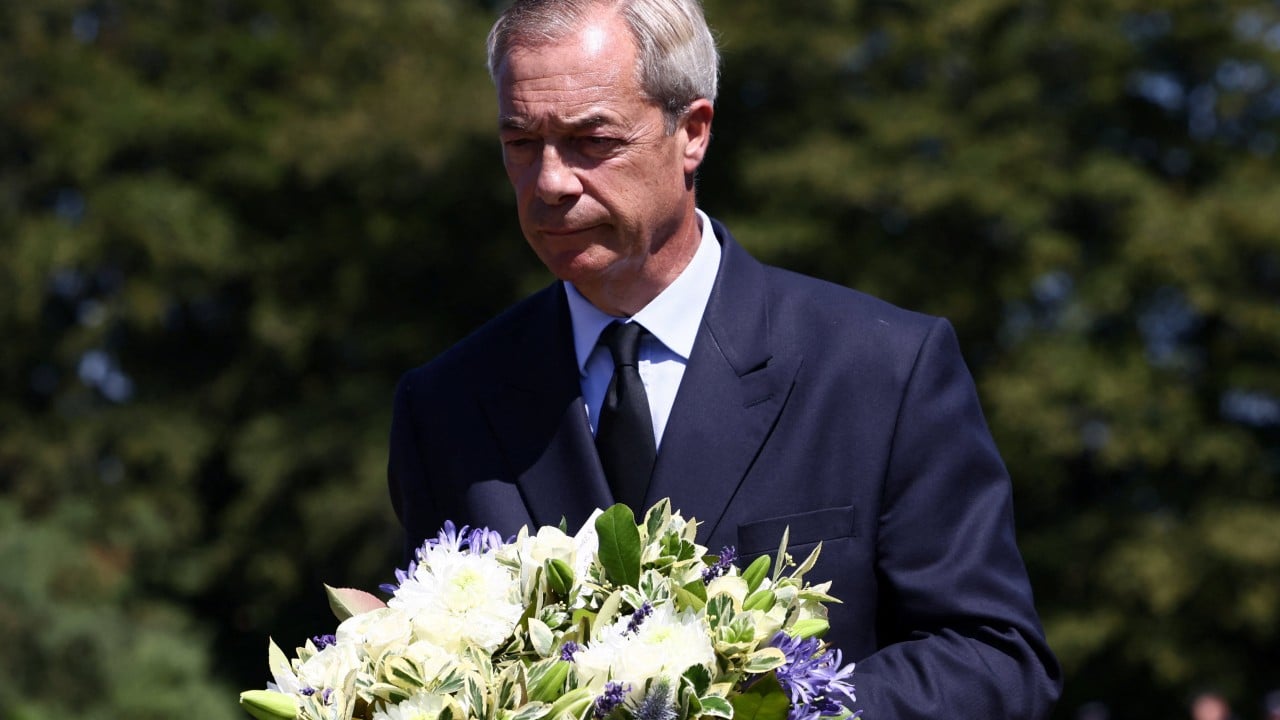
To the man at the center of the storm, this is home. Nigel Farage has spent decades breathing this air. He is a political showman who thrives on the physical, chaotic friction of the British electorate. He wants the shouting. He wants the flying milkshakes, the wet cement thrown from scaffolding, the finger-pointing, and the red-faced fury of the town square. For a populist, the crowd is the battery. You plug yourself in, and even the hatred gives you power.
But there is a point where the theater stops.
It stops when the threats lose their theatrical flair and take on the cold, heavy weight of lead.
On a quiet morning, far from the roaring crowds of Clacton-on-Sea, a different kind of silence fell over a police station. A notification had flashed. A line had been crossed. A man, sitting in a room somewhere in the United Kingdom, had decided that words were no longer enough. He had threatened to shoot the politician.
Not throw a drink. Not shout a slur.
Shoot.
Suddenly, the pantomime of the British campaign trail evaporated, leaving behind the stark, terrifying reality of a democracy teetering on a knife-edge.
The Ghost in the Room
Every politician standing on a soapbox in modern Britain walks with ghosts.
To understand why a digital threat triggers a massive, armed police response, you have to look at the scars on the nation’s body politic. The names are whispered like talismans of tragedy. Jo Cox, murdered on a pavement in Birstall. David Amess, stabbed to death in a Methodist church while meeting his constituents.
These were not abstract figures in a distant history book. They were people who went to work one morning and never came home.
Consider the security detail surrounding any major political figure today. They do not look at the flags or the supporters. They look at hands. They look at pockets. They watch the crowd’s eyes, scanning for the glassy, hyper-focused stare of someone who has moved past anger into obsession.
When the threat against Farage came in, it was not dismissed as online bluster. The police cannot afford the luxury of skepticism. In the post-Amess world, every threat is treated as an active countdown.
The machinery of the state moved with quiet, terrifying speed. There was no press conference initially, no grandstanding. Just the synchronized movement of detectives, digital forensics experts, and local officers tracing an IP address, mapping a location, and planning a raid.
A knock on a door. A sudden, violent disruption of a quiet morning. A suspect in handcuffs.
The arrest of a 25-year-old man on suspicion of sending threats to kill was announced with the usual flat, emotionless vocabulary of the police press release. But behind the jargon was a collective, national intake of breath.
The Chemistry of the Crowd
We have become accustomed to the division. We watch the television screens and see the shouting matches, the polarization, the digital tribes hurling abuse across the electronic void. It feels like a game. We log off, and the noise stops.
But the noise does not stop for those who live in the center of it.
Imagine standing on a stage in a drafty community center. The lights are hot, shining directly into your eyes, blinding you to the back of the room. You know there are hundreds of people out there. Most of them are cheering. Some are silent.
And then you remember the threat.
Every sudden movement in the crowd becomes a potential threat. A hand reaching into a coat pocket is no longer someone looking for their phone; it is a heart-stopping moment of suspense. The politician must smile, keep talking, project strength, and pretend that the sweat on their brow is just from the stage lights.
This is the psychological tax of modern public service. It is a tax paid not just by Farage, but by every candidate of every political stripe who dares to step off the screen and onto the street.
The threat to shoot Farage represents a deeper, more insidious decay. It is the belief that the ballot box is too slow, too compromised, or too ineffective, and that the only true arbiter of political change is violence. It is the ultimate rejection of the democratic contract.
We agree to disagree. We agree to vote. We agree to accept the result, even when it stings, because the alternative is chaos. When a gun enters the conversation, even hypothetically, the contract is torn to shreds.
The Click and the Consequence
It is easy to blame the internet. We talk about echo chambers and radicalization as if they are weather systems, things that happen to us without our consent.
But consider the path of the man who made the threat.
It starts with a feeling of impotence. A young man sits in a room, watching the news feed scroll by. He sees faces he dislikes, policies he hates, a world he feels is leaving him behind. He finds a community of like-minded souls online. They feed on each other’s anger, sharpening their words like knives.
The language escalates. What starts as disagreement becomes dehumanization. The politician is no longer an opponent; they are an existential enemy, a monster, a cancer.
Once you convince yourself of that, the leap to violence feels not just logical, but heroic.
"Someone should do something."
Then, the fingers hover over the keyboard. A few taps. A click. The message is sent into the ether.
Perhaps he thought it was shouting into a void. Perhaps he thought the anonymity of the screen would protect him like a shield. He forgot that the digital world leaves footprints as deep as boots in wet mud.
When the police arrived, the screen was likely still glowing. The transition from digital warrior to a scared young man in the back of a police van is brutally fast. The bravado melts away in the sterile light of a custody cell, replaced by the realization that a moment of keyboard rage has just derailed a life.
The Fragile Circle
Democracy is not a building. It is not the Palace of Westminster, with its gothic spires and green leather benches. It is a fragile circle of trust.
It is the belief that a politician can walk into a pub, buy a pint, and talk to a bricklayer without a bulletproof vest. It is the expectation that a candidate can stand on a high street, hand out leaflets, and debate a rival without needing a ring of armed officers to keep the peace.
Once we lose that, we lose everything.
If our leaders must hide behind bulletproof glass, if they must communicate only through curated video clips and pre-screened audiences, then the connection between the governor and the governed is broken forever. We are left with a political class that is distant, fearful, and insulated, and a public that is cynical, detached, and angry.
The arrest in Salisbury was a success for the police. A threat was neutralized. A tragedy was averted.
But it was also a warning.
As the campaign bus rolls on to the next town, and the rain continues to smear the glass, the crowds will still gather. The megaphones will still blare. But underneath the noise, there will be a new, quieter frequency.
Everyone on that stage, and everyone watching from the pavement, now knows the price of admission. The soapbox is no longer just a platform. It is a target.