Singapore has built its entire sovereign identity on a razor-thin ledge. For decades, the Southeast Asian city-state positioned itself as an indispensable broker between superpowers, balancing Western capital with Chinese supply chains while maintaining an independent voice. But as strategic competition between Washington and Beijing intensifies into an unyielding geopolitical rivalry, that balancing act is fracturing. Foreign Minister Vivian Balakrishnan’s assertion that Singapore must retain the sovereign right to say "no" to both the United States and China is not merely diplomatic posturing. It is a desperate defense mechanism for a microstate caught in the gravitational pull of two colliding giants.
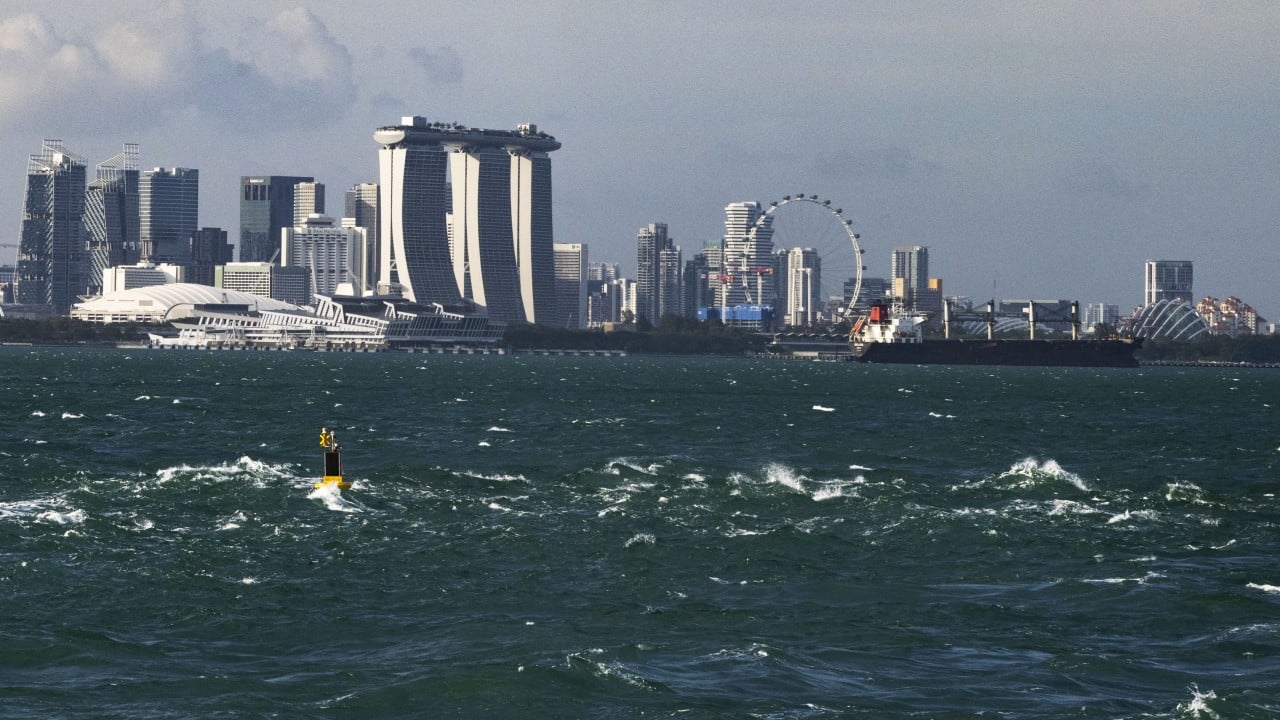
To understand why this stance matters, look past the polished communiqués of ASEAN summits and examine the structural reality of modern trade and security. Singapore sits astride the Strait of Malacca, a maritime chokepoint through which a staggering share of global commerce and energy supplies passes. This geographic accident made the island rich. It also made it a prime prize in a silent, protracted contest for regional hegemony.
Washington offers a security umbrella, intelligence-sharing, and deep financial integration. Beijing offers a massive consumer market, heavy infrastructure investments, and regional economic gravity. When both capitals demand alignment—explicitly or through economic coercion—saying "no" ceases to be a theoretical diplomatic exercise. It becomes an invitation for retaliatory trade restrictions, diplomatic freezes, or secondary sanctions.
The core vulnerability lies in the asymmetry of power. A superpower can absorb the friction of a broken trade deal or a recalcitrant ally. A nation of six million people, devoid of natural resources and reliant entirely on open global sea lanes and multilateral rules-based trade, cannot. When the rules-based order begins to fray, the middle powers and small states face a brutal choice: pick a master or build a shield of collective neutrality so dense that neither side can afford to shatter it.
Singapore’s strategy has historically relied on institutional multilateralism. By anchoring itself within the Association of Southeast Asian Nations and championing free trade agreements that bind major powers into shared economic frameworks, the island sought to dilute bilateral friction. If Beijing or Washington steps out of line, the censure comes from a chorus of nations, not a single vulnerable target.
Yet, that multilateral shield is cracking. ASEAN is chronically divided, split between mainland states tethered tightly to China’s economic orbit and maritime nations anxious about Beijing’s territorial assertions in the South China Sea. When consensus fails, individual states are exposed.
This is where the insistence on saying "no" takes on structural weight. If Singapore accepts a U.S. demand to ban certain technological infrastructure, it invites immediate economic retaliation from its largest trading partner, China. If it turns a blind eye to security concerns raised by Washington to appease Beijing, it risks eroding the foundational security partnerships that have guaranteed its defense since independence.
The diplomatic vocabulary of neutrality often sounds archaic in an era of zero-sum technological decoupling and supply chain nationalism. Semiconductors, artificial intelligence, and green energy are no longer neutral commodities; they are instruments of statecraft. When the United States implements sweeping export controls on advanced silicon and pressures allies to fall in line, neutrality becomes an expensive luxury. Singapore’s leaders understand that acquiescence to every external demand is a slow form of self-annihilation. Once a small state surrenders its independent judgment, it ceases to be a sovereign actor and becomes a vassal.
The real test for Singapore will not be whether it can issue bold statements of independence during international forums. The test will arrive in the quiet, closed-door negotiations where loans are approved, security clearances are granted, and port access is weighed against economic punishment. Preserving strategic autonomy requires an unyielding commitment to domestic resilience, economic diversification, and a refusal to internalize the paranoia of others. The cost of saying no is high, but the price of compliance is everything.