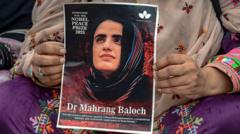
You don't expect a pediatric resident to become the biggest threat to a nuclear-armed state. But that's exactly what happened when Mahrang Baloch decided she'd had enough of the silence. For years, she was just another face in the crowd, holding up a faded photograph of her father. Today, she's writing from inside a cold cell in Hudda Prison, Quetta, facing the prospect of life behind bars. The crime? Speaking out against the systemic abduction of Baloch men by Pakistan's security agencies.
This isn't a story about random crime. It's about a state-sanctioned policy of enforced disappearances that has torn through Balochistan for decades. What makes the current moment different is the leadership. The men are gone, so the women have stepped into the vacuum. They aren't asking for political revolution. They're asking for bodies, DNA tests, and a basic adherence to the law. And for that, the state is treating them like terrorists.
The Cycle of Grief Passing Down Generations
To understand why a young doctor would risk a life sentence, you have to understand the specific flavor of trauma that defines childhood in Balochistan. Mahrang Baloch didn't grow up playing with toys. She grew up in the shadow of her father's first abduction in 2006, when she was only ten. He came back after three years, altered but alive, only to be snatched again seven months later.
In 2011, she received his body. It was riddled with bullet holes and bore the unmistakable marks of severe torture. This is the brutal template for thousands of families in the region.
The state relies on a dynamic of absolute fear. Security forces take men from their beds, from university classrooms, or off buses. Years pass without a word. Then, occasionally, a mutilated body turns up by the roadside, or a "fake encounter" is staged where detainees are killed in staged gunfights.
When the Baloch Yakjehti Committee (BYC) organized a massive march to Islamabad, it was driven by the murder of a young man named Balaach Mola Bakhsh. He had been seen alive in a court of law just days before security forces claimed he died in an armed ambush. The family refused to bury him. They sat with his corpse in the freezing cold for seven days, sparking a movement that finally crossed the borders of Balochistan and forced the rest of Pakistan to look.
Why Peaceful Words Terrify the Military
The Pakistani deep state knows how to deal with armed insurgents. It has helicopters, artillery, and a massive intelligence apparatus. What it doesn't know how to handle is a young woman with a microphone who explicitly renounces violence.
In her writings from prison, Mahrang noted that state security offered her a simple deal: shut up, stop the politics, and go home. She refused. The state's primary legal weapon against her isn't evidence of violence. It's sedition charges stemming from a press conference she gave following a train hijacking by militants. She didn't defend the hijackers. Instead, she tried to draw a clear line between those who pick up guns and those who use peaceful protest.
That distinction is exactly what the state wants to erase. By labeling peaceful human rights advocates as terrorists or foreign proxies, the military justifies its total control over the province. Balochistan is rich in natural resources, including natural gas and minerals, yet its population remains among the poorest in the country. The narrative of an eternal security crisis ensures that the military retains total authority over these resources without civilian oversight.
The Global Spotlight and the Backlash
The state's hostility toward these women intensified when the world started paying attention. Mahrang Baloch was featured on the BBC 100 Women list and even received a nomination for the Nobel Peace Prize. When she traveled to Norway at the invitation of PEN International, the Pakistani establishment reacted with fury. Upon her return, she was slapped with sedition charges.
International recognition is a double-edged sword in Pakistan. On one hand, it acts as a thin shield. It makes it harder for security agencies to simply make someone disappear forever without causing a major diplomatic incident. On the other hand, it triggers the deep-seated paranoia of the military elite, who view any foreign validation as proof of an international conspiracy to tear Pakistan apart.
When Mahrang tried to fly to New York to attend a Time magazine event, she was stopped at the Karachi airport without a valid legal reason. The message was clear: you can speak to the locals if you must, but we will not let you speak to the world.
How to Support the Fight Against Enforced Disappearances
If you want to move beyond passive observation and actually support the human rights movement in Balochistan, you need to target the mechanisms that allow these disappearances to continue with impunity.
- Pressure International Bodies: Amplify the reports of organizations like Amnesty International and Human Rights Watch. They consistently document these violations and push the UN Working Group on Enforced or Involuntary Disappearances to demand access to Pakistani detention centers.
- Challenge the Official Narrative: The Pakistani state relies heavily on digital censorship and state-controlled media to paint activists as violent separatists. Sharing direct testimonies from groups like the Baloch Yakjehti Committee on independent platforms helps break the information blockade.
- Demand Aid Conditionalities: International donors and democratic governments providing financial aid or military assistance to Pakistan must be pressured to tie that funding directly to human rights benchmarks, specifically the criminalization and cessation of enforced disappearances.
The struggle in Balochistan isn't going to end because a few leaders are locked up. A generation of children raised on the grief of missing parents has now come of age, and they've lost their fear of the state's prisons.