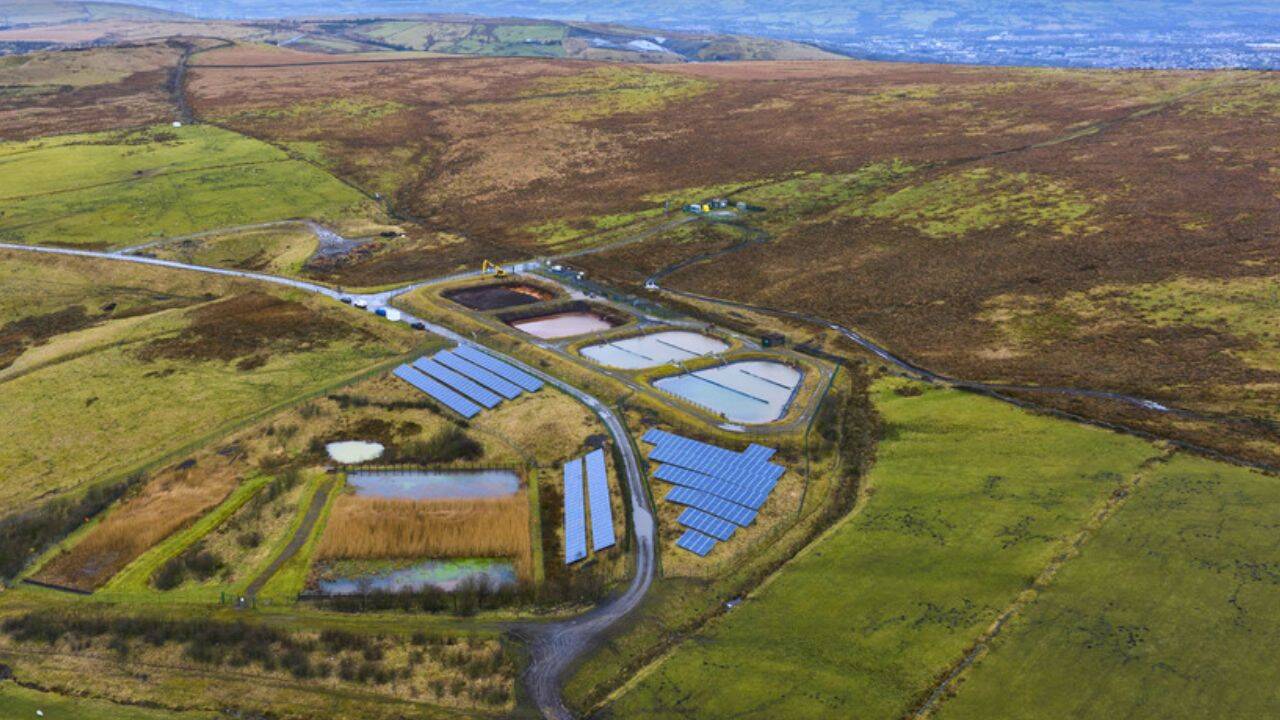
Industrial waste streams often represent a failure of process engineering, manifesting as mass that carries a negative net economic and environmental value. In the case of non-ferrous and coal extraction operations, acidic mine drainage introduces massive quantities of dissolved iron sulfates into local watersheds. Neutralization of these acidic effluents through the addition of alkaline reagents—such as hydrated lime, sodium hydroxide, or calcium carbonate—drives a rapid precipitation cascade. This reaction yields an amorphous, highly hydrated iron oxyhydroxide sludge universally designated as ochre.
The structural and economic liability of managing this sludge is severe. Millions of tonnes of high-moisture ochre accumulate in surface settling lagoons, requiring perpetual maintenance to prevent dam breaches or downstream heavy metal migration. However, physical-chemical characterization reveals that this material possesses unique pozzolative and stabilization attributes. Rather than treating ochre as a terminal disposal problem, industrial reuse frameworks position it as a structural reagent for heavy metal immobilization and geotechnical soil reinforcement.
The Mineralogical and Physical Profile of Mine Drainage Ochre
To evaluate the utility of ochre in soil stabilization, the material must be categorized through its constituent phases. Freshly precipitated ochre is rarely a pure chemical species; it is a complex heterogenous mixture dominated by ferrihydrite, goethite, and schwertmannite, intermixed with gypsum, trace aluminum precipitates, and co-precipitated trace elements including zinc, copper, lead, and arsenic.
The geotechnical behavior of raw ochre is governed by two limiting parameters: an extremely high initial water content and a high specific surface area. Freshly dredged sludge frequently exhibits moisture contents exceeding four hundred percent by dry weight. The particles are sub-micron in scale, resulting in low permeability and significant compressibility when unconfined.
[Acidic Mine Drainage]
       │
       ▼
[Alkaline Neutralization]
       │
       ▼
[Precipitation Cascade] ──> [Amorphous Ferrihydrite / Goethite (Ochre)]
                                   │
                                   ├── Geotechnical Binding (Pozzolanic Matrix)
                                   └── Chemical Fixation (Adsorption / Precipitation)
Direct application of raw sludge to structural subgrades is unfeasible due to volumetric instability upon drying and low shear strength. Stabilization requires pretreatment, typically thermal drying or mechanical dewatering followed by structural blending with secondary cementitious materials such as Portland cement, ground granulated blast furnace slag, or fly ash. When blended into fine-grained soils—such as expansive clays or silt matrices—the active iron oxides interact directly with clay mineral edge charges, while secondary pozzolanic reactions form stable calcium silicate hydrate and calcium ferrite crystal networks.
Mechanisms of Heavy Metal Immobilization in Contaminated Substrates
Contaminated soils frequently contain elevated baseline concentrations of metalloids and heavy metals that leach into groundwater under fluctuating redox conditions. Remediation strategies traditionally rely on pump-and-treat methodologies or soil excavation and landfill disposal, both of which incur prohibitive operational expenditures and introduce massive carbon footprints.
Ochre functions as an in-situ chemical stabilization matrix through three distinct mechanisms:
- Specific Surface Adsorption: The high surface area of microcrystalline goethite and ferrihydrite provides an extensive array of hydroxylated surface sites. Positively and negatively charged ionic species—particularly arsenate, chromate, nickel, and cadmium—form inner-sphere surface complexes with the iron oxide matrix. This changes the thermodynamic state of the contaminants, reducing their mobility and bioavailability by orders of magnitude.
- Co-Precipitation and Structural Incorporation: During the initial precipitation phase and subsequent curing within a soil matrix, heavy metal cations substitute into the growing iron oxide crystal lattice or become structurally occluded as the amorphous phases age into more stable crystalline goethite or hematite.
- Redox Buffering: The iron-rich matrix establishes a stable redox buffer within the soil pore water. By maintaining iron in oxidized ferric states, the material prevents the reductive dissolution of metal-bearing phases that typically occurs in water-logged environments, thereby suppressing contaminant mobilization during seasonal water table fluctuations.
Engineering Protocols for Subgrade Stabilization
Deploying industrial ochre as a geotechnical stabilizing agent demands strict adherence to engineering design thresholds. The integration process is executed through controlled mix-design optimization to avoid structural failure of the treated subgrade.
The primary operational constraint is moisture management. Because raw ochre retains structural water tightly, precise moisture-density relationships must be established via modified Proctor compaction tests. Exceeding the optimum moisture content during field mixing leads to trapped pore water pressure, reducing the unconfined compressive strength of the stabilized matrix.
+-----------------------------------+------------------------------------------+
| Parameter                         | Engineering Target / Threshold           |
+-----------------------------------+------------------------------------------+
| Initial Moisture Content (Raw)    | Reduce to < 15% via mechanical pressing  |
| Binder Ratio                      | 3% to 7% cementitious additive by mass   |
| Curing Period                     | Minimum 7 days at constant humidity      |
| Unconfined Compressive Strength   | Target > 1.2 MPa at 28 days              |
+-----------------------------------+------------------------------------------+
Mixing protocols dictate the use of industrial pugmills or in-situ stabilization rototillers to ensure homogenous distribution of the ochre-binder blend throughout the native soil column. Stratified pockets of untreated ochre create planes of weakness, resulting in localized shear failures under dynamic vehicle loads or structural foundations.
Economic and Environmental Cost Functions
The transition from a linear waste disposal model to a circular reuse framework alters the project economics of contaminated land remediation. Traditional soil stabilization relies heavily on commercial lime and Portland cement manufacturing, industries responsible for substantial greenhouse gas emissions. Substituting a fraction of these commercial binders with processed mining waste reduces the raw material acquisition cost while diverting industrial by-products from surface impoundments.
The logistical cost function is defined by the proximity of the mine water treatment facility to the contaminated remediation site. Because unrefined ochre exhibits high transport costs due to water weight, processing facilities must be located within a regional transport radius, or dewatering units must be integrated directly into the water treatment plant infrastructure.
[Traditional Linear Model]
Mine Drainage -> Treatment -> Sludge Production -> Perpetual Lagoon Storage (High Liability)

[Circular Reuse Framework]
Mine Drainage -> Treatment -> Dewatering & Blending -> Subgrade Stabilization / Brownfield Remediation (Asset Recovery)
Lifecycle assessments indicate that utilizing mineral by-products for heavy metal fixation cuts the carbon equivalent intensity of remediation projects by reducing the extraction and transport of virgin aggregates and primary chemical reagents. However, long-term monitoring must account for potential weathering effects. Changes in pH or extreme microbial reduction in the stabilized soil matrix could theoretically destabilize the iron oxide complexes, necessitating continuous leachate monitoring protocols during the first operational decade.
Scaling Pathways and Operational Implementation
Industrial adoption of mine water treatment by-product ochre as a stabilization reagent requires standardizing quality control metrics across variable mining outputs. Because the chemical composition of raw mine drainage fluctuates based on host rock mineralogy and seasonal hydrology, quality assurance programs must mandate batch-by-batch X-ray fluorescence and X-ray diffraction screening to detect undesirable sulfate concentrations or excess alkali levels that could compromise long-term structural integrity.
Engineering firms and regulatory bodies must establish standardized specifications for waste-derived construction materials. Transitioning this material from an experimental alternative to a specified civil engineering input requires updating regional highway authority manuals and brownfield remediation guidelines to explicitly permit the incorporation of treated industrial iron residues.
Project execution requires integrating the ochre supply chain directly with active civil works. Remediation contractors must establish supply agreements with industrial treatment plants to secure consistent, dewatered feedstock quantities. By aligning the output schedules of water treatment facilities with the seasonal demands of earthwork operations, heavy civil infrastructure projects can consume local waste streams at scale, permanently locking heavy metals into structural foundations while eliminating perpetual surface storage liabilities.