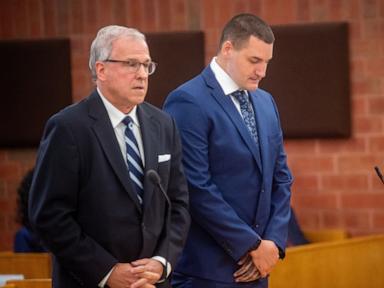
The courtroom hallway was packed, tense, and deeply divided. On one side stood a row of police officers and community members, lining up to hug a state trooper facing first-degree manslaughter charges. On the other side, a grieving family watched, feeling the sting of what they saw as a blatant display of institutional protection. This wasn't just another routine court appearance. It was a stark manifestation of the deep cultural divide in America’s legal system.
When Connecticut State Trooper Brian North walked into Derby Superior Court after the fatal shooting of Mubarak Soulemane, the scene captured something raw. Legal cases involving police officers rarely stay confined to the courtroom evidence. They become battlegrounds for public opinion, systemic trust, and emotional survival.
Understanding this case requires moving past the standard headlines. It demands a look at the actual legal thresholds, the tactical decisions made in a split second, and the long-term fallout for accountability.
The Reality of the Mubarak Soulemane Shooting
The facts of January 15, 2020, are heavy, rapid, and tragic. Mubarak Soulemane was a 19-year-old community college student battling schizophrenia. On that afternoon, his mental health spiraled. After an incident in Norwalk involving a knife, Soulemane allegedly carjacked a rideshare driver, taking off in a Hyundai Sonata down Interstate 95.
State police and local departments gave chase. The pursuit ended under a highway overpass in West Haven after Soulemane bumped into a civilian vehicle and got boxed in by police cruisers.
What happened next took less than a minute. Officers surrounded the car. One officer used a taser on the passenger side window, which was closed. Trooper Brian North stood on the driver's side. He saw Soulemane pull a kitchen knife. North fired his service weapon seven times through the closed driver's side window. Soulemane died at the scene.
The defense argued North acted to protect his fellow officers. They maintained that the threat of the knife was imminent. The prosecution countered that Soulemane was completely surrounded, boxed in a car with broken windows, and unable to harm anyone outside the vehicle at that exact moment.
The Legal High Wire of Manslaughter Charges for Police
Charging a police officer in Connecticut is incredibly rare. Convicting one is even harder. Under state law, and reinforced by federal precedent like the Supreme Court's Graham v. Connor ruling, an officer's use of force must be judged from the perspective of a reasonable officer on the scene. It explicitly rejects 20/20 hindsight.
This standard creates an uphill battle for prosecutors. They don't just have to prove that a different decision could have saved a life. They must prove that no reasonable officer would have fired those shots under those exact circumstances.
In this case, the Inspector General took over the investigation under a relatively new state mandate designed to ensure independence. The decision to charge North with first-degree manslaughter with a firearm signaled a shift in how the state evaluates police actions. The prosecution focused heavily on the lack of immediate danger. The officers were outside the car. The doors were closed. The suspect was contained.
The Power Dynamic in the Courtroom Hallway
The images of North hugging supporters before his arraignment went viral for a reason. To his supporters and fellow officers, the hugs represented solidarity. They saw an officer who made a split-second decision under intense pressure being criminalized for doing his job. They showed up in uniform and civilian clothes to send a message: we have your back.
To civil rights advocates and Soulemane’s family, those hugs looked like structural defiance. It felt like the system was rallying around its own, minimizing the loss of a young Black life.
This visual tug-of-war highlights a major flaw in how our society processes these events. We treat them as sports matches where you must choose a team. You're either entirely with law enforcement or entirely against them. This tribalism erodes the nuanced analysis required to actually fix systemic issues. It ignores the reality that an officer can be a dedicated public servant and still make a criminal error in judgment.
Tactical Errors and the Mental Health Crisis
The criminal justice system is designed to determine guilt or innocence, not to fix broken systems. Even if a jury finds an officer's actions legally justified, it doesn't mean the outcome was good or inevitable.
The Soulemane case exposes a massive gap in how law enforcement handles high-speed pursuits involving individuals experiencing severe mental health crises.
- Containment vs. Escalation: When a suspect is boxed in and cannot escape, the immediate tactical goal should shift to de-escalation and time-buying. Smashing windows and using tasers often escalates panic, especially for someone in a schizophrenic episode.
- The Weapon Barrier: A knife is a deadly weapon, but its lethality depends entirely on distance and barriers. A knife inside a locked or blocked car presents a radically different threat level than a knife in an open space.
- The Absence of Mental Health Professionals: Police officers are forced to act as psychiatric evaluators, social workers, and tactical operators all at once. It rarely works out well.
True progress means changing policies so these confrontations don't happen in the first place. It means stricter pursuit policies and real, heavily funded mental health crisis response teams that can co-respond to high-stress calls.
What Follows a High-Profile Police Trial
When the cameras leave and the verdicts are read, communities are left to pick up the pieces. If you want to see real change in your local area, waiting for a national headline is too late. Accountability happens in the mundane details of local governance.
Start by looking at your town or city's police pursuit policy. These documents dictate when an officer must back off. High-speed chases are incredibly dangerous for the public, the officers, and the suspects. Many progressive departments now forbid chases unless a violent felony has occurred.
Next, track how your local budget allocates funds for crisis intervention teams. Check if your police department mandates annual de-escalation training that goes beyond mere check-the-box slideshows. True accountability is built on transparent policies and proactive training, long before a weapon is ever drawn from its holster. Focus on those local policies, attend city council meetings, and demand clarity on use-of-force guidelines. That is where the real work begins.