Political leaders in Israel and Washington love a clean villain. Every time violence erupts in the West Bank, opposition figures like Yair Lapid or Benny Gantz step up to a microphone, denounce "Jewish terrorism," and demand that the government rein in "rogue extremists."
The international press eats it up. Headlines frame the crisis as a battle between rational Israeli moderates and a fringe cabal of radical hilltop youth. Meanwhile, you can explore related stories here: What Swimming the Strait of Hormuz Actually Proves About War and Our Oceans.
That framing is comforting. It is also completely wrong.
Treating West Bank settler violence as a localized policing failure—or a purely moral aberration by fringe actors—obscures the structural reality on the ground. According to analyses from organizations like the International Crisis Group and Israeli human rights monitors such as Yesh Din, the surge in attacks on Palestinian villages is not an isolated breakdown of law and order. It is the predictable output of a decades-old administrative, legal, and military architecture that blurs the line between state authority and civilian vigilantes. To explore the complete picture, check out the detailed article by Reuters.
When opposition politicians condemn "Jewish terrorism" while leaving the underlying institutional mechanisms unexamined, they aren't solving the problem. They are performing political theater that reinforces the status quo.
The Illusion of the "Fringe" Actor
To understand why standard political condemnations fail, look at how mainstream media and opposition leaders define the perpetrators. The standard narrative relies on a comforting binary: there is the legitimate state apparatus on one side, and a handful of lawless extremists on the other.
Security analysts and legal scholars who have spent years documenting the West Bank point out that this separation simply does not exist in practice.
- Institutional integration: Many of the individuals leading unauthorized outpost expansions are no longer outsiders operating against the state. Following the 2022 Israeli coalition agreements, key figures from the ultranationalist religious Zionist movement were handed direct administrative control over civil affairs in Area C of the West Bank, including authority over planning, enforcement, and land allocation.
- Military overlap: Following the outbreak of war in October 2023, the Israel Defense Forces (IDF) drafted thousands of West Bank settlers into regional defense battalions. Human rights organizations, including B'Tselem, have documented multiple incidents where armed settlers wearing IDF uniforms—or operating alongside active-duty soldiers—participated in expelling Palestinian herding communities.
- Impunity by design: Data compiled by Yesh Din over nearly two decades shows that more than 90 percent of Israeli police investigations into ideologically motivated crimes against Palestinians in the West Bank are closed without an indictment.
Calling this "fringe extremism" ignores the documented integration of these actors into the state's security and bureaucratic machinery. You cannot arrest your way out of a policy framework.
Why Sanctions and Soundbites Change Nothing
In early 2024, the United States, the United Kingdom, and the European Union began imposing targeted financial and visa sanctions on specific violent settlers and unauthorized outposts. Pundits hailed this as a watershed moment—a decisive blow against impunity.
On the ground, the trajectory of displacement barely flinched.
According to the United Nations Office for the Coordination of Humanitarian Affairs (OCHA), hundreds of settler attacks occurred in the months following the initial sanctions packages, leading to the forcible transfer of dozens of Palestinian pastoral communities. Why did Western sanctions fail to deter the behavior?
Because sanctions target symptoms while subsidizing the ecosystem.
Individual extremists do not fund road networks, water infrastructure, electricity grids, or military protection for illegal outposts out of their own checking accounts. Those resources flow through municipal councils, state-backed settlement divisions, and government ministries. Freezing the personal bank account of a single outpost leader does nothing when the regional council continues to receive state budgets to pave access roads to that very hill.
Similarly, when a rival to Prime Minister Benjamin Netanyahu denounces settler violence in the Knesset, the speech generates international applause without altering a single rule of engagement for the soldiers stationed at West Bank checkpoints.
The Legal Architecture of Dual Rule
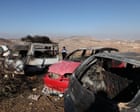
Most coverage of the West Bank focuses on the immediate clash—the burned olive groves, the damaged vehicles, the clashes between villagers and settlers. By zooming in on the violence, commentators miss the mundane legal machinery that makes the violence structural.
In Area C—which constitutes roughly 60 percent of the West Bank and contains the vast majority of its agricultural land and water resources—two distinct legal systems operate simultaneously on the exact same territory.
- Israeli civil law applies personally to Israeli citizens living in settlements. They vote in Israeli national elections, enjoy full constitutional protections, and are tried in civilian courts.
- Israeli military law applies to Palestinians living in the exact same geographic space. They are subject to military decrees, tried in military courts with conviction rates exceeding 99 percent, and face near-total freezes on building permits from the Civil Administration.
Legal scholars, including former Israeli Attorney General Michael Ben-Yair and researchers at the Association for Civil Rights in Israel (ACRI), have noted that this dual-system structure inevitably creates an asymmetric enforcement environment. When a Palestinian farmer builds a cistern without a permit, the state possesses swift administrative demolition powers. When an Israeli settler establishes an unauthorized herding outpost on state or private Palestinian land, the state routinely delays demolition orders for years, often retroactively legalizing the outpost instead.
Violence thrives in the vacuum created by unequal law. When one population sees that aggressive land seizure is routinely rewarded with retroactive state recognition and military protection, aggression ceases to be irrational. It becomes a proven real estate strategy.
What the "Security First" Argument Gets Wrong
Defenders of the current West Bank posture—including many center-right Israeli politicians who criticize overt settler violence—often argue that a heavy civilian presence in the hills is essential for Israel's eastern border security. The theory is simple: settlements act as a buffer zone and provide intelligence depth.
Even former top Israeli defense officials dispute this premise.
Organizations like Commanders for Israel's Security, a coalition of hundreds of retired IDF generals, Mossad directors, and Shin Bet heads, have repeatedly argued that unchecked settlement expansion and settler violence actively degrade national security. Their reasoning is purely operational:
- Troop diversion: Guarding dozens of isolated hilltop outposts requires pinning down elite infantry battalions that would otherwise be training for high-intensity warfare or securing recognized borders. Prior to October 7, 2023, massive numbers of IDF troops had been redeployed from the Gaza border to the West Bank to manage friction caused by settlement expansion and nationalist marches.
- Radicalization: Every unpunished attack on a Palestinian village acts as a recruitment engine for militant groups in Jenin, Nablus, and Tulkarm. Shin Bet chiefs have repeatedly warned the Israeli cabinet—warnings leaked to the Israeli press—that nationalist Jewish violence fuels Palestinian terror attacks, creating a self-sustaining cycle of escalation.
- Diplomatic erosion: Ongoing impunity in the West Bank threatens Israel's intelligence-sharing agreements, arms transfers, and normalization prospects with neighboring Arab states, particularly Jordan, which views forced displacement in the West Bank as an existential threat to its own domestic stability.
The people claiming to protect Israel by expanding control over every hilltop are, according to Israel's own former security establishment, stretching the military thin and igniting a third front.
The Questions Nobody Wants to Ask
When public debate centers on whether a politician used the phrase "Jewish terrorism," the conversation stays safely within the bounds of rhetoric. To move beyond empty condemnation, observers and policymakers have to confront the actual mechanics driving the conflict.
Does the Israeli military actually have the mandate to stop settler violence?
In theory, yes. In practice, IDF soldiers in the West Bank operate under blurred chains of command and intense political pressure. Soldiers who intervene forcefully against violent settlers frequently face backlash from ultranationalist cabinet ministers and right-wing media outlets. Consequently, human rights monitors routinely document soldiers standing by during attacks or firing tear gas at the Palestinian residents attempting to defend their property rather than at the attackers.
Can the Palestinian Authority (PA) protect its own citizens?
No. Under the Oslo Accords framework, Palestinian security forces are barred from operating in Area C and require Israeli coordination even to move between Area A enclaves. When settlers attack villages in Area B or C, PA police have zero legal or operational capacity to intervene. Residents are left entirely defenseless, caught between armed civilians and an army that views the Palestinian population primarily as a security threat.
Is this just a product of the current right-wing government?
While the current coalition has accelerated outpost legalization and dismantled bureaucratic checks, the underlying trend spans decades and crosses party lines. Successive Israeli governments—left, center, and right—expanded settlement infrastructure, maintained the dual legal regime in Area C, and failed to prosecute civilian violence against Palestinians. Blaming everything on one prime minister or one extremist minister erases fifty years of institutional continuity.
The Uncomfortable Reality of Accountability
Genuine disruption of this cycle requires measures that virtually no mainstream Israeli politician is willing to endorse, and that Western allies are hesitant to enforce.
Condemnations cost nothing. Even targeted sanctions on a dozen individuals remain largely symbolic. Real accountability would require conditioning military and economic support on verifiable structural changes:
- Dismantling the dual legal system in Area C and applying uniform criminal enforcement regardless of nationality.
- Freezing state funding and municipal infrastructure budgets for any regional council that supports unauthorized outposts.
- Prosecuting not just the teenagers throwing stones on the hilltops, but the officials and commanders who facilitate, fund, or ignore the attacks.
Of course, any Israeli leader who attempts to dismantle the settlement enterprise's administrative protections faces immediate political suicide—and potentially severe civil unrest from a well-armed, ideologically committed constituency. That political reality is precisely why opposition rivals stick to carefully worded condemnations of "terrorism" while avoiding the structural questions of land, law, and sovereignty.
Until the incentives on the ground change, the cycle will continue exactly as it has for decades. Politicians will condemn the violence, reporters will file the stories, and the map of the West Bank will keep shifting one hill at a time.