The morning air in the Philippines does not circulate; it clings. It carries the sharp, metallic tang of exhaust mixed with roasting coffee and, if you are near a construction site, the powdery, chemical bite of drying cement.
At 8:00 AM, a skeleton of steel and gray mud looks like progress. It looks like investment. To the men tying rebar on the seventh floor, it looks like a paycheck.
Then, the world loses its footing.
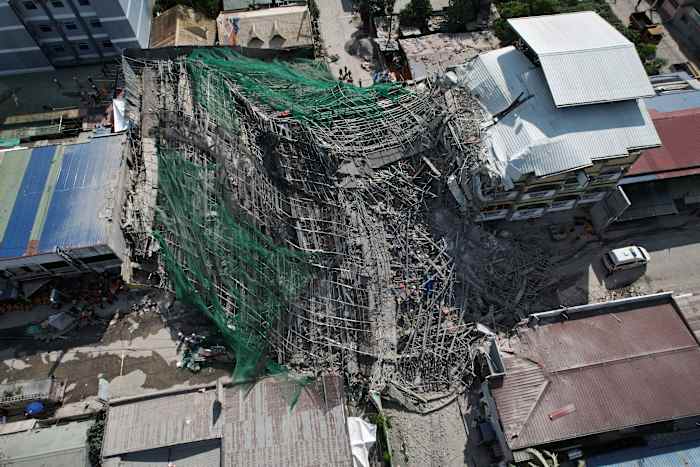
It does not happen like it does in the movies. There is no slow-motion tilt, no cinematic groan of metal giving warning. There is only a sudden, catastrophic roar that sounds like thunder swallowed by the earth. A nine-story building under construction does not merely fall over; it pancaked. Floor nine crushed floor eight, which obliterated floor seven, cascading down in less than four seconds until nine stories of human ambition became a three-story heap of jagged gray teeth.
When the dust settled, the silence was absolute. Then came the screaming.
Twenty-one people are gone. They are not dead, not officially. They are "missing," a clinical word that masks a horrific reality. They are trapped somewhere in the dark spaces between failed concrete slabs, suffocating under the weight of a system that valued speed over structural integrity.
The Anatomy of an Unnatural Disaster
To understand why a building falls, you have to understand what holds it up. It is a delicate dance between two materials that hate each other but need each other: concrete and steel.
Think of concrete as a stubborn old man. It possesses incredible compressive strength. You can stack tons of weight on top of it, and it will not flinch. But pull it from the sides, or twist it, and it snaps like dry chalk. That is tensile strength, or rather, the lack of it.
To fix this, engineers weave a skeleton of steel rebar through the liquid stone. Steel loves tension. It bends, it stretches, it absorbs the earth's shifts. When a building stands tall, it is because the steel is quietly saving the concrete from its own brittle nature.
But that synergy requires honesty.
When a developer cuts corners, the first thing to thin out is the steel. They use grade-40 rebar instead of grade-60. They space the stirrups—the steel loops that keep columns from bursting outward—too far apart. To the untrained eye, the building looks identical. It looks robust. But on a molecular level, it is a ticking time bomb.
Consider a hypothetical worker named Jun. He is thirty-two, has three kids in the province, and possesses hands calloused by a decade of mixing mortar. Jun does not know the exact chemical formulation of the concrete pouring from the chute. He does not know if the contractor watered down the mix to make it stretch across another fifty square meters. He assumes the engineers did their math. He trusts the blueprint.
Jun goes to work on a Tuesday. By noon, he is buried under twelve million pounds of rubble.
The tragedy is that concrete leaves clues before it kills. It cracks. It spalls, shedding its outer skin like a snake. But in the rush of a booming metropolis, where deadlines dictate bonuses and delays mean ruin, those clues are treated as cosmetic nuisances. They are slapped with a coat of gray plaster and forgotten.
The Illusion of Safety in the Tropical Sky
This is not an isolated failure of engineering. It is a failure of oversight.
In rapidly developing nations, cities grow faster than the laws meant to govern them. The skyline rises at a breakneck pace, driven by a desperate need for residential high-rises and commercial hubs. But beneath the shiny glass facades lies a regulatory wilderness.
Inspectors are few. Construction projects are many. It is an open secret in the trade that a well-placed envelope or a familial connection can fast-track an occupancy permit without a single stress test being performed on the columns.
We see the statistics later. We read the dry copy in the morning papers: 21 missing, investigation pending, developer promises full cooperation.
But what does cooperation mean to the families sitting on plastic chairs just outside the yellow police tape? They watch the heavy excavators claw at the debris with agonizing slowness. Every bucket of shattered stone removed is a terrifying gamble. If they move a piece of rebar too quickly, the entire unstable mountain could shift again, crushing anyone still breathing in the pockets of air below.
The human body is resilient, but it has limits. Without water, in the stifling heat of a tropical ruin, the clock ticks with brutal clarity. The air inside a collapsed building turns into an oven. Dust fills the lungs. Dehydration sets in within forty-eight hours.
The rescuers know this. They work in shifts, their faces masked against the dust, using acoustic sensors to listen for the faint, rhythmic tapping of a pipe.
Tap. Tap. Tap.
Every time a machine shuts down for a "listening period," a heavy, suffocating silence blankets the crowd. Hundreds of people hold their breath, praying for a sound from the grave. Most of the time, there is nothing but the hum of the city continuing just three blocks away.
The Hidden Cost of the Lowest Bid
Why does this keep happening?
The answer lies in the economics of the lowest bid. When a project goes to tender, developers often choose the contractor who promises the impossible: the lowest cost in the shortest timeframe.
But physics does not care about profit margins.
Concrete takes twenty-eight days to reach its full design strength. That is a non-negotiable law of chemistry. You can add accelerants, you can use high-early mixes, but you cannot bypass the fundamental nature of hydration—the chemical reaction between water and cement that turns liquid into stone.
When a contractor rushes to pour the next floor before the one below it has fully cured, they are stacking weight on a weak foundation. It is the architectural equivalent of building a house of cards on a vibrating table. The structure might hold for a week, a month, or a year. But eventually, the load exceeds the capacity.
The collapse is instantaneous.
The real problem lies in the anonymity of the blame. When the dust clears, the developer blames the contractor. The contractor blames the subcontractor. The subcontractor blames the material supplier. The paper trail dissolves into a labyrinth of shell companies and shifting liabilities.
Meanwhile, the twenty-one families are left with nothing but a name on a casualty list and a hole in their lives that no corporate settlement can ever fill.
We look at modern skyscrapers and see triumphs of human ingenuity. We marvel at the glass needles piercing the clouds. But we rarely think about the thousands of tons of gray matter holding them up, or the men who poured it in the heat of the sun.
The disaster in the Philippines is a grim reminder that every structure we enter is an act of faith. We trust that the floor will hold. We trust that the pillars are solid. We trust that someone, somewhere, valued human life more than a five percent reduction in material costs.
As the sun sets over the ruins of the nine-story building, the floodlights click on, casting long, skeletal shadows across the wreckage. The excavators continue their slow, mechanical dance. The families refuse to leave. They sit, wrapped in cheap blankets, staring at the mountain of gray dust, waiting for a miracle that becomes less likely with every tick of the clock.
A single red shoe lies on the edge of the perimeter, covered in a fine layer of white powder, completely still.