The steel rods were supposed to hold up a god. Instead, they are rusting in the monsoon rain of Gaibandha, a district in northern Bangladesh where the soil stays damp and the air smells eternally of river silt.
For months, Haridas Chandra Tarani Das watched those rods rise. He had envisioned an 81-foot-high statue of Lord Ram anchoring the skyline of Palashbari. To the local Hindu community, it was not merely an architectural ambition; it was a physical manifestation of permanence in a homeland that often felt increasingly precarious. Alongside it, the blueprinted outlines of a 50-foot Krishna and a 30-foot Shiva promised an sanctuary of stone and faith.
Then came the bulldozer threats from local pulpits. Then came the boots on the sacred imagery. Finally, the cold click of handcuffs.
When the Criminal Investigation Department intercepted Haridas in the Uttara sector of Dhaka, they did not charge him with blasphemy or building without a permit. The state chose a far more clinical weapon. Money laundering. They alleged suspicious transactions totaling Tk 9.35 crore, wrapping a highly volatile religious dispute in the dry, unassailable language of financial crime.
But on the streets of Dhaka, nobody is talking about bank ledgers.
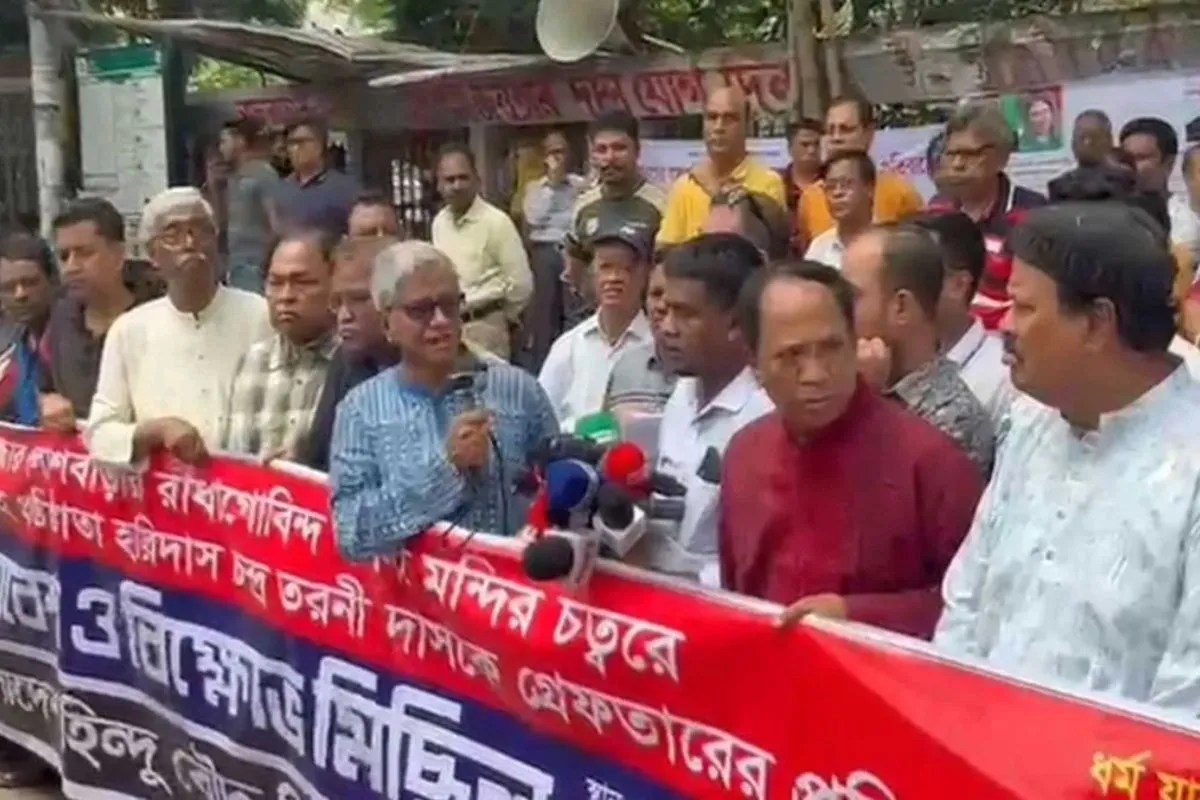
The anger boiled over outside the National Press Club. It did not start as a roar, but as the rhythmic, metallic scrape of thousands of feet moving in unison. By Friday evening, the Shahbagh intersection—the traditional lungs of Dhaka’s political dissent—was choked with smoke and a distinct, heavy heat.
Imagine standing in that crowd. The air thick with the smell of kerosene from hundreds of bobbing torches. The orange glow catches the sweat on the foreheads of young university students, their voices hoarse, chanting names that the state would rather keep confined to a judicial docket. This is not an abstract debate about minority rights or constitutional secularism. It is the raw, visceral panic of a community that feels its boundaries shrinking by the centimeter.
Manindra Kumar Nath, a veteran leader of the Bangladesh Hindu-Buddhist-Christian Unity Council, stood amidst the swelling tide, his voice strained but carrying over the static of police megaphones. He knew, as everyone in the square knew, the terrifying efficiency of a financial charge in a fractured legal system. When a minority citizen is accused of hurting sentiments, the international community watches for signs of state-sponsored bigotry. But when the charge is money laundering, the world looks away, assuming it is just another case of white-collar corruption.
It is a subtle, lethal strategy.
Consider the arithmetic of fear that governs the daily lives of these families. The collective memory of the community is fragile, punctuated by moments like the sudden disappearance of historical shrines or the quiet relocation of festival idols under the cover of darkness. Every time a temple wall is compromised or a young leader is detained, the calculus changes for the families living in the rural provinces. They look at their children, look at their ancestral plots, and wonder if the horizon is telling them to leave.
The leaders on the makeshift podium outside the Press Club did not mince words. They delivered a 72-hour ultimatum to the transitional administration. The language was stark, stripped of the usual diplomatic pleasantries that minoritarian bodies use to appease the ruling elite.
"Under whose direction, whose instructions, and whose intervention was such a devotee arrested?" demanded Subrata Chowdhury, his finger pointed toward the government secretariat. He was targeting the invisible bureaucracy, the deep-state apparatus that often operates independent of whoever happens to hold the prime ministerial seal in Dhaka.
The ultimatum has now expired. The silence from the administrative blocks is heavy.
But the real problem lies elsewhere. The danger of targeting figures like Haridas is that it creates a vacuum where moderate voices used to exist. When the state uses its heaviest machinery to crush an architectural dream, it signals to the radical fringes that the season of open season has begun. Across the border, New Delhi watches with an anxious, official eye, issuing cautious statements about the preservation of religious symbols and the safety of the vulnerable. But statements do not clean the mud off desecrated shrines, nor do they pull a construction worker out of a central jail cell.
The torches have burned down to charcoal stubs on the asphalt of Shahbagh. The protesters have dispersed into the humid Dhaka night, back to their rented rooms and student dormitories, leaving behind the faint smell of burnt fuel.
But back in Gaibandha, the unbuilt god still waits in the rain. The empty scaffolding stands against the gray sky like an unfinished sentence, a monument not to divine majesty, but to the fragile, fracturing peace of a nation wrestling with its own soul.