The dust in La Playa does not settle. It hangs in the thick, salt-heavy air of coastal Colombia, tasting of dry earth, diesel exhaust, and the nearby Magdalena River. If you walk those unpaved roads at noon, the heat presses against your chest like a physical weight, blurring the horizon where tin roofs meet the Caribbean glare.
For decades, a child born in this neighborhood—a district on the fringes of Barranquilla—inherited a script written long before they took their first breath. The ink was poverty. The margins were defined by displacement, violence, and the quiet, suffocating absence of a desk to sit at.
Most celebrity charity is a performance. We have all seen the glossy press releases, the staged photo ops where a pop star in immaculate linen holds a smiling toddler for forty-five seconds before boarding a private jet back to Los Angeles or London. You feel a brief, warm rush of secondhand virtue, and then nothing changes. The cameras pack up. The dust returns. The systemic rot remains untouched beneath a fresh coat of donated paint.
I used to believe all famous philanthropy was fundamentally hollow, a tax-deductible vanity project designed to polish a public image. I watched millions of dollars evaporate into administrative bloat across Latin America, leaving behind rusted playground equipment and empty promises. I was cynical because the evidence demanded cynicism.
Then I looked closely at what happened when an eighteen-year-old girl from Barranquilla decided she wasn't going to write a check and walk away.
The Architecture of a Different Kind of Bet
In 1995, Shakira Isabel Mebarak Ripoll had just released Pies Descalzos—Bare Feet—the album that turned her from a local curiosity into a continental phenomenon. She was barely an adult, swimming in her first real wave of fame and money. The easy move, the expected move, would have been to buy a mansion in Miami and occasionally auction off a guitar for charity.
Instead, she named a foundation after the album and went back to the mud.
To understand the scale of what followed, you have to strip away the stadium lights, the Super Bowl halftime shows, and the tabloid headlines. Look only at the numbers, because cold math is the hardest thing to fake. Over nearly three decades, the Pies Descalzos Foundation has directly impacted more than 224,000 children across Colombia. It has built nine sprawling, state-of-the-art public schools in some of the country’s most marginalized, conflict-scarred regions—from Barranquilla and Cartagena to Quibdó and Tibú.
Stop. Read that number again.
Two hundred and twenty-four thousand. That is not a crowd at a concert. That is a mid-sized city of human beings whose trajectories were violently yanked away from generational poverty.
Consider a hypothetical boy—let’s call him Mateo—growing up in Quibdó, the capital of Chocó, a region battered by torrential rain, state neglect, and armed conflict. In a typical scenario without intervention, Mateo’s story follows a predictable, tragic arc. His local school lacks a roof that stops the monsoon rains. There are no books. His mother, displaced from a rural farm by guerrilla violence, works fourteen hours a day selling fruit on the street, leaving Mateo unsupervised. By age thirteen, the local armed groups offer him something the state never did: a sense of belonging, a uniform, and cash. Education isn't a pathway out; it’s a broken bridge.
Now, drop a Pies Descalzos mega-school into Mateo’s neighborhood.
Everything changes, and not just because there is concrete where there used to be mud. The foundation operates on a philosophy that most Western donors completely misunderstand: you cannot educate a starving, traumatized child, and you cannot save a child if you abandon their community.
Why Concrete and Calories Matter More Than Inspiration
When you walk through the Institución Educativa Distrital Pies Descalzos in Barranquilla, the first thing that strikes you isn't a poster of Shakira. In fact, her face is conspicuously absent. What hits you is the sheer, unapologetic dignity of the architecture.
Designed by renowned architect Giancarlo Mazzanti, the building looks like a sleek, futuristic cultural center—the kind of place wealthy parents in Bogotá or New York would pay fifty thousand dollars a year to send their kids to. It features airy, ventilated classrooms built to survive the brutal coastal heat without expensive air conditioning, sprawling libraries, science laboratories, music rooms, and sports facilities.
Why spend money on award-winning architecture for kids who don't even have paved streets at home?
Because poverty is psychological as much as it is economic. When a society gives poor children crumbling, prison-like boxes to learn in, it sends an unmistakable message: You are an afterthought. Expect less. When you give them beauty, space, and light, the message flips entirely. It tells a child that their mind is worth a cathedral.
But bricks and mortar are only the shell. Think of a school like a high-performance engine; without fuel and maintenance, the finest engineering on earth is just heavy metal. In impoverished communities, the fuel is nutrition and stability.
For thousands of students in these schools, the breakfast and lunch served in the cafeteria are the only guaranteed meals they will eat all day. If a nine-year-old hasn't eaten since yesterday afternoon, asking her to focus on fractions is an act of cruelty. Her brain is in survival mode, burning its own reserves just to stay awake. By integrating comprehensive nutrition programs directly into the school day, the foundation removes the biological barrier to learning before the first bell even rings.
And when the last bell rings at three in the afternoon, the gates don't lock.
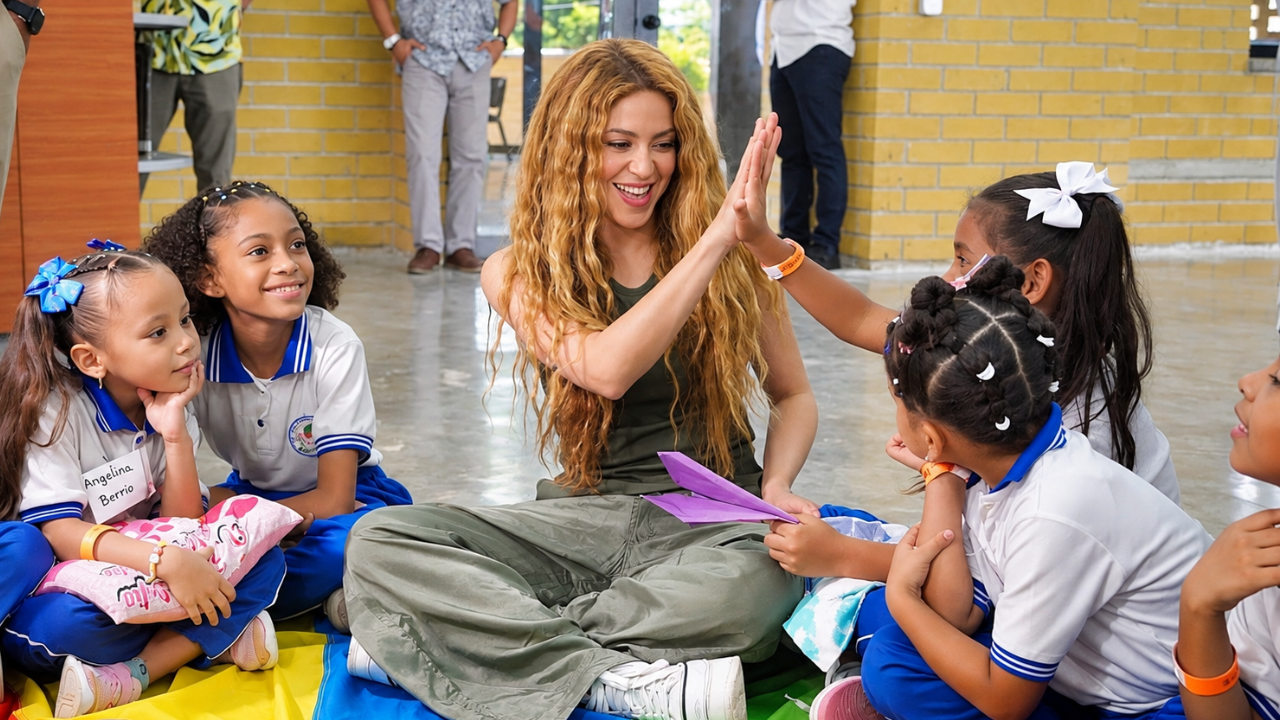
In most vulnerable neighborhoods, the hours between 3:00 PM and 7:00 PM are the danger zone. Parents are still at work. The streets are wide open. Pies Descalzos turns its campuses into community hubs after hours. Parents come in for vocational training, literacy classes, and micro-enterprise workshops. Health clinics operate on-site. Local leaders meet to organize neighborhood improvements.
By anchoring the parents to the school, the foundation creates a protective ring around the child. A mother learning to manage a small business in the afternoon is infinitely more invested in keeping her daughter in the classroom the next morning.
The Invisible Cliff After High School
For years, the foundation celebrated a massive milestone: their students were not just staying in school; they were outperforming national averages on Colombia’s standardized Saber 11 exams. In districts where dropping out was the norm, graduation rates soared.
Then, they hit a wall. A brutal, heartbreaking wall.
Imagine watching a young woman—let's call her Valeria—fight her way through twelve years of rigorous education. She survives the heat, the family struggles, the neighborhood pressures. She graduates near the top of her class in Cartagena, bursting with ambition to become a civil engineer or a nurse. She stands at the edge of adulthood, armed with potential, and looks out across the chasm separating her from a university degree.
There is no bridge.
In Colombia, as in much of the developing world, public university slots are fiercely scarce, and private higher education is astronomically expensive. Even if a brilliant student from a Pies Descalzos school wins a partial scholarship, how does she pay for bus fare across the city? Who buys her textbooks? How does she eat while attending lectures when her family desperately needs her to take a minimum-wage job washing dishes to help pay the electric bill?
This is the silent killer of social mobility. You lift a child to the eighteenth floor, and then you open a window into thin air.
Recognizing that a high school diploma was no longer enough to break the cycle of extreme poverty, the foundation made a strategic, aggressive pivot: boosting higher education access.
It wasn't enough to celebrate graduation day; they had to follow their alumni into the lecture halls and technical institutes. Through strategic alliances with universities, corporate partners, and government scholarship funds, Pies Descalzos began building the missing bridge. They established mentorship networks, career counseling, and financial support mechanisms designed specifically to catch low-income graduates before economic desperation forced them out of university.
Today, thousands of former Pies Descalzos students aren't just surviving; they are engineers, teachers, doctors, software developers, and accountants. They are the first in their bloodlines to hold professional degrees, systematically rewriting the economic DNA of their families.
The Economics of One Dollar
Critics of celebrity philanthropy often ask a fair question: Isn't this just a drop in the ocean? Colombia has millions of children living in poverty. Can one singer’s foundation—even one reaching 224,000 kids—actually move the needle for an entire nation?
If Pies Descalzos operated like a traditional private charity, the answer would be no. Private charities run out of money. Founders get bored, markets crash, and the schools shut down.
Shakira and her executive director, Patricia Sierra, understood this trap early on. Instead of building a parallel, private school system that depended forever on gala fundraisers and album royalties, they engineered a public-private partnership model that forces the state to do its job.
Here is how the alchemy works: Pies Descalzos raises the capital—through Shakira’s personal contributions, global corporate sponsors like FC Barcelona’s foundation, and international donors—to acquire the land, design the architecture, and construct the school. Once the building is standing and the model is running, they hand the operational keys over to the Colombian Ministry of Education.
The government pays the teachers' salaries. The government covers the baseline utility costs. The school becomes a 100% free, fully integrated public school.
Meanwhile, Pies Descalzos stays embedded on-site, providing the secret sauce that public budgets rarely cover: teacher training, nutritional supplements, psychosocial support for traumatized kids, arts and sports programming, and those crucial higher education pathways.
Think about the leverage in that model. Every dollar donated to the foundation doesn't just buy a pencil; it unlocks tens of dollars in permanent, recurring public funding that the government is legally obligated to maintain forever. It turns charity into systemic infrastructure. When Shakira steps onto a stage in Paris or Tokyo, she isn't just singing; she is effectively acting as a geopolitical lobbyist, sitting across from Colombian presidents, mayors, and ministers of education, using her blinding global fame as a crowbar to pry open state budgets for kids who have zero political voice.
What We Get Wrong About Impact
We live in an era addicted to instant gratification. We want problems solved in a single news cycle. We want viral videos of someone handing a stack of hundred-dollar bills to a crying stranger on a sidewalk because it gives us an immediate, neat dopamine hit of resolution.
Real change is agonizingly slow. It takes twenty years to raise a child from a kindergarten classroom to a university graduation stage. There is nothing glamorous about auditing municipal nutrition contracts, arguing with local contractors over concrete quality during a rainy season in Chocó, or training math teachers in rural Cauca on modern pedagogical methods.
It is messy. It is bureaucratic. Sometimes, projects stall for years because a local mayor changes and refuses to honor the previous administration's land-use agreement. There are moments when the sheer weight of inequality in Latin America feels immovable, like trying to empty the ocean with a teaspoon.
Yet, if you stand outside the gates of the school in La Playa at seven in the morning, the cynicism evaporates.
You watch hundreds of children walking down those still-dusty streets, their white uniforms impossibly crisp against the red earth, backpacks slung over their shoulders. They aren't walking with their heads down. They are arguing about science projects, practicing rhythms on makeshift drums, and talking about which university they plan to apply to in Bogotá or Medellín.
In 1995, a young woman looked at the bare feet of the children in her hometown and saw a reflection of what her own life could have been had fortune tilted slightly differently. She didn't offer them pity. Pity is cheap, and it keeps the giver safely above the receiver.
She gave them concrete, calories, books, and a stubborn, decades-long refusal to look away. And somewhere in Barranquilla right now, a fourteen-year-old girl is sitting at a wooden desk in a sunlit classroom, solving an equation that her grandmother couldn't have read—quietly proving that destiny is nothing more than a lack of opportunity.