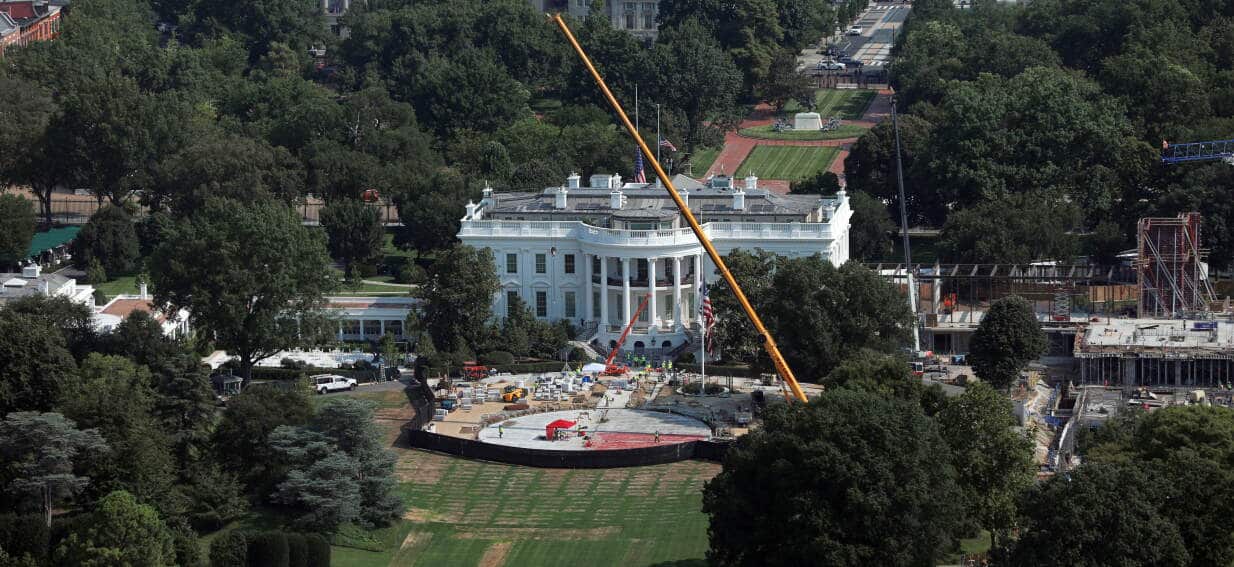
The ground beneath the South Lawn carries a distinct weight. It is not merely dirt and manicured Kentucky bluegrass. It is history compressed by centuries of boots, carriage wheels, and the heavy machinery of successive administrations eager to leave a permanent physical signature on the most famous address in the world.
Buildings here do not simply rise; they argue. Every slab of poured foundation, every line drawn by an architect, and every brick laid into place serves as a visible manifestation of an executive will testing the boundaries of its authority.
When a court orders the halt of a massive construction project within the executive domain, the immediate headlines focus on injunctions, legal briefs, and constitutional friction. But beneath the dry language of judicial review lies a much older, more intimate contest. It is a struggle over who actually owns the physical canvas of the American presidency. Is it the temporary occupant living above the Oval Office, or is it the enduring institutional framework designed to outlast them?
To understand why a federal court stepped in to freeze the construction of a sprawling new White House ballroom, one must step back from the modern cable news cycle and look at how the physical estate has evolved.
Think of the White House not as a static museum, but as a living organism constantly shedding its skin. Theodore Roosevelt ripped out Victorian interiors to build the West Wing. Harry Truman gutted the entire interior of the mansion down to its exterior shell, living in Blair House while engineers poured a concrete and steel skeleton to keep the crumbling historic walls from collapsing inward.
Renovations are standard. Alterations are expected. Presidents have added bowling alleys, swimming pools, tennis courts, and putting greens.
Yet, scale matters. Permanence matters.
The proposed ballroom project was not a minor interior refresh. It was a massive structural undertaking designed to host large-scale state events without the logistical nightmare and astronomical expense of setting up temporary South Lawn tents. Proponents argued it was a long-overdue modernization, a practical necessity for a global superpower that routinely hosts foreign heads of state in temporary fabric pavilions.
Opponents, however, saw something entirely different. They saw an executive branch bypassing traditional consultative guardrails, moving at breakneck speed to alter a historic landmark protected by federal preservation statutes.
This is where the invisible machinery of government grinds into motion.
When the legal challenges materialized, they did not arrive as abstract political arguments. They landed in courtrooms as technical claims involving the National Historic Preservation Act and the Commission of Fine Arts. Preservationists and oversight groups argued that radical alterations to the executive mansion require rigorous public review, environmental assessments, and architectural scrutiny.
The executive branch, conversely, historically claims a broad mantle of discretionary authority over the management of its immediate working and living quarters.
Power is seductive in its simplicity. When an administration encounters friction from regulatory bodies, advisory boards, or statutory review periods, the temptation to bypass them grows. The executive ego wants to build. The institutional bureaucracy wants to deliberate.
When a federal judge grants an injunction halting the construction, the immediate sensation is a sudden, jarring halt. Cranes freeze mid-swing. Staging areas fall quiet. Hard-hatted workers step away from incomplete forms.
But the silence is deceptive.
The court's decision represents a fundamental mechanical check on executive ambition. It operates on a principle that feels increasingly foreign in an era of rapid executive orders and unilateral declarations: that even the most powerful political office in the world must answer to statutory law and judicial oversight.
History is watching this dispute with a familiar smirk. Every generation of Americans believes its political battles are entirely unprecedented, uniquely divisive, and dangerously high-stakes. Yet, the friction between presidential overreach and institutional preservation dates back to the very first stones laid on Pennsylvania Avenue.
The halting of the ballroom construction is a reminder that the architecture of American democracy is designed to cause friction. It is supposed to be difficult. It is supposed to require paperwork, debate, and occasionally, a judge telling the most powerful person in the world to pause and check their blueprints.
The concrete remains half-poured. The permits are locked in legal briefs. And the South Lawn waits quietly, bearing the weight of an argument that will define the limits of power long after the current machinery of government has packed its boxes and moved on.