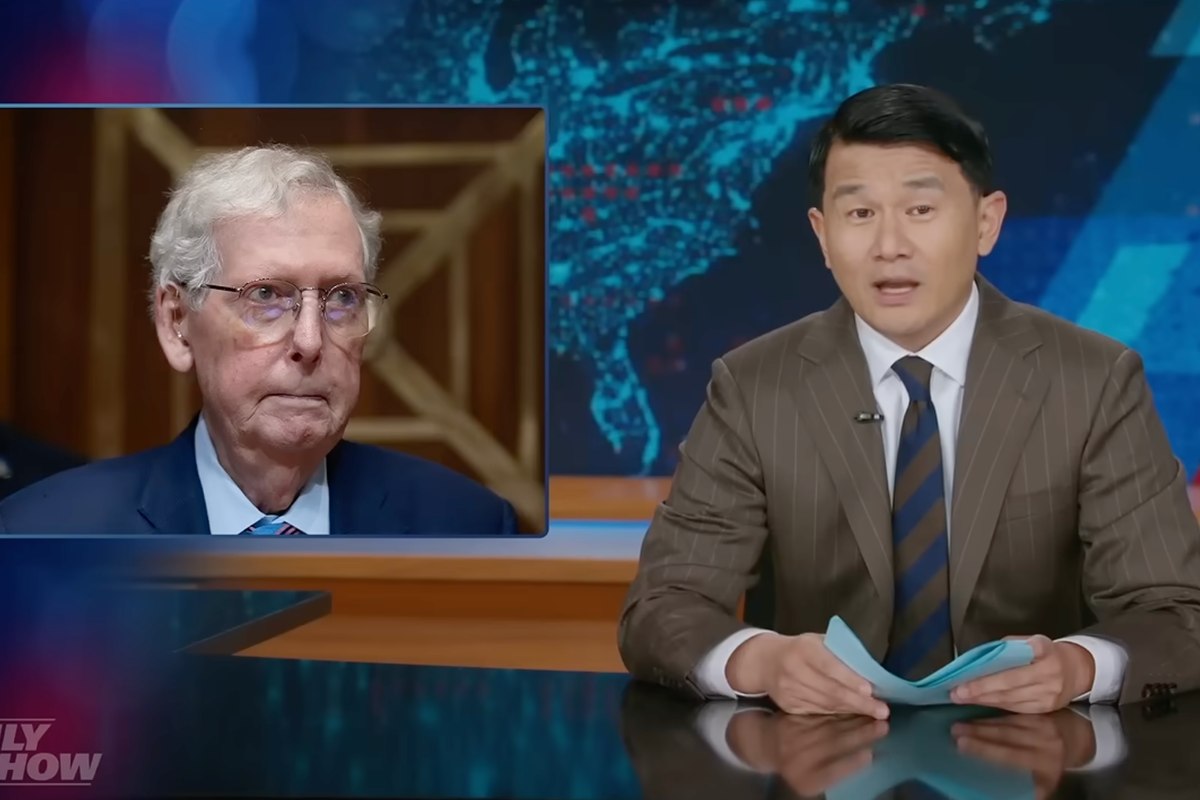
Late-night television is broken. It has degenerated into a self-congratulatory echo chamber that prioritizes easy laughs over genuine political literacy. The recent spectacle of The Daily Show relentlessly mocking Mitch McConnell over his "totally legit" 20-minute phone calls with fellow Republicans is a textbook example of this intellectual decay.
The media consensus fell right into line. The narrative was simple, clean, and entirely wrong: an aging, out-of-touch politician telling a transparently clumsy lie to cover up a fractured party caucus. Audiences laughed. Writers room self-flagellated with applause.
They missed the entire point.
While the chattering classes treat Washington like a high school drama club, they fail to grasp that political power does not operate on the wavelength of a late-night monologue. What The Daily Show framed as a pathetic falsehood was actually a masterclass in party discipline, institutional control, and the deliberate deployment of strategic ambiguity.
The Myth of the 20-Minute Conversation
Let us look at the premise that the media found so hilarious. McConnell claimed he had extensive, individual 20-minute phone conversations with a massive roster of Republican senators in a impossibly short window. The immediate, knee-jerk reaction from late-night hosts was to pull out a calculator. They ran the math, proved the timeline was physically improbable, and declared victory.
This is a profound misunderstanding of how legislative whip counts actually work.
When a Senate leader says they "spoke for 20 minutes" with thirty different senators, a seasoned operative knows exactly what that means. It does not mean they discussed the weather or debated the finer points of policy.
- The Check-In: It means a highly coordinated whip operation where staff did the heavy lifting, laying the groundwork before the principal ever picked up the phone.
- The Execution: It means the leader stepped in for the final, critical two minutes to secure a commitment, nod in agreement, or deliver a directive.
- The Translation: In political parlance, "I had a 20-minute call" is code for "I exercised the full weight of my office to ensure compliance, and the deal is locked."
By taking the statement literally, the media exposed its own naivety. They focused on the logistics of the clock rather than the mechanics of leverage. McConnell wasn't lying to the public; he was signaling to his opponents that his caucus was aligned, organized, and entirely under his purview.
Why Mockery is a Failed Political Strategy
The left has long used satire as a crutch, a way to cope with structural legislative defeats by pretending their opponents are stupid. This strategy dates back to the George W. Bush administration, through the Obama years, and into the modern era.
But laughing at your opponent does not strip them of power. In fact, it often shields them.
While The Daily Show spent decades painting conservative leadership as a collection of bumbling, incompetent cartoon villains, those same leaders were quietly reshaping the federal judiciary, capturing state legislatures, and securing long-term structural advantages.
I have watched political organizations pour millions of dollars into viral media campaigns designed to make fun of opposition leadership, only to watch those same leaders outmaneuver them on the Senate floor when it mattered most.
The obsession with "gotcha" moments creates a dangerous blind spot. If you convince your base that the opposition is merely a joke, your base will be completely unprepared when that opposition executes a brutal, highly effective legislative maneuver. McConnell’s longevity isn't a fluke born of luck; it is the result of a cold, transactional understanding of power that late-night writers are fundamentally unequipped to analyze.
The Reality of Strategic Ambiguity
In the arena of high-stakes negotiation, clarity is a liability. Ambiguity is an asset.
When a political leader gives a press conference and delivers a statement that seems obviously flawed or easily debunked by a fact-checker, the immediate assumption by the press is that the leader made a mistake.
They rarely consider that the statement was designed precisely to absorb the media cycle.
Consider the mechanics of news distribution. While reporters are busy writing articles about the mathematical impossibility of a phone call schedule, they are not writing articles about the specific policy concessions being made behind closed doors. The joke becomes the distraction. The mockery becomes the camouflage.
To break this down cleanly:
| What the Media Sees | What is Actually Happening |
|---|---|
| A politician making a clumsy excuse | A leader signaling total control over their voting bloc |
| A funny, mathematically impossible timeline | A coordinated staff operation executing a whip count |
| An opportunity for a viral late-night monologue | A deliberate distraction to shift the focus away from backroom deals |
This is the trade-off that outsiders fail to recognize. A master legislative strategist will happily endure forty-eight hours of ridicule on cable television if it means securing the fifty-one votes needed to pass or block a generation-defining piece of legislation. Power cares about outcomes, not reviews.
Dismantling the Comedy-to-Politics Pipeline
The underlying problem is that the public now consumes news through the lens of entertainment. We want our political coverage to be satisfying, to feature clear heroes and villains, and to end with a punchline that makes us feel intellectually superior.
This desire has ruined political analysis.
When The Daily Show mocks a figure like McConnell, it provides the audience with a false sense of victory. The viewer feels like they have won an argument, even though nothing on the ground has changed. It breeds a passive, lazy electorate that mistakes retweets and laughs for actual political engagement.
If you want to understand Washington, you have to stop watching the comedians. You have to look at the committee assignments, the procedural votes, the filibuster carve-outs, and the donor networks. You have to look at the things that cannot be easily turned into a three-minute monologue.
The truth is uncomfortable. The people running the legislative machinery of this country are not stupid, they are not bumbling, and they are not losing sleep over what an actor says about them behind a desk in New York. They are playing a completely different game, by a completely different set of rules, on a completely different timeline.
Stop laughing at the phone calls. Start looking at the votes.



