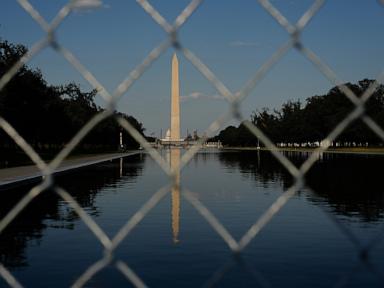
The rubber was blue. Not just any blue, but a bright, defiant hue meant to evoke the stars and stripes, laid down at the base of the Lincoln Memorial. It was supposed to be a triumph. A sixteen-million-dollar testament to national pride, timed perfectly for the country's 250th anniversary. Instead, on a sticky afternoon in mid-June, the blue was peeling. It floated to the surface of the greening water like dead skin.
David Hearn saw it. He didn't see a political statement. He didn't see a battlefield. He saw a material failure. Don't miss our recent article on this related article.
Hearn is sixty-seven years old. His body bears the quiet, enduring strength of a man who spent three different decades representing the United States in the Summer Olympics. He is a canoeist. He knows water. More importantly, he spent his life running a business that manufactured composite materials for watercraft. He knows resins. He knows polymers. He knows exactly what happens when adhesive fails to bond with concrete.
He was fifty-two miles into a sixty-four-mile bicycle ride through the capital, the city where he was born. He stopped at the National Mall to see the grand renovation. What he found was a botched paint job. Curious, with the professional instinct of a craftsman, he leaned over the stone coping. He reached his hand into the water. He touched the loose, rubbery flap of the liner just to feel its consistency. If you want more about the context of this, CBS Sports provides an excellent summary.
By the time he fully understood what was happening, he was in handcuffs.
Consider what happens next when a simple moment of tactile curiosity collides with the gears of a hyper-politicized state. The narrative transformed instantly. The retired athlete, a man who voluntarily spent decades clearing debris and maintaining National Park Service property along the Potomac River, was no longer a citizen examining a public pool. He was an insurgent.
The federal government descended with the full weight of its prosecutorial machinery. The U.S. Attorney for the District of Columbia announced a grand jury indictment. The charge? Felony destruction of property. The maximum penalty? Ten years in a federal prison.
The government's version of that afternoon reads like an action movie. Prosecutors claim Hearn didn't just touch the floating liner; they allege he "forcefully and violently" ripped it up with both hands, causing precisely one thousand dollars worth of damage across two square feet of sealant. They described him as belligerent, shouting at a park worker who told him to stop. They cast him as a rogue agent of chaos, a foot soldier in a phantom army of vandals out to deface America's treasures.
But the real problem lies elsewhere, far beneath the surface of the pool.
The renovation had been plagued from the start. A no-bid contract had been awarded to a company connected to a presidential golf club. The rush to complete the project before the July Fourth festivities resulted in an immediate, embarrassing setback. Within days of opening, the pristine "American flag blue" water began to turn a murky, stagnant green. Algae blooms choked the surface. The administration quickly claimed that the failure wasn't due to rushed construction or poor engineering. It was the work of radical saboteurs. The public was told that anonymous villains had dumped fertilizer into the water and sliced the lining with box cutters, leaving a massive three-hundred-foot gash.
There was just one issue: the Interior Secretary himself later admitted the algae wasn't from fertilizer. It was already in the pipes.
On a humid Thursday morning, Hearn walked into D.C. Superior Court wearing a sharp navy suit. His hair was gray, his posture straight. The courtroom was suffocatingly full, packed to capacity with reporters and dozens of aging athletes, friends who had watched him paddle for fifty years. Outside, the sidewalk was a sea of red, white, and blue signs. "Davey's a champ, not a scamp!" one read.
Inside, the atmosphere was clinical. Hearn sat between his defense attorneys, Norm Eisen and Mary Dohrmann. When the single felony count was read, Hearn did not hesitate. The plea was entered: not guilty.
The prosecutors tried to tighten the vise. They requested a stay-away order, a restriction that would legally bar the three-time Olympian from the very monuments he had spent his life admiring. His lawyer pushed back hard, calling the government's evidence laughably weak and the restriction a blatant waste of court resources. Judge Carmen McLean looked at the man before her—an upstanding resident of Bethesda with deep roots in the community—and denied the government's request. Hearn was released on his own recognizance, without supervision.
But the trial is set for February 2027. For the next several months, a man who carried the American flag on the global stage will live under the shadow of a decade behind bars.
The strategy of the defense is clear, and it extends far beyond the legal technicalities of property damage. It is an indictment of an administration looking for a scapegoat to cover up a multimillion-dollar construction blunder. It is easy to blame a lone cyclist for a torn liner when the alternative is admitting that sixteen million dollars of taxpayer money was washed down the drain on a rushed, defective contract.
When Hearn finally emerged from the courthouse doors, the crowd erupted. The chants of "Davey! Davey!" echoed off the concrete structures of the capital. For a brief moment, the solemn expression left his face. He looked at the bank of cameras, smiled, and raised a single, weathered fist into the air. He didn't speak. He didn't need to.
The Lincoln Memorial Reflecting Pool is designed to mirror the sky, to show us an image of ourselves against the backdrop of history. Right now, it mirrors something far more fractured. It shows a landscape where an old athlete's curiosity is twisted into a federal crime, where the color of the water matters more than the truth of its depth, and where a man can go to prison for ten years just for pointing out that the paint is starting to peel.