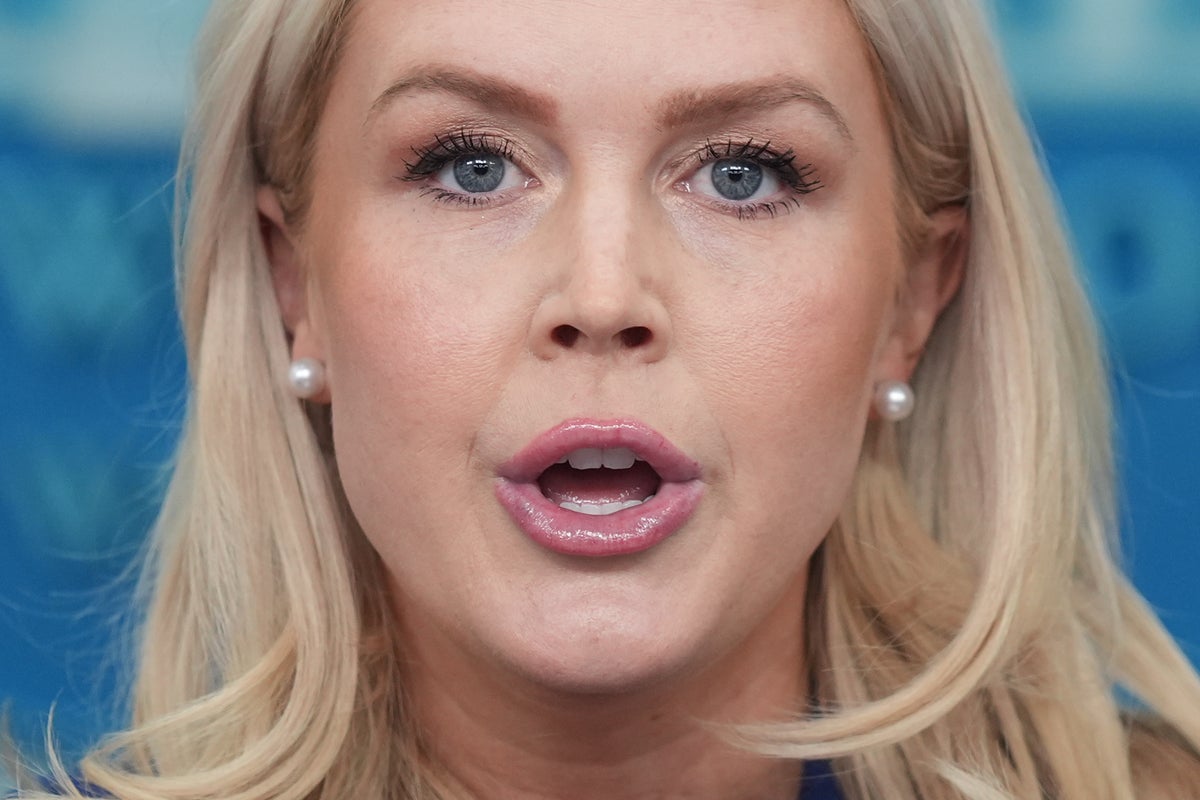
Karoline Leavitt walked into the briefing room to defend a rhetoric of scorched earth. When Donald Trump claimed that civilization as we know it would effectively end if his opponents prevailed, he wasn't just using hyperbole. He was setting a trap for his own communications team. The subsequent struggle to reconcile "civilization will die tonight" with a coherent political platform didn't just expose a lack of preparation. It revealed a fundamental breakdown in the modern political machinery of damage control.
Leavitt, a veteran of the combat-heavy press cycles, found herself at a rare loss for words. The reporters in the room weren't looking for a soundbite. They wanted a definition. What does the death of civilization look like in a policy memo? Does it involve the suspension of the Constitution, or is it merely a metaphor for a lost election? By failing to provide a clear answer, the spokesperson allowed the vacuum to be filled by the most alarmist interpretations possible. This was a masterclass in how not to manage a firebrand principal.
The High Cost of the Apocalyptic Pivot
The Trump campaign has long leaned on the "Flight 93" election theory—the idea that the country is a hijacked plane and you must charge the cockpit or perish. But there is a ceiling to this strategy. When you move from "the economy is struggling" to "the world is ending in ten hours," you lose the ability to speak to the middle-of-the-road voter who just wants their grocery bill to go down.
Leavitt’s struggle was born from the impossibility of her task. You cannot "spin" an apocalypse. You either embrace it as a literal prophecy or dismiss it as a joke. She tried to do neither, resulting in a series of half-starts and deflections that only emboldened the press corps. The fundamental error here was the assumption that the "MAGA" base's comfort with high-octane rhetoric would translate to a skeptical general audience. It didn’t.
The mechanics of this failure are worth dissecting. In political communications, the Pivot is the most basic tool in the shed. Usually, when a candidate says something outrageous, the press secretary pivots to a related policy success. However, there is no policy equivalent to the end of the world. By staying in the defensive crouch, Leavitt allowed the "civilization" comment to dominate three full news cycles. That is an eternity in a modern campaign, and it is a self-inflicted wound.
Why the Press Secretary Role is Breaking
We are seeing the exhaustion of the "deny and attack" model. For years, the strategy was simple: if the boss says something wild, call the reporter biased and move on. That worked when the statements were about crowd sizes or minor policy flip-flops. It fails when the statements touch on the fundamental stability of the nation.
Journalists have caught on to the game. During the Leavitt exchange, the room stayed on the "death of civilization" topic for nearly twenty minutes. This wasn't a fluke. It was a coordinated refusal to let the spokesperson escape into her talking points. This shift in the press room dynamic suggests that the "war room" style of communication has reached a point of diminishing returns.
The Burden of Literalism
The core problem for Leavitt—and any analyst worth their salt knows this—is the Literalism Gap. Half of the audience hears Trump's words as "vibe-based" entertainment. The other half hears them as a literal threat to their safety. A press secretary has to satisfy both.
- The Base: They want to see the spokesperson "own" the media.
- The Undecideds: They want to know if the candidate is stable.
- The Opposition: They are looking for a legalistic admission of intent.
Leavitt catered only to the first group. In doing so, she alienated the second and gave a gift to the third. This is why the briefing felt like a car crash in slow motion. She was speaking to a rally of one, while the rest of the world was looking for a sign of adult supervision.
The Ghost of Briefings Past
Historically, the role of the Press Secretary was to be a shock absorber. People like Ari Fleischer or even James Brady were there to slow things down, to add layers of "clarification" that dulled the edges of the President's more radical impulses. They were the cooling rods in the nuclear reactor of the Oval Office.
Leavitt represents the new breed: the Amplifier.
This role doesn't seek to soften the blow; it seeks to increase the volume. But when the volume is already at a ten, there’s nowhere left to go but feedback. The "civilization will die" threat was already at maximum volume. By refusing to clarify it, she essentially held the microphone up to the speaker, creating a screeching sound that drove everyone out of the room. This isn't just bad PR; it's a strategic failure that suggests the campaign has no "Plan B" for when the rhetoric goes too far.
Tactical Errors in Real Time
If we look at the transcript, we see three specific points where Leavitt could have regained control but didn't.
- The Specificity Trap: When asked "How exactly does civilization end?" she responded with a list of border statistics. This created a logical disconnect. Voters know that high immigration numbers, while a serious policy issue, do not equal the literal collapse of human society by midnight.
- The Emotional Mismatch: She remained stoic and rehearsed while discussing an existential threat. If the world is truly ending, you shouldn't sound like you're reading a grocery list.
- The Exit Strategy: She stayed at the podium too long. A veteran journalist knows that when you are losing a room, you take one more question on a different topic and leave. She allowed the narrative of her "floundering" to be filmed, edited, and distributed before she even walked out the door.
The Psychological Toll of the "End Times" Pitch
There is a documented phenomenon in political science called Apocalypse Fatigue. When a candidate tells voters that every single election is the "last chance to save the country," the message eventually loses its potency. By the time Trump reached the "civilization will die tonight" level of rhetoric, many voters had already tuned out.
Leavitt’s inability to defend the statement is a symptom of this fatigue. Even the defenders are getting tired of defending the indefensible. You could see it in her eyes—the realization that there is no logical defense for a statement that is, by its very nature, an emotional outburst rather than a policy position.
The Data Behind the Rhetoric
Internal polling for most major campaigns shows that "existential threats" are great for fundraising but terrible for persuasion. Small-dollar donors love the idea that they are "saving the world" with a $20 contribution. However, the suburban voters in Pennsylvania or Wisconsin—the ones who actually decide who becomes President—tend to find such language exhausting and "weird."
By leaning into the "death of civilization" line, the campaign effectively traded 5,000 undecided voters for 50,000 donor clicks. That might keep the lights on in the campaign office, but it won't put the candidate back in the White House. Leavitt’s performance was the public-facing version of this bad trade. She prioritized the "fight" over the "win."
The Future of the Podium
What happens when the next spokesperson steps up? If the "civilization" line becomes the new standard for rhetoric, the Press Secretary role as we know it is dead. It will no longer be a place for information or even "spin." It will be a theater of the absurd where the only goal is to survive the thirty minutes without a viral clip of your own silence.
We are entering an era of Post-Policy Communication. In this environment, the facts of the border or the economy don't matter as much as the intensity of the fear. Leavitt didn't fail because she was a bad speaker; she failed because you cannot bring a fact-sheet to a ghost story. She was trying to use a spreadsheet to explain a nightmare, and the math didn't add up.
The media’s role is also changing. For years, they were criticized for "both-sidesing" every issue. In that briefing, however, they stopped. They saw an opening where the rhetoric was so detached from reality that they didn't need to provide a counter-argument. They just needed to ask "How?"
The Institutional Damage
Every time a spokesperson "flounders" like this, it chips away at the credibility of the office. Whether it’s Karoline Leavitt or her counterparts on the other side of the aisle, the public’s trust in the "official word" is at an all-time low. When civilization-ending threats are tossed around like sports scores, the language itself becomes debased.
This is the real "death of civilization" that people should be worried about: the death of a shared reality where words have specific, agreed-upon meanings. If "civilization will die" just means "I might lose an election," then the language of the state has been completely evacuated of its power.
What the Campaign Needs to Change
To avoid a repeat of this disaster, the strategy must shift from Provocation to Proportion.
- Audit the Hyperbole: The candidate needs to be told—though few have the courage to do it—that certain phrases are "un-spinnable."
- Empower the Spokesperson: Leavitt needs the authority to say, "The President was using a figure of speech." By forcing her to defend it as literal truth, the campaign set her up for a public execution.
- Focus on the Tangible: Shift the conversation back to things people can see, touch, and feel. A gas pump is a more powerful political symbol than a crumbling civilization.
The visual of a young, capable spokesperson struggling to explain why the world was about to end is a metaphor for the current state of the American political discourse. It is a machine that has been overclocked for too long, and the parts are starting to fly off.
The room didn't just press Leavitt because they didn't like her or her boss. They pressed her because the statement was an insult to the intelligence of the electorate. You can't tell people the sky is falling when they can look out the window and see it's still there. If you want to run a country, you have to show you can handle the reality of it, not just the fantasy of its destruction.
Stop trying to defend the hyperbole and start explaining the plan. The moment you lose the ability to tell the difference between a campaign slogan and a declaration of war, you've already lost the room. Take the win on policy and leave the end-times prophecies to the cult leaders. Any campaign that can't survive a single follow-up question on its own rhetoric isn't ready for the high-stakes pressure of a general election. The clock is ticking, but civilization isn't dying—the strategy is.