The global energy supply chain is currently facing its most severe existential threat since the 1973 oil embargo as the Strait of Hormuz becomes the primary lever in a rapidly expanding regional conflict. Tehran's declaration that the world’s most vital maritime chokepoint is closed marks a definitive shift from shadow warfare to open economic sabotage. While news cycles focus on the immediate kinetic exchange between Israel and Lebanon, the real story lies in the calculated dismantling of the maritime security architecture that has underpinned the global economy for half a century.
A closure of the Strait is not merely a regional crisis. It is a fundamental break in the flow of roughly 21 million barrels of oil per day, or about 21% of global petroleum liquid consumption.
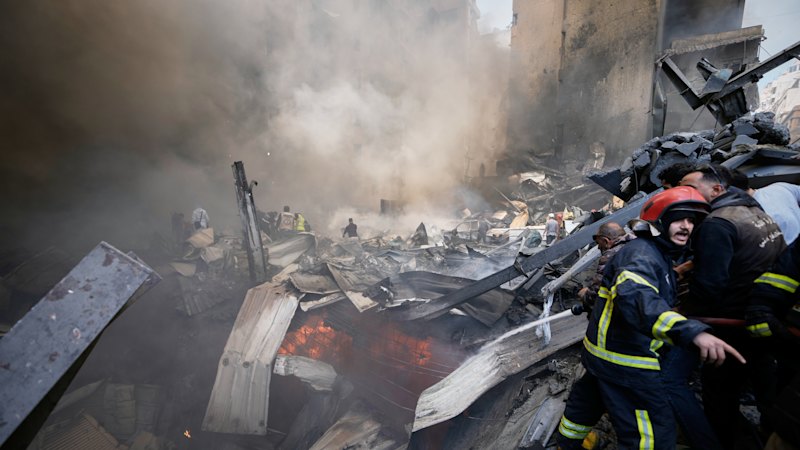
The current escalation follows a series of record-breaking Israeli strikes across Lebanon, aimed at degrading Hezbollah’s command structure, which have effectively shattered the fragile ceasefire agreements previously mediated by international powers. As these terrestrial lines of control dissolve, Iran has moved to its ultimate insurance policy. By threatening the passage of tankers through the 21-mile-wide passage between Oman and Iran, the Islamic Republic is betting that the threat of global hyperinflation will force a Western hand that military posturing could not.
The Chokepoint Strategy and Economic Gravity
The Strait of Hormuz is a unique geographical vulnerability. Unlike the Red Sea, where the Bab el-Mandeb allows for some diversion around the Cape of Good Hope at a significant cost, there is no viable alternative for the vast majority of crude exported from Saudi Arabia, Iraq, the UAE, and Kuwait. Pipelines do exist, such as the East-West Pipeline in Saudi Arabia and the Habshan–Fujairah line in the UAE, but their combined capacity can only handle a fraction of the daily volume currently transiting the water.
Logistics experts are now grappling with the reality of "stranded supply." If the closure holds for more than 72 hours, the maritime insurance markets will likely freeze. We are already seeing "war risk" premiums for tankers in the Persian Gulf spike by over 400%. This is not just a tax on oil; it is a tax on every product moved by sea, from grain to semiconductors.
Iran's military capability in the Strait does not require a traditional blue-water navy. They utilize a doctrine of "asymmetric denial." This involves thousands of fast-attack craft, sophisticated anti-ship cruise missiles hidden in coastal silos, and a massive inventory of naval mines. Clearing these mines is a slow, methodical process that can take weeks or months, during which time the global economy would remain in a state of suspended animation.
Israel and the Lebanese Front
While the maritime threat looms, the ground reality in Lebanon has shifted from tactical skirmishes to a full-scale campaign of degradation. The record strikes reported in southern Lebanon and Beirut’s suburbs are designed to accomplish what 2006 could not: the total severance of the "land bridge" connecting Tehran to the Mediterranean.
Intelligence sources suggest these strikes are targeting deeply buried precision-missile manufacturing sites. The intensity of the bombardment indicates that the Israeli Defense Forces (IDF) are operating on a compressed timeline, perhaps anticipating that the window for high-intensity operations will close if the U.S. is forced to pivot its naval assets to escort missions in the Gulf.
The cracks in the ceasefire were not accidental. They were the result of a fundamental misalignment of goals. Diplomacy failed because it sought a return to the status quo, whereas the current regional actors view the status quo as an intolerable threat. For Israel, the presence of Radwan forces on its northern border is a non-starter. For Hezbollah, retreating behind the Litani River is a surrender of its domestic political legitimacy.
The Crude Reality of Energy Markets
Oil markets are notoriously skittish, but the current reaction is different. Traders are no longer pricing in a "risk premium"; they are pricing in a "scarcity event." If the Strait remains blocked, we are looking at oil prices that could easily exceed $150 per barrel within a fortnight.
Global Export Vulnerability
| Country | Reliance on Hormuz | Primary Alternative |
|---|---|---|
| Saudi Arabia | High | East-West Pipeline (Limited) |
| Kuwait | Total | None |
| Qatar (LNG) | Total | None |
| Iraq | High | Ceyhan Pipeline (Geopolitically unstable) |
| UAE | Moderate | Fujairah Pipeline |
The impact on Liquefied Natural Gas (LNG) is perhaps even more critical for European markets. Qatar, the world’s largest exporter of LNG, is entirely dependent on the Strait. In a winter where Europe is still weaning itself off Russian gas, the loss of Qatari volumes would lead to immediate industrial rationing in Germany and skyrocketing heating costs for households across the continent.
Miscalculations and the Risk of Total War
The danger of the current moment is the "escalation ladder." Every move made by one side is seen as a defensive necessity, while the opposing side views it as a provocative escalation. Iran believes that closing the Strait is its only way to stop the destruction of its proxies in Lebanon. Israel believes that intensifying the Lebanese campaign is the only way to prevent a multi-front invasion.
Washington finds itself in a precarious position. The U.S. Navy’s 5th Fleet is tasked with keeping the lanes open, but a direct kinetic engagement with Iranian coastal defenses would likely signify the start of a regional war that involves direct strikes on Iranian soil. This is the scenario every administration for the last thirty years has sought to avoid.
The "cracks" in the ceasefire are now canyons. When a state like Iran officially declares a waterway of this importance "closed," it is not just a rhetorical flourish. It is an invitation for the international community to either concede to their terms or engage in a maritime conflict that hasn't been seen since the Tanker War of the 1980s. The difference now is the technology. Modern drones and precision munitions make the Persian Gulf a "no-go zone" for even the most advanced carrier strike groups without significant risk.
The Logistics of a Locked Gulf
Shipping companies are already beginning to "darken" their vessels—turning off AIS (Automatic Identification System) transponders—to avoid being targeted, though this does little against radar-guided coastal batteries. Major firms like Maersk and MSC are reportedly reviewing their Persian Gulf calls. If the commercial sector decides the risk is too high, the Strait is effectively closed even without a single shot being fired.
We must look at the technical reality of naval mine warfare. Iran possesses the EM-52, a rocket-propelled mine that sits on the seabed and fires upward when it detects a ship's acoustic signature. These are not the floating "spiked balls" of cinema; they are high-tech, lethal, and incredibly difficult to find in the silt-heavy waters of the Strait.
The assumption that the U.S. can simply "sweep" the mines and resume business as usual is a dangerous fantasy. Mine counter-measure (MCM) operations are conducted at a crawl. A single mine found can shut down a shipping lane for days. In a narrow channel where ships must follow strict deep-water paths, there is no room for error.
The Collapse of Mediation
Third-party mediators like Qatar and Oman are currently sidelined. Their influence relied on both sides wanting to avoid a total break. That premise no longer holds. The Israeli cabinet appears committed to a "decisive victory" doctrine, while the Iranian leadership feels backed into a corner by the systematic elimination of their external deterrents.
This isn't about a single border dispute or a specific rocket attack anymore. It is about the redistribution of power in the Middle East. If Israel successfully dismantles Hezbollah while Iran successfully chokes the global energy market, we enter a period of prolonged global instability where the price of fuel is dictated by the frequency of missile launches.
The record strikes on Lebanon have signaled that the era of "containment" is over. The closure of the Strait signals that the era of "globalized commerce" is, at least in the Middle East, under siege.
Investors and governments should stop waiting for a diplomatic breakthrough that isn't coming. The structural incentives for peace have been replaced by the tactical incentives for total displacement. Preparedness now means assuming the Gulf remains a combat zone for the foreseeable future. Stockpiling, rerouting, and securing alternative energy sources are no longer "worst-case" strategies; they are the only remaining survival strategies.
The world is about to find out exactly how much it is willing to pay for a gallon of gas when the cost includes a naval war in the world’s most dangerous waters.