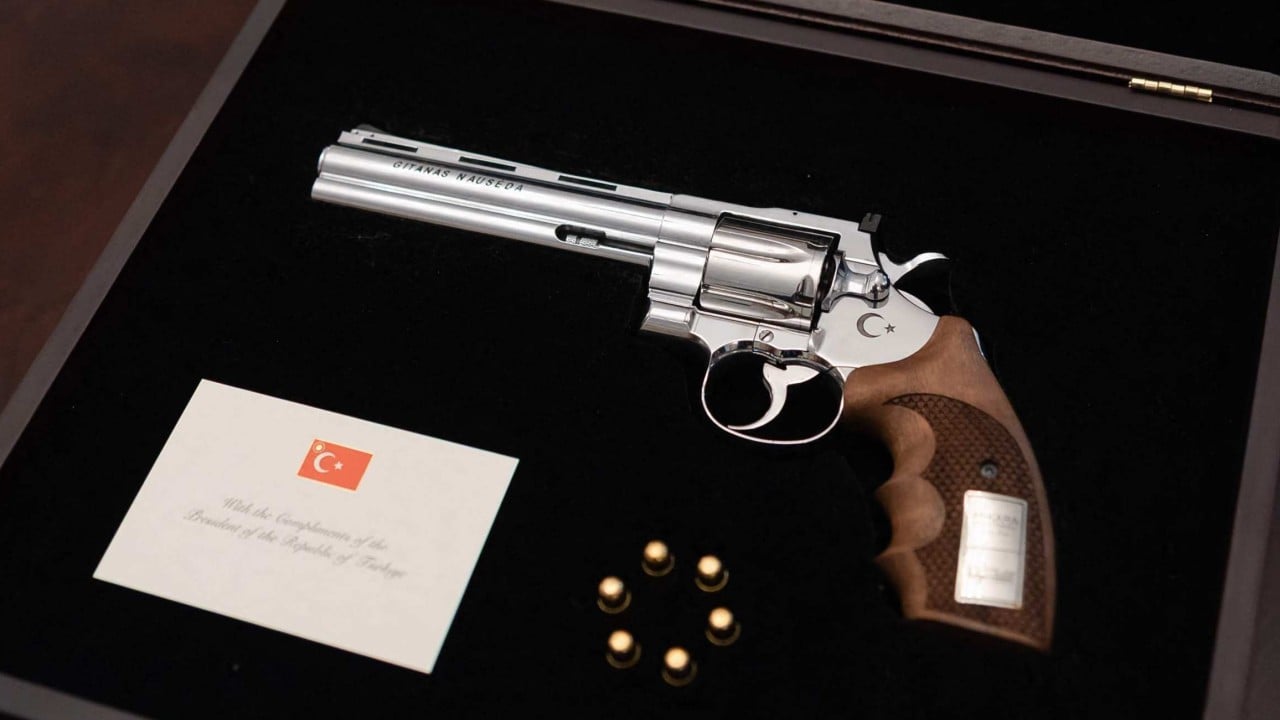
The room smelled of expensive wax, aged mahogany, and the faint, unmistakable scent of high-grade gun oil.
World leaders are accustomed to a specific kind of theater. Diplomacy is usually a dance of soft edges. It is a world of silk ties, carefully drafted communiqués, and gifts designed to offend absolutely no one. Usually, an international summit concludes with the exchange of engraved silver platters, rare books, or perhaps a piece of traditional porcelain meant to gather dust in a government archive. They are symbols of unity, wrapped in velvet and tied with ribbons of polite fiction.
Then came the velvet box from Ankara.
When the lid clicked open, it did not reveal a commemorative coin or a framed photograph. It contained steel. Specifically, a single, polished revolver. Next to it, nested in custom-cut foam, sat six pristine bullets.
The air in the room shifted. A gift like that doesn't just sit on a table. It demands that you look at it. It forces you to think about what it means to hold the power of life and death in your hands, stripped of all the bureaucratic language that usually disguises the harsh realities of geopolitical alliance.
The Iron Beneath the Velvet
To understand the sheer shockwaves a gesture like this sends through the diplomatic corps, one must understand the psychology of the modern summit. These gatherings are masterclasses in optics. Leaders smile for cameras, shake hands with practiced warmth, and project an image of absolute stability. Every movement is choreographed by an army of protocols and aides.
But diplomacy is inherently a polite mask worn over raw power.
When the Turkish delegation presented this specific token to fellow alliance members, it stripped away the mask. Consider the physical sensation of receiving such an item. You lift a heavy, lacquered box. You expect a medal. Instead, you feel the cold, heavy balance of an instrument designed for a singular, lethal purpose.
The symbolism is impossible to ignore. A revolver is not a weapon of mass destruction. It is not a drone strike or a cyberattack launched from thousands of miles away by an anonymous operator staring at a glowing screen. It is an intimate weapon. To use it, you must look your target in the eye. You must make a conscious, heavy choice.
Six bullets. One chambered at a time. It represents a finite, calculated utility. In an alliance built on the concept of collective defense, where an attack on one is treated as an attack on all, the presentation of a personal firearm feels less like a traditional gift and more like a stark, unvarnished reminder of what everyone in that room is actually signed up for.
They are not just signing trade agreements. They are managing the mechanics of violence.
A History Written in Gunpowder
This is not the first time a firearm has crossed the threshold of high-stakes international relations, but the context here changes everything. Historically, leaders have gifted engraved rifles or ceremonial swords as symbols of shared martial history or craftsmanship. But those are museum pieces. They are meant for display cases, hung on the walls of presidential libraries to be admired from a safe distance.
A modern revolver accompanied by live ammunition is different. It feels functional. It feels immediate.
Imagine the quiet conversations that took place in the corridors of the summit venue after the exchange. Analysts and diplomats, accustomed to decoding the subtle shifts in paragraph placement within a twenty-page joint declaration, suddenly found themselves staring at an object that required no translation.
What does a leader say when handed six bullets?
Some might view it as a calculated assertion of sovereignty. Turkey occupies a unique, often turbulent position on the global stage. Straddling two continents, navigating the complex waters between East and West, its foreign policy has long been defined by a pragmatic, fiercely independent streak. A gift of steel tells the world that while alliances are vital, survival ultimately rests on readiness, strength, and the willingness to pull the trigger when backed into a corner.
It challenges the comfortable complacency that often settles over long-standing institutions. It reminds the comfortable capitals of western Europe that security is not a default state of nature. It is bought, maintained, and defended with cold iron.
The Human Element in High Places
We often look at global politics as a chess game played by giant, abstract entities called nations. We talk about "Washington," "Ankara," "London," or "Berlin" as if they are monolithic blocks moving across a map.
They are not.
They are rooms filled with flawed, tired human beings who carry the immense psychological weight of millions of lives. When a president or prime minister opens a box to find a weapon, the abstraction vanishes. Suddenly, the reality of their position hits home. The decisions they make in those carpeted rooms dictate whether young men and women will be sent into harms way.
The revolver forces a moment of profound vulnerability. It asks a silent, uncomfortable question: Are you truly prepared for the consequences of your signature?
The contrast between the polished surfaces of the summit and the brutal reality of the gift is where the true narrative lies. It highlights the deep, often unacknowledged anxiety that underpins modern international relations. We live in an era where the old rules feel increasingly fragile. Treaties are strained. Borders are contested. The certainty that defined the post-Cold War era has evaporated, replaced by a fluid, unpredictable friction.
In such a world, a gift of six bullets is not just unusual. It is prophetic.
The Unspoken Message
Every object tells a story. A silver platter says, "We remember our history." A piece of art says, "We value our culture."
A gun says, "Trust, but keep your powder dry."
This gesture reminds us that beneath the cooperative statements and the group photographs lies a world still governed by the oldest rules of human history. Power matters. Preparedness matters. The ability to defend oneself is the foundation upon which all other freedoms are built.
The leaders who received that box will eventually return to their respective capitals. The boxes will be cataloged, stored, or perhaps placed in private offices away from the public eye. But the image of that steel against the velvet will linger. It serves as a stark reminder that in the grand theater of global politics, the stage is always set, the actors are always watching, and the stakes are always life and death.
The mask of diplomacy is comfortable, but the iron beneath it never truly goes away.



