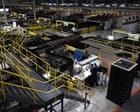
The rhythm of a foundry is something you feel in your teeth. It is a low, bone-deep hum, punctuated by the sharp, metallic clang of cranes and the hiss of cooling steel. For three generations, my family lived by that rhythm. When the furnaces were hot, the town felt alive. Shops were full, pubs were loud, and the future seemed forged in something permanent.
Today, that rhythm is stuttering.
Step inside a modern British manufacturing plant and you will not see a Dickensian soot-stained workshop. You will see advanced robotics, precision engineering, and highly skilled workers monitoring complex systems. But you will also see something else. Anxiety. It hangs in the air as thick as the heat from the melting pots. The danger facing British industry right now is not a lack of skill, a lack of grit, or a lack of global demand. It is a quiet, invisible strangulation. The weapon is the electricity bill.
Consider a hypothetical factory owner. Let us call him David. David runs a mid-sized plastics extrusion plant in the Midlands. He employs seventy-four people. His machinery runs twenty-four hours a day to meet contracts with automotive brands and medical supply companies. Two years ago, David spent roughly ten percent of his operational budget on energy. Today, that figure routinely hovers around forty percent.
David cannot simply pass these costs onto his customers. He operates in a global marketplace. If a car manufacturer can buy the same plastic component from a supplier in Spain or the United States for fifteen percent less, they will. Loyalty evaporates when margins are thin. So, David squeezes his own business. He delays upgrading his machinery. He freezes hiring. He cuts back on the apprentice program that serves as the lifeblood of the local community.
He lies awake at three o’clock in the morning, staring at a spreadsheet, wondering which month will be the one where the math simply stops working.
The broader numbers back up David’s midnight dread. Trade bodies representing thousands of manufacturers across the United Kingdom are sounding an alarm that sounds less like a routine policy complaint and more like a distress flare. A recent comprehensive survey of the sector revealed a stark consensus: without immediate, structured intervention on industrial energy pricing, Britain faces a genuine threat of deindustrialisation.
Deindustrialisation is a heavy, academic word. It sounds clean. It sounds like a natural economic evolution. It is not. It is the sound of a factory gate locking for the last time. It is the sight of a crane being dismantled and sold for scrap. It is the permanent erasure of generational knowledge. Once an industrial ecosystem dies, you cannot simply flip a switch to bring it back. The supply chains shatter. The talent disperses. The community loses its core.
The root of the crisis is a massive disparity in competitive playing fields. British manufacturers are paying significantly more for their power than their direct competitors in continental Europe and across the Atlantic. While governments elsewhere have insulated their critical industries with long-term price caps, direct subsidies, or structural energy market reforms, British firms have been left largely exposed to the volatile whims of wholesale energy markets.
We often talk about the transition to a green economy as if it happens in a vacuum. We want wind turbines, electric vehicle batteries, and carbon-capture infrastructure. But where do we think the steel for those turbines comes from? How do we expect to build the chassis for those electric vehicles? If we price our own foundational industries out of existence, we do not eliminate carbon emissions; we merely offshore them. We import the steel from countries with lower environmental standards and higher transport emissions, while pretending we have solved the problem.
It is a bewildering paradox.
The argument from policymakers has often centered on market forces, suggesting that businesses must adapt to the new reality of expensive energy. But adaptation requires capital. If every spare pound a company makes is swallowed by the monthly utility bill, there is nothing left to invest in solar arrays, energy-efficient motors, or hydrogen capability. High energy prices do not accelerate the transition to green technology; they starve it of oxygen.
Think about the ripples. When a primary employer in an industrial town closes, the impact radiates outward in precise, devastating waves. The local logistics company loses its biggest client. The commercial catering firm that supplied the canteen lays off staff. The corner shop sees its daily revenue drop. Property values stagnate. The tax base shrinks, meaning less money for local schools, parks, and road repairs. The social fabric frays at the edges, all because the cost per megawatt-hour crossed a line on a chart in a London office.
We have a habit in this country of romanticising our industrial past while neglecting our industrial present. We visit museums dedicated to the Industrial Revolution and celebrate the innovators who built the modern world, yet we watch silently as their successors are priced into oblivion. Manufacturing still accounts for a massive portion of UK exports and provides high-wage, high-skill jobs in regions that desperately need them. These are not relics of the past. They are the scaffolding of our economic present.
The solution is not a mystery. Industry leaders are not begging for permanent bailouts or handouts to line investors' pockets. They are asking for structural parity. They need an energy market framework that recognises foundational manufacturing as a matter of national security and economic resilience. They need long-term predictability so they can sign five-year contracts, invest in new facilities, and hire the next generation of engineers with confidence.
The alternative is a quiet, gradual emptying out. A slow fading of the hum that has defined entire regions for more than a century.
Last week, I spoke with a retired steelworker who spent forty years on the shop floor. He looked out over the valley where his old plant still operates, its cooling towers silhouetted against the grey sky. He told me that when he was young, you could tell how the economy was doing just by looking at the color of the smoke and listening to the pitch of the machinery.
Right now, if you listen closely, the machine is telling us that it is running out of fuel.