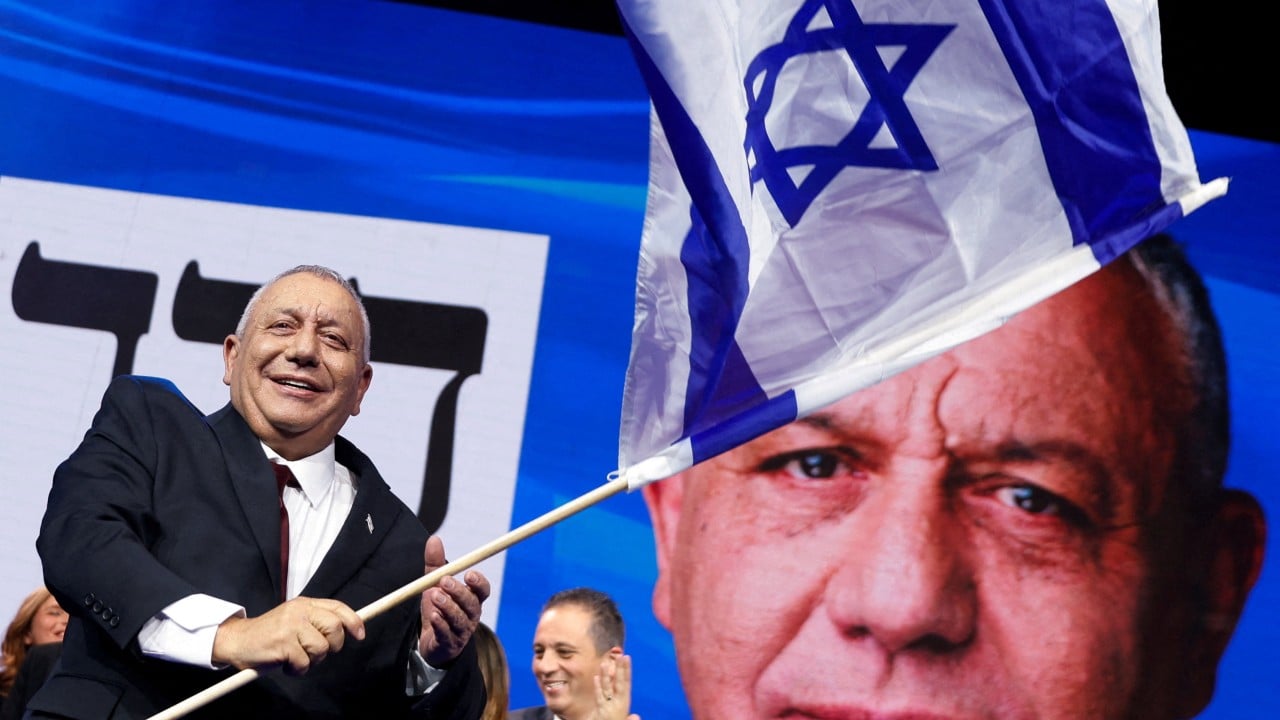
The decision by Israel’s president to transfer the mandate to form a government to Gadi Eisenkot represents a structural rupture in the parliamentary coalition mechanics that have sustained Benjamin Netanyahu’s executive tenure. Under Israel’s Basic Law: The Government, the presidential mandate is not a ceremonial endorsement of the largest single party; it is a strictly utilitarian calculation based on which Knesset member possesses the highest probability of assembling a 61-seat majority within a fixed statutory window. When a president bypasses an incumbent prime minister in favor of an opposition figure like Eisenkot—a former Israel Defense Forces (IDF) Chief of Staff—the action signals that the incumbent’s coalition-building capacity has reached an arithmetic dead end, shifting the political burden from defensive bloc preservation to active coalition construction.
To evaluate the operational viability of an Eisenkot-led government, analysts must strip away partisan rhetoric and examine the institutional constraints of the Knesset, the structural friction points among potential coalition partners, and the game-theoretic incentives governing party defections.
The Statutory Mechanics of the Presidential Mandate
The Israeli parliamentary system operates on pure proportional representation with a single nationwide electoral district and a 3.25% electoral threshold. Because no single party has ever won an outright majority of the 120 Knesset seats, governance depends entirely on post-election bargaining.
When an election concludes, or when an existing government collapses without an immediate vote of constructive no-confidence, the President of the State holds consultations with representatives of every faction elected to the Knesset. During these consultations, each faction recommends a candidate for prime minister. The legal threshold for receiving the mandate is not absolute majority support on day one, but rather the president’s assessment of which candidate holds the most realistic path to securing the confidence of at least 61 Members of Knesset (MKs).
- The Initial Mandate Phase: The designated candidate receives 28 days to negotiate coalition agreements, allocate ministerial portfolios, and present a government to the Knesset for a confidence vote.
- The Discretionary Extension: If negotiations remain incomplete at the end of 28 days, the president may grant a single extension of up to 14 days, provided the candidate demonstrates tangible progress toward a majority.
- Mandate Transfer: If the initial candidate fails to assemble a coalition within the maximum 42-day window—or informs the president earlier that no coalition is possible—the president has two options: assign the mandate to a second MK (who receives a strict, non-extendable 28-day window) or inform the Speaker of the Knesset that no candidate can form a government.
- The Knesset-Wide Phase: If the second candidate also fails, a 21-day period begins during which any group of 61 MKs may petition the president in writing to assign the mandate to a specific MK—including a candidate who previously failed. Failure at this stage triggers automatic dissolution of the Knesset and new elections.
Tapping Eisenkot at this juncture places him inside a compressed operational timeline. Unlike an initial mandate holder who enjoys a potential 42-day runway, a secondary or post-deadlock mandate holder operates under heightened time decay, where every unaligned faction gains exponential leverage as the statutory clock approaches zero.
Deconstructing the Coalition Arithmetic
The core obstacle facing any Israeli prime minister-designate is the multi-dimensional cleavage structure of the Knesset. Unlike two-party systems where bargaining occurs along a single left-right economic axis, Israeli coalition politics requires simultaneous alignment across four distinct policy dimensions:
- Security and Territorial Governance: Positions regarding military operations, regional normalization, border security architecture, and the future status of the West Bank and Gaza.
- Religion and State: Disputes over ultra-Orthodox (Haredi) military conscription exemptions, state funding for religious institutions, public transportation on the Sabbath, and rabbinical authority over personal status laws.
- Institutional and Judicial Governance: Conflicts over the balance of power between the executive branch, the Knesset, and the Supreme Court, including the process for judicial appointments and the scope of judicial review.
- Socioeconomic Policy: Divergences between free-market fiscal conservatism and targeted welfare subsidies for specific demographic sectors.
Netanyahu’s historical durability rested on his ability to bind right-wing nationalist factions with Haredi parties by guaranteeing religious autonomy and statutory exemptions from IDF service, while maintaining ideological alignment on security and judicial reform. That architecture breaks down when internal or external shocks—such as prolonged military conflict, manpower shortages in the IDF, or judicial rulings invalidating Haredi draft exemptions—force a zero-sum choice between coalition partners.
Eisenkot’s selection as a mandate holder reflects an alternative coalition hypothesis: that a centrist-led unity or broad-based bloc can bridge the security and institutional divides if it successfully isolates ideological extremes. However, assembling 61 seats without Netanyahu’s core loyalists requires solving an acute mathematical puzzle.
The Three Pillars of an Eisenkot Coalition Strategy
For Eisenkot to convert a presidential mandate into a sworn-in government, his negotiating team must execute a three-part structural alignment. Failure on any single pillar collapses the entire arithmetic.
Pillar One: Consolidating the Center-Left and Secular Right
The baseline foundation of an anti-Netanyahu or post-Netanyahu coalition requires uniting centrist factions, left-wing Zionist parties, and right-wing secular nationalists who prioritize institutional stability and universal military conscription over loyalty to Netanyahu. While these factions share a common strategic objective—replacing the incumbent leadership—they hold incompatible views on long-term diplomatic frameworks and economic intervention. Eisenkot’s operational approach must rely on policy compartmentalization: freezing contentious ideological initiatives (such as unilateral territorial concessions or sweeping constitutional overhauls) through binding coalition guidelines, thereby narrowing the government’s mandate to immediate security management, economic stabilization, and statutory consensus items.
Pillar Two: Navigating the Haredi Veto Players
In almost every plausible Knesset arithmetic scenario, reaching 61 seats without the Arab-majority parties requires the participation—or at least the external abstention—of the ultra-Orthodox factions (Shas and United Torah Judaism). Historically, Haredi parties have operated as pragmatic power brokers willing to sit with either left- or right-wing prime ministers in exchange for institutional budgets and protection of yeshiva students from military service.
This creates a direct structural contradiction for Eisenkot. As a former IDF Chief of Staff, Eisenkot’s political credibility is anchored in the principle of equitable burden-sharing and universal conscription—particularly during periods of high operational tempo when reserve forces face prolonged deployments. Secular right-wing partners in a prospective Eisenkot coalition demand strict enforcement of draft quotas and financial sanctions for non-compliance. Conversely, Haredi leaders treat draft exemptions as an existential red line. Bridging this gap requires designing a phased, multi-year conscription framework with incremental targets that satisfies the Supreme Court’s legal thresholds without triggering an immediate Haredi walkout.
Pillar Three: The Arab Party Dilemma
If Haredi factions refuse to break their alliance with Netanyahu, the only remaining mathematical path to 61 seats involves the support of non-Zionist or Arab-majority parties (such as Ra'am or Hadash-Ta'al). While the 2021–2022 Bennett-Lapid government demonstrated that an Islamist party could formally join a ruling coalition, that precedent occurred during a period of relative calm on Israel’s borders. Under conditions of active regional conflict, incorporating Arab parties into a governing majority triggers severe internal defections among right-wing security hawks within the prospective coalition. Therefore, relying on Arab factions for a formal confidence vote carries a high risk of immediate coalition dissolution before the government even passes its first state budget.
Operational Vulnerabilities and the Incumbent Counter-Strategy
While receiving the mandate represents a tactical setback for Netanyahu, an outgoing or bypassed prime minister retains formidable institutional and political weapons to sabotage a rival’s coalition-building efforts.
First is the blocking bloc mechanism. Netanyahu does not need to form a government himself to regain power; he only needs to ensure that at least 61 MKs vote against Eisenkot’s proposed cabinet during the Knesset investiture session. By keeping his core bloc unified through ideological discipline and promises of future ministerial rewards, Netanyahu forces Eisenkot to peel away defectors from the incumbent camp—a maneuver that carries high reputational costs for any right-wing politician accused of defecting to the opposition.
Second is asymmetric leverage during negotiations. Because Eisenkot’s prospective coalition is inherently more ideologically diverse than a homogeneous right-wing bloc, every small faction holds veto power. A four- or five-seat party can demand disproportionate ministerial control—such as the Finance, Defense, or Justice portfolios—knowing that Eisenkot cannot reach 61 seats without them. Granting these demands alienates larger centrist partners; refusing them stalls the negotiations until the statutory deadline expires.
Third is the external shock vulnerability. Coalition negotiations in Israel do not occur in a vacuum. Escalations on northern or southern borders, diplomatic friction with key allies, or domestic economic downgrades alter the political calculus overnight. During acute security crises, voter sentiment and political pressure often shift toward maintaining continuity or demanding a full emergency national unity government that includes Netanyahu’s Likud party—a scenario that neutralizes Eisenkot’s mandate by forcing a power-sharing rotation rather than a clean transfer of executive authority.
Distinguishing Confirmed Reality from Strategic Hypotheses
When evaluating reporting around presidential mandate transfers in Israel, rigorous analysis requires separating verified institutional facts from speculative political narratives:
- Verified Structural Reality: The transfer of the mandate confirms that the incumbent prime minister failed to demonstrate a viable 61-seat majority during presidential consultations, and that the president identified Eisenkot as the candidate with the most credible alternative path under the Basic Law.
- Verified Institutional Constraint: Any government formed by Eisenkot must pass an explicit vote of confidence by an absolute majority of the Knesset (at least 61 of 120 MKs) and subsequently pass a state budget within statutory deadlines to avoid automatic Knesset dissolution.
- Strategic Hypothesis (Unproven): The assumption that Eisenkot’s military background and non-divisive public profile will automatically induce moderate Likud MKs or Haredi factions to defect from Netanyahu’s bloc. Historically, Israeli party discipline during non-election periods has proven resilient against individual defections unless accompanied by a formal split of an entire Knesset faction (requiring at least one-third of a party’s MKs to avoid legal sanctions under Knesset rules).
- Strategic Hypothesis (Unproven): The belief that a broad anti-Netanyahu coalition can survive beyond its initial formation. The 2021–2022 coalition proved that disparate factions can unite to win an investiture vote, yet it collapsed within a year due to internal ideological friction over routine legislative renewals.
The Tactical Sequence for Coalition Viability
For Eisenkot’s negotiating team to overcome the structural bottlenecks of the Knesset, their execution sequence must prioritize locking in high-friction agreements before distributing ministerial spoils.
- Establish a Binding Conscription and Budget Framework First: Before allocating cabinet seats, negotiators must draft the exact statutory language governing IDF recruitment targets and the upcoming fiscal budget. Deferring these disputes until after the government is sworn in guarantees collapse within six months.
- Secure Formal Faction Splits Rather Than Individual Defectors: Under Israeli law, an individual MK who defects from their party without formal faction approval faces severe penalties, including a ban on running with an existing party in the next election and restrictions on holding ministerial office. Eisenkot’s strategists must target entire factions or legally recognized one-third faction splits rather than isolated backbenchers.
- Neutralize Ideological Flashpoints via Status-Quo Clauses: Coalition agreements must explicitly bind all signatories to freeze contentious judicial, constitutional, and territorial legislation for the duration of the Knesset term, requiring unanimous consent among party leaders to bring any non-consensus bill to the plenum floor.
- Front-Load the Investiture Vote: Because prolonged negotiations amplify the extortion power of marginal factions, Eisenkot must compress the bargaining window and force an early Knesset confidence vote, compelling wavering MKs to choose publicly between joining a functioning governing majority or plunging the country into immediate, costly elections.
If Eisenkot fails to lock in a legally airtight agreement on conscription and budget priorities within the first fourteen days of his mandate, the coalition effort will stall into a war of attrition, leaving Netanyahu positioned to either force a broad unity government on his own terms or trigger new elections where he retains command of a consolidated right-wing base.