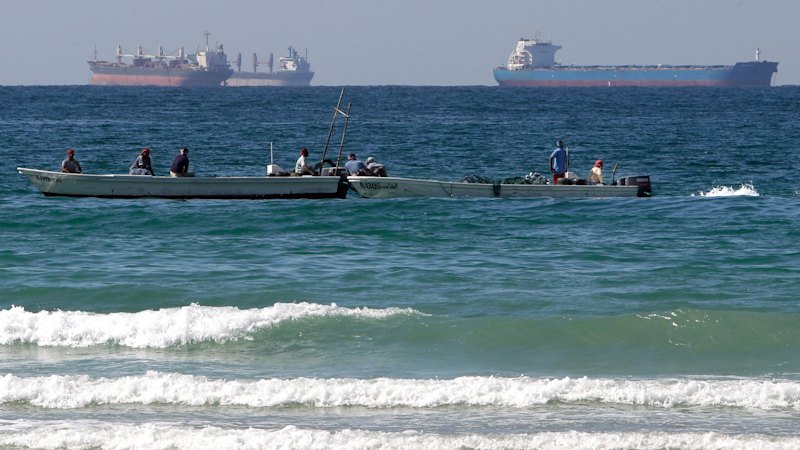
The steel hull of a VLCC supertanker is roughly three football fields long, a floating island of iron and crude. When you stand on the bridge of a vessel like that, the horizon feels infinite. But as you approach the Strait of Hormuz, the world begins to shrink. The water turns a deeper, more ominous shade of turquoise. On either side, jagged mountain ranges rise like the teeth of a trap. Twenty-one miles of water. That is all that separates the jagged cliffs of Oman from the coast of Iran. It is the narrowest of doorways, and right now, the entire planet is trying to squeeze through it while the walls are closing in.
In Washington, the rhetoric arrives in sharp, jagged bursts. Donald Trump has signaled a new, aggressive posture, calling on the international community to put their own skin in the game. His message is blunt. If your economy depends on the black blood of the earth flowing through this vein, you need to send your own warships to protect it. It is an ultimatum wrapped in a demand for a global police force, a shift from the decades-old status quo where the United States Navy acted as the de facto guarantor of the world's energy security.
But the maps in a war room don't show the heat. They don't show the way the air in the Persian Gulf feels like a wet wool blanket, or the way a young sailor’s hands shake when a fast-attack craft from the Iranian Revolutionary Guard zips across the bow. These are the human variables that data points can't capture.
The Invisible Tripwire
Consider the captain of a merchant vessel. He isn't a combatant. He is a man with a mortgage, a family in Manila or Odessa, and a crew that just wants to make it to the next port. When the news breaks that limpet mines have been attached to hulls or that drones are buzzing overhead, his reality shifts from logistics to survival. He is caught in a tectonic grind between superpowers.
To his left, the United States is pushing for a "coalition of the willing" to patrol these waters. To his right, Iran views every new foreign mast on the horizon as a direct provocation, a tightening of the noose. The Strait isn't just a shipping lane. It is a pressure cooker. One nervous finger on a trigger, one misunderstood radio transmission in the dead of night, and the spark becomes a conflagration.
The stakes aren't just about oil prices or stock market tickers in New York and London. If the Strait closes, the ripple effect isn't a gentle wave; it’s a tsunami. Imagine a hospital in a developing nation that loses power because the diesel for its generators doubled in price overnight. Imagine the frantic tension in a suburban kitchen when the cost of heating a home outstrips the weekly grocery budget. This is the "human element" of geopolitical posturing. We talk about "energy security," but we are really talking about the ability of a father to keep the lights on for his children.
A Second Front in the Shadows
While the world watches the tankers, another fuse is burning to the north. At the United Nations, the Secretary-General’s voice carries a different kind of weight—heavy with the exhaustion of a man watching history repeat itself. He is pleading with Israel and Hezbollah to step back from the edge of the abyss.
This isn't a separate conflict. It is a different limb of the same organism.
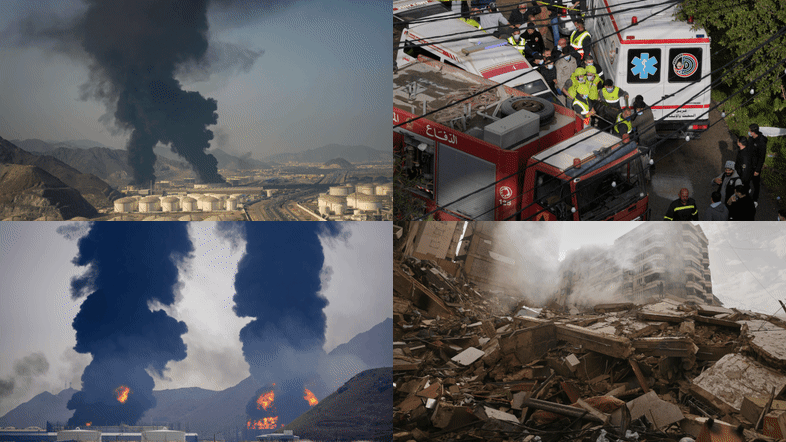
In the borderlands of Southern Lebanon, the silence is heavy. It’s the kind of silence that precedes a storm. Families there have spent decades living in the shadow of "what if." They know the sound of an outgoing rocket and the terrifying whistle of an incoming strike. For them, the high-level diplomacy at the UN isn't a matter of policy; it is a matter of whether their roof will still be there by morning.
Hezbollah sits on a massive arsenal of precision-guided missiles, a deterrent that keeps the region in a state of permanent, vibrating tension. Israel, scarred by the memory of past incursions and the reality of modern threats, maintains a posture of total readiness. When the UN chief calls for restraint, he isn't just checking a box. He is trying to prevent a regional war that would make previous conflicts look like skirmishes.
The Logic of the Brink
Why does this happen now?
The math is relatively simple, though the consequences are complex. The U.S. strategy of "maximum pressure" on Iran has created a cornered adversary. And a cornered adversary rarely looks for a peaceful exit; they look for a way to make their predicament everyone else's problem. By threatening the flow of oil in Hormuz, Iran reminds the world that it has its hand on the global thermostat.
Donald Trump’s counter-move is to decentralize the risk. By demanding that other nations—China, Japan, South Korea, India—protect their own interests, he is attempting to break the American monopoly on Persian Gulf security. It is a high-stakes gamble. If it works, it creates a multilateral shield. If it fails, it leaves the most volatile waters on earth poorly guarded and prone to chaos.
Think about the sailors on those ships.
A nineteen-year-old from Ohio or a twenty-four-year-old from Tehran. They are separated by language, religion, and thousands of miles of culture, yet they are bound together by the same stretch of water. They both look at the same stars at night. They both feel the same sudden jolt of adrenaline when the radar pings an unidentified contact. These are the people who will actually pay the price if the "live updates" turn into a casualty list.
The Cost of a Miscalculation
We often treat these geopolitical events like a game of chess. We move the pieces—carriers, sanctions, diplomatic cables—and wait for the opponent’s response. But in chess, the pieces don't bleed.
The real danger in the Strait of Hormuz isn't a planned invasion. It is a mistake.
It’s a radar operator misidentifying a civilian plane. It’s a patrol boat commander misinterpreting a maneuver as an attack. It’s the fog of war descending on a space so narrow that there is no room to maneuver and no time to think.
The UN chief’s warnings about Israel and Hezbollah carry the same frantic energy. The border is a tripwire. One kidnapped soldier, one stray shell hitting a school, and the machinery of war grinds into gear, fueled by a momentum that no diplomat can stop.
The world feels fragile because it is. We have built a global civilization on the assumption that these narrow passages will always remain open, that the "rules-based order" will hold even when the actors involved stop believing in the rules.
We watch the scrolling headlines. We see the photos of gray ships against a hazy sky. We hear the echoes of leaders shouting across oceans. But the real story is written in the quiet moments of the people caught in the middle—the tanker captain checking his radar one more time, the mother in Northern Israel listening for sirens, the shopkeeper in Beirut wondering if he should board up his windows.
The Strait of Hormuz is more than a geographic coordinate. It is a mirror. It reflects our dependence on a fragile peace and our terrifying proximity to a conflict that nobody wants but everyone is preparing for.
Tonight, the tankers will continue their slow, heavy crawl through the dark. The crews will drink their coffee and stare into the blackness, watching for a light that shouldn't be there, waiting to see if the world decides to hold its breath for one more day or finally exhales into the fire.