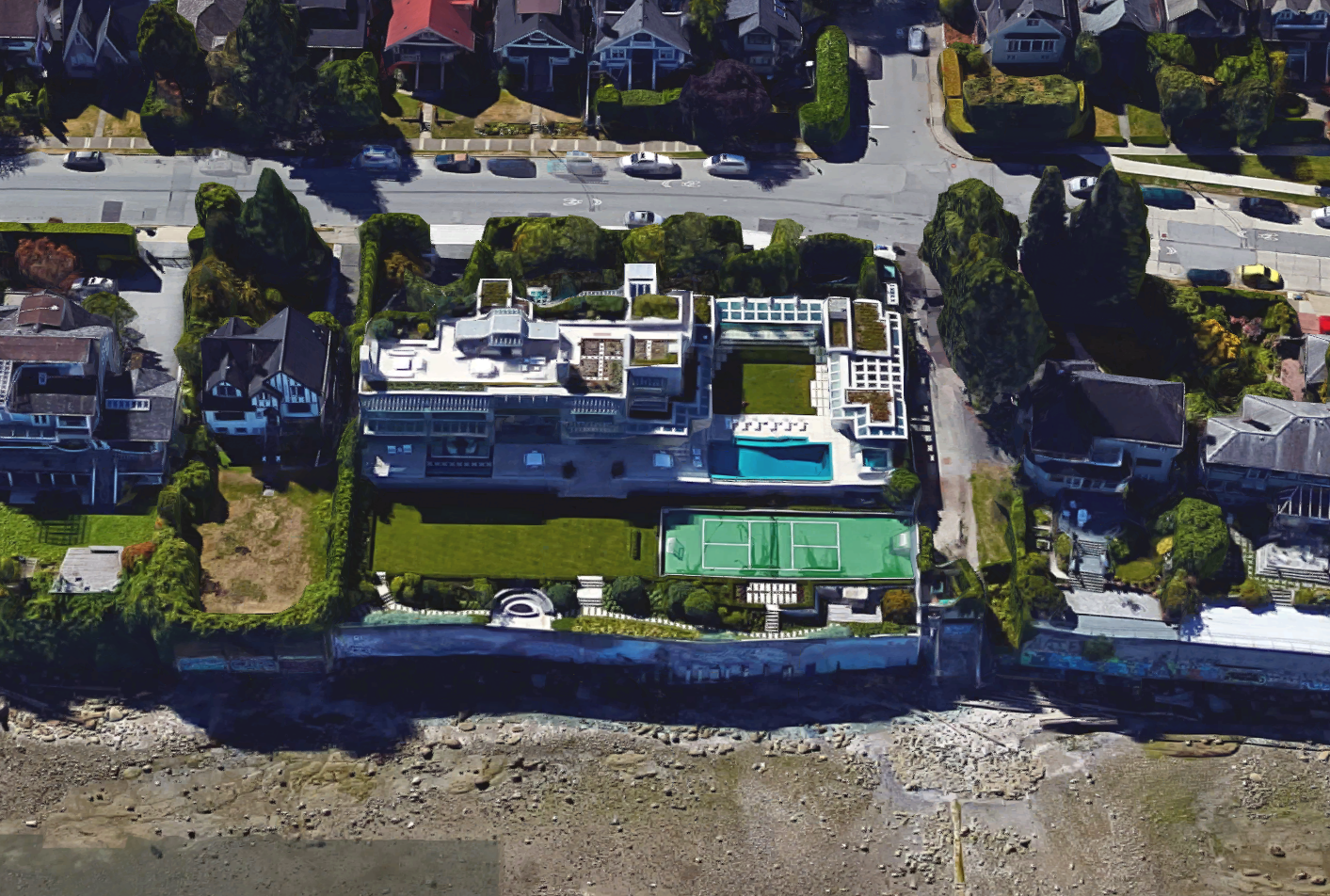
Billionaires don't like overpaying for their housing bills any more than you do. Lululemon founder Chip Wilson just proved that by forcing a massive reality check on the government agency responsible for valuing his waterfront estate.
The British Columbia Property Assessment Appeal Board dropped a bombshell ruling that slashes the 2025 assessed value of Wilson’s Kitsilano mansion by a staggering $18.27 million. BC Assessment initially pegged the sprawling property at 3085 Point Grey Road at $82.66 million. After a fierce bureaucratic tug-of-war, the independent tribunal ordered that number to be dragged down to $64.39 million. That is a whopping 22% drop.
If you think this is just rich people complaining about rich people problems, look closer. The fight exposes a deep, systemic flaw in how luxury real estate is valued, and it offers a masterclass in how property owners can successfully fight city hall when the taxman overreaches.
The Myth of Super Adequacy and the $14 Million House
Property valuation usually boils down to two things: the dirt and the structure sitting on top of it. In this appeal, nobody argued about the dirt. Both sides agreed that the prime waterfront land assembly along Vancouver's "Golden Mile" was worth every penny of its $50.07 million valuation.
The real war was fought over the house itself.
BC Assessment initially claimed the concrete structure, with its custom elevators, expansive glass, and massive entry spaces, was worth $32.6 million. Wilson’s legal team countered with a fascinating real estate concept known as super adequacy.
Basically, super adequacy means you built something so incredibly custom, so over-the-top, that the general market won't actually pay for it if you sell. Think of it as over-improving a house. Wilson's team argued that the concrete engineering and mega-mansion features exceeded what even ultra-luxury buyers care about. They initially wanted the total property value dropped all the way to $55 million.
While the appeal board didn't fully buy into the idea that the house was a completely unmarketable alien structure, they did agree that BC Assessment's math was totally broken. The board ultimately slammed the crown corporation for relying on a "cost-based approach"—essentially guessing what it would cost to build the place today—without providing any solid documentation or actual construction receipts to back up those numbers.
Instead, the tribunal looked at real life. They looked at actual market transactions.
Why Real Sales Always Trump Government Math
The tribunal tossed out the government's speculative calculations and focused heavily on the direct comparison approach. They looked at what actual wealthy humans paid for actual luxury homes in the area around the valuation date of July 1, 2024.
The highest benchmark on the table was a massive luxury sale on nearby Blanca Street that cleared for $43.7 million.
Now, Wilson’s new $64.39 million valuation is still nearly $21 million higher than that Blanca Street sale. The board decided that massive premium was completely fair because Wilson's estate sits on an exceptionally rare multi-lot waterfront assembly with massive frontage on Burrard Inlet. Point Grey Road only has about 70 waterfront single-family lots in total. It’s the ultimate scarce asset.
But by anchoring the decision to real, publicly marketed sales rather than theoretical construction spreadsheets, the board cut the value of the mansion's structure from $32.6 million down to $14.33 million. That is a brutal 56% haircut on the building's paper value.
The Massive Tax Break Hidden in the Math
Let’s talk about the real reason anyone goes through the headache of a formal property appeal: the tax bill.
In Vancouver, property taxes aren't just a flat rate. On luxury homes, owners get hammered with the standard municipal tax plus British Columbia's additional school tax, which adds a heavy premium on properties valued over $3 million and an even nastier tier for those above $4 million.
Before this ruling, local observers estimated Wilson’s annual tax bill on the $82.6 million assessment would hover somewhere around $589,000. With the new $64.39 million figure locked in for the 2025 roll, that estimated tax bill plummets to roughly $464,000.
That is an instant savings of about $125,000.
Sure, to a billionaire with a net worth scaling past six billion dollars, saving a buck-twenty-five is basically couch change. But it proves an important point. The system is designed to be fair, not political. The tribunal didn't care about the owner's bank account; they cared about whether the appraisal methodology held water under cross-examination. It didn't.
Setting a Precedent for the Rest of the Market
It is incredibly vital to note the timeline here because real estate cycles move fast. This entire battle was fought over the 2025 assessment roll, which reflects the market peak back on July 1, 2024.
It has absolutely nothing to do with the more recent 2026 assessment roll, which came out earlier this year based on July 1, 2025 values. On that newer 2026 roll, BC Assessment had already naturally adjusted the mansion down to $73.46 million because the entire Lower Mainland luxury market cooled off significantly throughout late 2024 and 2025.
What does this mean for everyday luxury property owners? It means you shouldn't just blindly accept the blue valuation notice that slides into your mailbox every January.
When the real estate market transitions from a roaring seller's market to an uncertain buyer's market, government mass-appraisal computer models almost always lag behind reality. They overvalue unique features and fail to account for how fast buyers pull back their wallets when interest rates or economic sentiments shift.
If you own a high-end or highly unique property and you want to follow a similar playbook to challenge your valuation, you need to execute a very specific strategy.
First, stop arguing about how much money you spent on renovations. The board explicitly proved that construction costs do not equal market value. Second, stop making emotional arguments about why your neighborhood is declining.
Instead, go hunting for arm's-length, publicly marketed sales data within a tight window of the official valuation date. Look for properties with similar lot sizes or waterfront frontages that actually closed. If BC Assessment cannot produce hard documentation to defend their custom valuation of your home's structural improvements, the board will almost always default to the hard evidence of real-world market transactions. It worked for a billionaire, and the exact same legal framework applies to your property too.