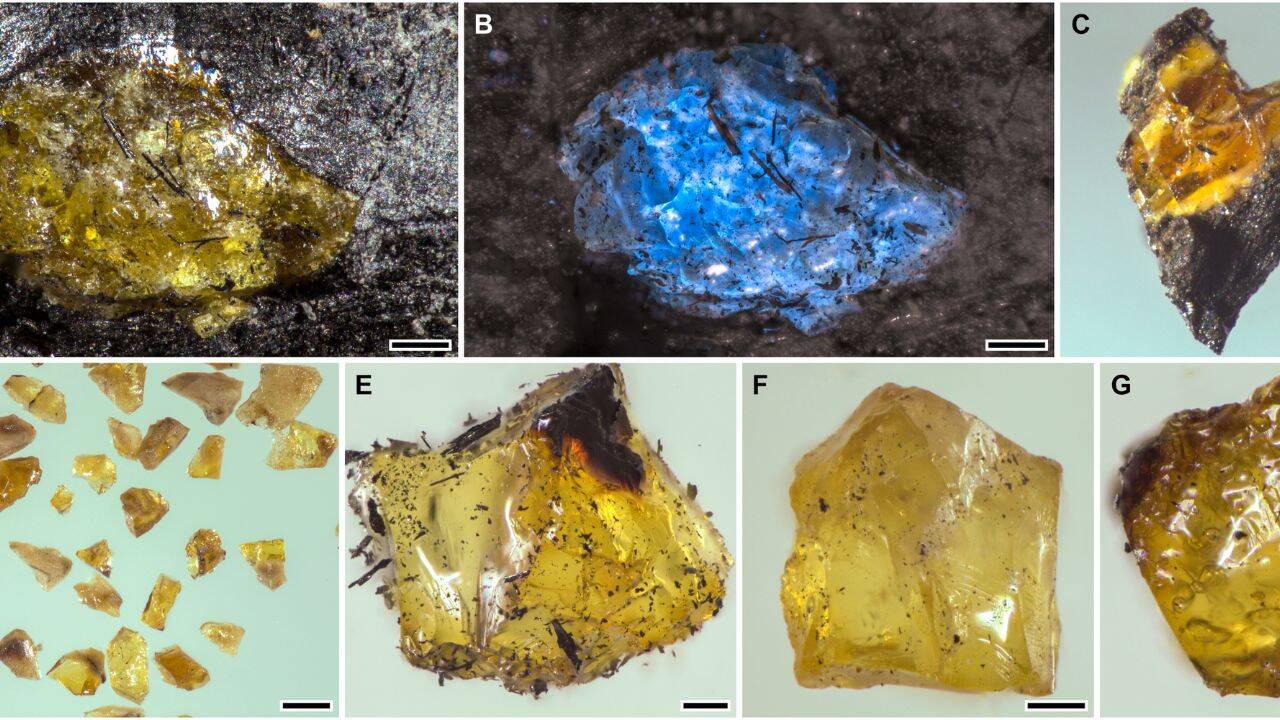
Science thrives on discarded assumptions. Every geological epoch is categorized, dated, and locked into neat little boxes until a single piece of evidence comes along and tears the locks right off. That happened when researchers pulled a remarkable piece of fossilized tree resin out of the earth in China, rewriting evolutionary history by pushing the appearance of ancient amber back tens of millions of years further than standard academic models ever allowed.
For decades, the consensus among paleontologists and paleobotanists was fixed. Amber, the fossilized sap of ancient trees, was thought to be relatively scarce in strata older than the Cretaceous period. Sure, small micro-droplets or obscure fragments turned up now and then in Paleozoic or early Mesozoic layers, but they were treated as anomalies. The vast majority of major amber deposits, along with the exquisitely preserved prehistoric insects trapped inside them, belonged to a world dominated by flowering plants and dinosaurs.
Then came the discovery in China.
The Timeline Problem That Baffled Geologists
Geochronology is an unforgiving discipline. When you claim to have found the world's oldest major amber deposit, you are not just offering a neat curiosity for a museum display. You are challenging a global consensus on when resin-producing ecosystems first evolved on a massive scale.
The material unearthed in China shattered previous estimates by roughly 65 million years. Think about what that temporal gap actually represents. Sixty-five million years is the entire span that separates our current post-dinosaur era from the Cretaceous extinction event. Entire phyla rise, dominate, and vanish in less time. To push a biological process like heavy tree resin production back by that magnitude forces a complete reevaluation of how ancient forests responded to environmental stress long before the first Tyrannosaurus rex ever walked the earth.
To understand why this discovery caused such friction in the academic community, you have to look at how amber forms in the first place. Trees do not bleed resin for fun. It is a metabolic defense mechanism. When a trunk is bored into by primitive insects, scarred by fungal infections, or subjected to sudden climatic trauma, the tree synthesizes complex organic polymers to seal the wound and trap the intruder.
Finding ancient amber in older strata means we are looking at ancient forests that were already employing sophisticated biochemical defense systems. It proves that the evolutionary arms race between flora and fauna was far more advanced during the early stages of terrestrial colonization than textbooks admitted.
Inside the Chemistry of Preservation
Most people know amber as a golden window into the past, immortalizing mosquitoes, ants, and feathers in crystalline clarity. But the physics of how that happens are profoundly counterintuitive.
Resin is a sticky nightmare when fresh. If left exposed to the elements, it oxidizes, degrades, and turns into crumbly dust within a few years. For amber to form, the resin must undergo a two-step process. First, it requires polymerization, where the volatile monoterpenes and sesquiterpenes evaporate, leaving behind stable diterpenoid or triterpenoid networks. Second, the hardened resin must be buried in an oxygen-free sedimentary environment, usually in marine or lacustrine silts, where it can cure under high pressure for millions of years.
The Chinese deposit underwent this exact sequence at a time when the Earth's atmosphere and climate were radically different from today. Oxygen levels fluctuated. Carbon dioxide concentrations were punishingly high. Plant life was experimenting with structural forms that have no modern equivalent.
When analysts put these ancient resin samples through gas chromatography-mass spectrometry, the molecular signature told a story that contradicted standard botanical lineages. The chemical makeup did not match the conifers we typically associate with old-world amber, such as ancient pines or araucarians. It pointed toward an extinct or deeply archaic lineage of gymnosperms. These were trees operating under evolutionary rules we are only beginning to decode.
The Methodological Battle Over Dating
Whenever a discovery upends a timeline by 65 million years, skepticism is the only rational response. Peer review in paleontology is notoriously brutal, and for good reason. Contamination is a constant ghost in the laboratory. Younger organic material can easily leach into older rock fissures through groundwater percolation, trickling down to create the illusion of ancient provenance.
The researchers behind the Chinese find knew they were walking into a minefield. To survive the onslaught of peer review, they had to bypass standard stratigraphic guesswork and deploy high-precision radiometric dating on the surrounding volcanic ash beds and microfossils.
They looked at uranium-lead ratios in zircon crystals trapped within the same sedimentary layers. Zircon is nature's ultimate geological clock. As soon as a zircon crystal forms in magma, its internal radioactive uranium begins ticking away at a steady, mathematically predictable rate, decaying into lead. By measuring the ratio of uranium to lead with a secondary ion mass spectrometer, the team locked down the age of the deposit with agonizing precision.
The data refused to budge. The rock layer was definitively older than previous models predicted for amber of this scale. The samples were not contaminants. They were native to the strata. The timeline had to bend.
What Lies Trapped Within
Beyond the chemistry and the geology, the primary fascination of any amber deposit lies in what got stuck inside the goo before it hardened.
In younger Cretaceous and Cenozoic amber, the inclusions are a biological treasure trove. You find entire ecosystems frozen mid-stride: parasitic wasps laying eggs, spiders wrapping prey, archaic feathers showing iridescent color patterns, and microscopic fungi spores. These inclusions provide a three-dimensional preservation quality that traditional flat-rock fossils can never touch, because minerals usually crush or distort organic tissue during compression.
In the case of this older Chinese deposit, the inclusions are smaller, stranger, and rarer. Finding complex multicellular organisms trapped in resin from this specific epoch is like finding a digital recording of a concert played on instruments that haven't existed for millennia.
Early arthropods and primitive mites preserved in these samples offer a rare glimpse into the micro-fauna of a world that was just beginning to figure out how to live on dry land. Before this discovery, our understanding of these microscopic pioneers relied entirely on fragmented exoskeletons found in shale deposits, where every specimen looked like it had been run over by a steamroller. Amber changes the geometry of observation. It gives depth back to creatures that lived and died before the continents even looked the way they do on a modern map.
The Broader Implications for Earth Science
Scientific discoveries do not exist in a vacuum. Pushing the amber timeline back by 65 million years forces a domino effect across multiple disciplines.
First, it changes our models of atmospheric evolution. Trees produce more resin when they are stressed by high temperatures, drought, or extreme atmospheric shifts. The presence of massive amber deposits in this specific geological window suggests that the ancient climate experienced volatile swings that triggered widespread arboreal stress responses on a global scale.
Second, it rewrites the evolutionary timeline of insects. If resin was already widely available and sticky enough to trap organisms tens of millions of years earlier than we thought, then the small, crawling inhabitants of those ancient forests were navigating environmental hazards we never accounted for. The pressure to develop flight, better sensory organs, or chemical camouflage must have been intense.
We are left with a stark reminder that the history of life on Earth is not a smooth, orderly staircase. It is a chaotic series of revisions driven by the next shovel that happens to hit the right rock in the right place. Every time we think we have the book of nature neatly paginated, a chapter falls out from the margins that nobody knew was there.

.png?itok=1mb05mKJ)

