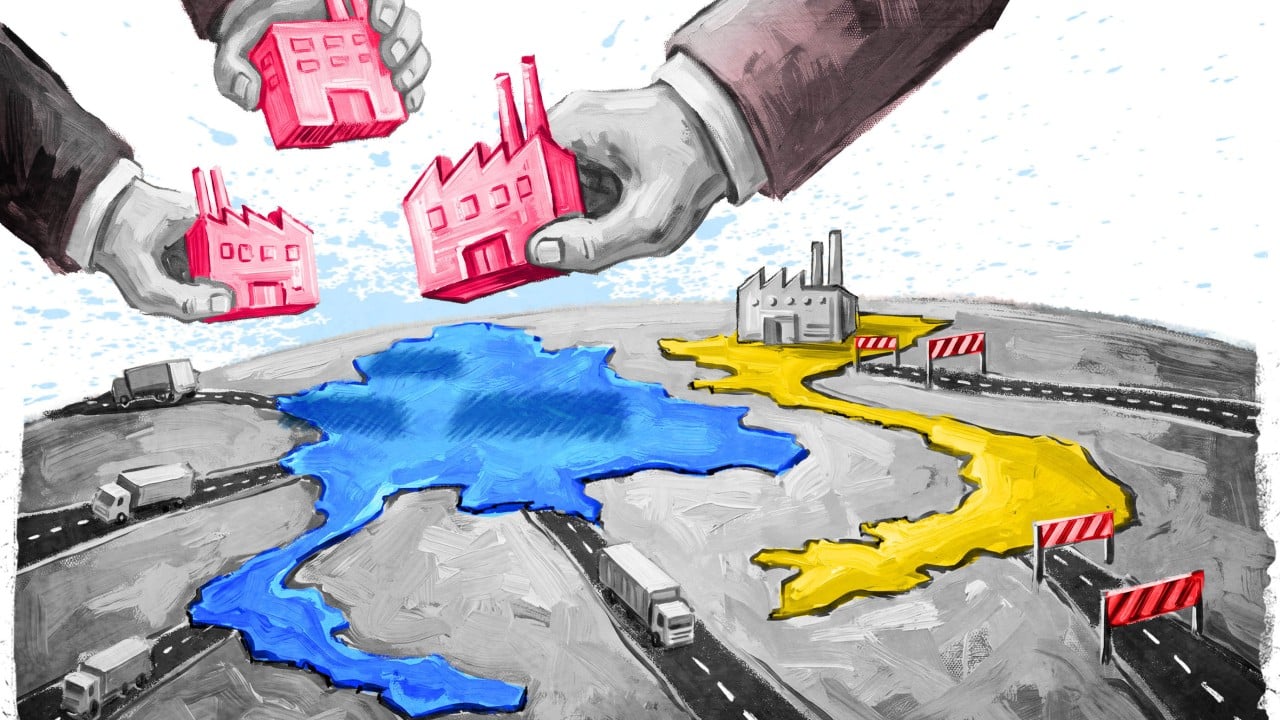
More Chinese manufacturers are shifting expansion plans toward Thailand, and honestly, the math behind it isn't subtle. While Vietnam ran into assembly saturation, infrastructure bottlenecks, and tighter scrutiny over tariff diversion, Thailand stepped into the spotlight with ready-built industrial estates, aggressive Board of Investment (BOI) incentives, and a deep supply chain for higher-value sectors like electric vehicles, electronics, and solar equipment.
Data from China's Ministry of Commerce shows Thailand pulled in US$5.33 billion in Chinese investment in 2025 compared to Vietnam's $2.46 billion. Between 2021 and 2025, mainland China's total investment into Thailand reached 132.5 billion yuan, growing at an average annual clip of 56%, and momentum carried straight into 2026. In the first half of 2026 alone, Thailand's BOI approved 321 mainland China-backed projects for incentives—one-quarter of all approved projects—worth 45.7 billion baht (about 9.7 billion yuan or $1.4 billion).
If you're looking at Southeast Asia for a China+1 footprint, Thailand isn't a cheap-labor shortcut anymore. It's a strategic hub for complex manufacturing and regional reach.
Why Thailand Is Pulling Ahead of Vietnam
For years, plenty of companies treated Vietnam as the automatic default for moving assembly out of China. That playbook ran into friction. Even before U.S. crackdowns on transshipped goods intensified—including steep tariffs such as 40% levies on Chinese products found to be routed through Vietnam to dodge duties—assembly hubs there faced rising labor costs, power and logistics strain, and growing local pushback.
In Vietnam, policymakers and domestic manufacturers grew increasingly skeptical of factory arrivals that looked like quick tariff-evasion plays rather than true upgrades. Limited technology transfer and pressure on local suppliers made the welcome mat noticeably cooler.
Thailand sits in a very different spot. Its Eastern Economic Corridor (EEC) and mature industrial parks already have decades of automotive, electronics, and precision-engineering DNA. When BYD opened its $490 million Rayong EV plant—designed for up to 150,000 vehicles a year and around 10,000 local workers—the first Thai-built EV rolled off the line in 2024, while BYD's planned Vietnam plant faced delays. That contrast sums up the shift in momentum pretty clearly.
Still, let's be realistic. Thailand isn't magic, and it isn't immune to growing pains. Local factories worry about fierce price competition from imported goods and new entrants, and rules-of-origin checks from major export markets mean slapping a new label on a mostly finished product won't cut it.
What Chinese Investors Are Actually Building
This wave isn't just T-shirts and basic box assembly. Chinese capital in Thailand has moved heavily into EVs, batteries, electronics, clean energy, and digital infrastructure.
According to Thailand's BOI, EV supply chain commitments reached roughly $4.1 billion across nearly 200 projects by mid-2026, spanning battery electric vehicles, hybrids, battery cells and packs, drive motors, power electronics, and tens of thousands of charging points. Solar panels, printed circuit boards, and data centers are also drawing serious money, backed by Chinese banks and cross-border payment players expanding across ASEAN.
Thailand's real edge isn't rock-bottom wages. It's the combination of BOI incentives, concentrated industrial estates, and an existing supplier base that lets companies scale tech-heavy production faster.
Consumer brands are part of the story too, though their path is trickier. As noted in trade research from the Hong Kong Trade Development Council, Chinese companies entering Thailand often run marketing in-house at first and rely on familiar playbooks, only to hit a wall after six to twelve months. Spec sheets and aggressive price promotions that work back home often fall flat with Thai shoppers who care deeply about emotional storytelling, cultural nuance, and local identity.
The Risks and Bottlenecks Nobody Should Ignore
Anyone pitching Thailand as friction-free is glossing over real operational headaches. Energy and water demand is climbing fast, especially as power-hungry factories and data centers expand. Local content requirements, customs scrutiny, and shifting trade rules also force manufacturers to prove genuine value creation inside Thailand rather than minimal assembly.
Then there's the diplomatic tightrope. As Krungsri Research highlights, Thailand has to balance major-power rivalries while pushing deeper integration between Thai suppliers and incoming Chinese ecosystems. If local businesses feel shut out of the supply chain, political friction follows quickly.
Workforce training is another quiet bottleneck. Finding enough skilled engineers, technicians, and bilingual managers takes time and money—especially when multiple factories ramp up in the same industrial corridor at once.
Practical Next Steps If You're Planning a Move
If you're evaluating Thailand for expansion or sourcing right now, don't start with real estate brochures. Start with the numbers and compliance rules.
- Map true local value early: Check exact rules-of-origin and local-content thresholds for your target export markets—whether that's the U.S., Europe, or fellow ASEAN countries—before locking in bill-of-materials sourcing.
- Test BOI eligibility before picking a site: Review current Thailand Board of Investment criteria around technology level, capital commitment, and skilled hiring so you don't leave tax or duty perks on the table.
- Audit utility capacity on the ground: Confirm power stability, grid access, and water availability directly at the industrial estate level, particularly if your operation involves high heat, heavy electronics, or data processing.
- Localize commercial strategy early: If you plan to sell directly to Thai consumers alongside manufacturing, bring in local cultural and marketing expertise before your first year stalls out.
The companies winning in Thailand right now are the ones treating it as a long-term regional hub with real local roots, not a quick detour around tariffs.