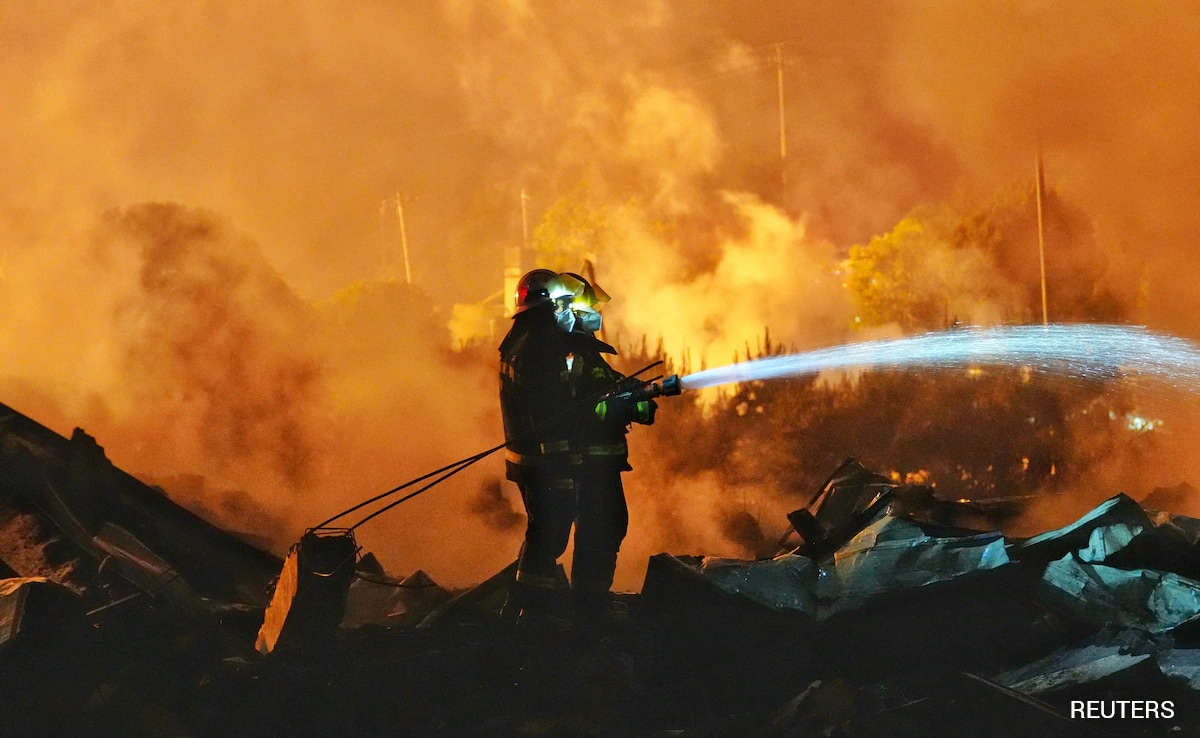
Hunan is burning again. Twenty-one dead. Sixty-one hospitalized. The headlines follow a script so predictable it’s almost offensive. Western outlets frame these fireworks factory explosions as "tragic failures of oversight" or "Third World safety standards." They wag their fingers at the Hunan provincial government, demand stricter inspections, and lament the human cost of cheap pyrotechnics.
They are missing the point. Entirely.
These explosions aren't just accidents. They are the friction heat of a high-velocity industrial machine that the rest of the world has forgotten how to build. When you move at the speed of China’s supply chain, things break. Sometimes, people die. To suggest that we can have the global supply of consumer goods without these "catastrophes" is a lie sold by people who haven't stepped foot on a factory floor in twenty years.
The Safety Industrial Complex is Lying to You
Mainstream media loves the "negligence" narrative. It's easy. It’s clean. It implies that if we just had more paperwork, the fire would never have started.
But I’ve spent fifteen years auditing manufacturing hubs from Shenzhen to Liuyang. Here is the truth: Regulation follows innovation, but it can never catch it.
The Hunan blast happened because the demand for high-output manufacturing outstrips the physical capacity of the infrastructure. We want our celebrations to be cheap. We want our New Year’s Eve displays to cost pennies on the dollar. The "lazy consensus" says we need better safety protocols. The reality? Safety protocols are a luxury of the stagnant.
In the West, we have reached "Peak Safety." We have so many layers of compliance that we can no longer build a bridge in under a decade. China has chosen the opposite path. They prioritize throughput. They prioritize the result.
Is it brutal? Yes. Is it efficient? Indisputably.
The Fireworks Fallacy: Why Rural Industry is a Battlefield
Critics look at a fireworks factory in a place like Liling or Liuyang and see a "sweatshop." I see a decentralized economic engine.
Fireworks manufacturing is a $4 billion industry in China. It is the lifeblood of rural Hunan. When a factory explodes, the immediate reaction is to "shut it all down." This is the peak of intellectual laziness.
Shutting down these hubs doesn't make people safer; it makes them poorer. And in the industrial world, poverty is a far more consistent killer than black powder.
The Real Physics of the Hunan Blast
Let’s talk about $T_{ignition}$. In a standard fireworks assembly line, you are dealing with friction, static electricity, and chemical instability.
Standard safety manuals suggest a separation distance of $D = K \cdot W^{1/3}$ where $D$ is the distance and $W$ is the explosive weight. In a hyper-growth economy, $K$ is treated as a suggestion, not a law.
Why? Because if you follow the $K$-factor used by the Bureau of Alcohol, Tobacco, Firearms and Explosives (BATF) in the United States, your output drops by 70%. Your price per unit triples. Your village goes from being a global exporter to a ghost town.
The Hunan factory wasn't "negligent." It was optimized for a world that demands cheap goods. We are the ones who pull the trigger on those explosions every time we demand lower prices from our suppliers.
The Myth of "Human Error"
Whenever 61 people are injured, the report always finds a scapegoat. A floor manager who smoked a cigarette. A worker who dropped a crate.
"Human error" is a corporate fiction designed to protect the system.
In high-stakes manufacturing, the "error" is the system itself. We are asking biological entities—humans—to interact with volatile chemical compounds at a pace that exceeds human reaction time.
If you want to solve the Hunan problem, you don't hire more inspectors. You automate. But here is the contrarian reality: Automation is too expensive for the margins we allow these factories to have.
We have trapped the Hunanese worker in a catch-22. We refuse to pay enough for the products to fund robotic assembly, yet we scream "human rights" when a manual assembly line goes up in smoke.
Why Stricter Laws Will Actually Increase Deaths
Counter-intuitive? Maybe. Factually grounded? Absolutely.
When the central government in Beijing cracks down on "illegal" fireworks plants, the industry doesn't vanish. It goes underground.
- Fragmentation: Large, visible factories are replaced by "cottage" operations in residential basements.
- Zero Oversight: Underground shops have no fire exits, no ventilation, and no medical kits.
- Volatility: Transporting raw materials in unmarked vans creates mobile bombs on public roads.
I have seen this play out in the textile industry and the coal sector. The "safety crackdown" is the most dangerous period for a Chinese worker. It forces the risk into the shadows where it can't be measured, only mourned.
Stop Asking "How Did This Happen?"
People Also Ask: "Why can't China fix its safety record?"
The question is flawed. It assumes the record is "broken." Compared to the industrial revolutions of the UK or the US, China is actually ahead of the curve in terms of deaths-per-unit-of-GDP.
We forget that the Monongah Mining Disaster in West Virginia killed 362 people. We forget the Triangle Shirtwaist Factory. We grew out of those disasters because we became wealthy enough to afford the inefficiency of safety.
China is in the middle of that transition. To demand they have 21st-century Swiss safety standards while they are still the world’s primary industrial furnace is a form of economic colonialism.
The Hard Truth for Investors and Policy Makers
If you are a CEO sourcing from these regions, stop pretending your "Code of Conduct" does anything. Your "Code of Conduct" is a piece of paper that gets filed in a cabinet while the factory floor remains a powder keg.
If you actually cared about the 21 people who died in Hunan, you would do one of two things:
- Pay double for your inventory. (You won't, because your shareholders would fire you.)
- Invest in on-site chemical stabilization technology. (You won't, because the ROI is ten years and your horizon is three months.)
The rest is just theater.
The Hunan blast is a reminder that the global economy is a high-pressure system. Pressure creates energy, but it also creates explosions. We can’t have the energy without the risk.
We should stop acting surprised when the bill for our cheap, brightly colored lifestyle finally arrives in the form of a casualty count. The people of Hunan aren't victims of "bad policy." They are the sacrificial anodes of a global market that values a five-dollar firework more than the person who filled it with powder.
Stop looking for a "fix." There is no fix. There is only the price of progress. And right now, Hunan is paying it in full.