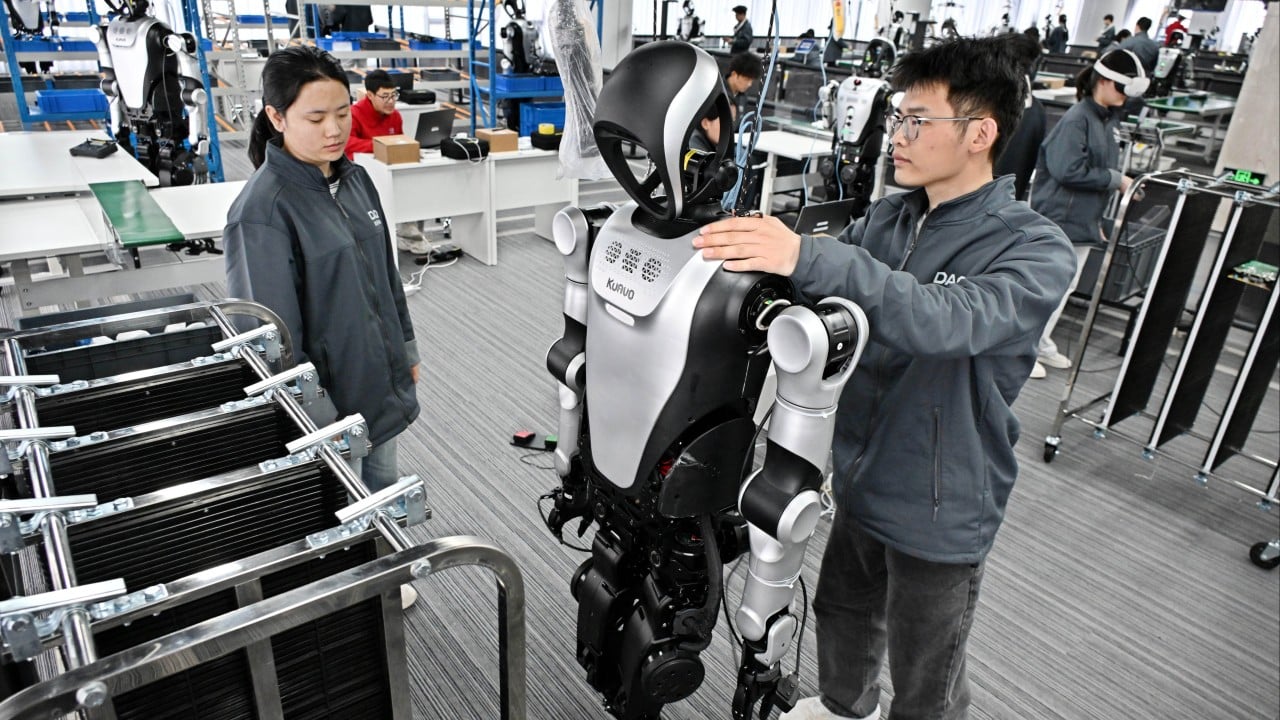
The Hardware Hallucination
The tech press is obsessed with the idea that China can simply "copy and paste" its smartphone dominance onto humanoid robots. It’s a seductive narrative. You have the factories, the lithium-ion batteries, and the sensors already in place. Investors see a humanoid as a "phone with legs."
They are dead wrong.
A smartphone is a static brick of silicon and glass. A humanoid robot is a chaotic system of dynamic physics, torque density, and high-precision mechanical strain. You cannot assemble a revolutionary robot by sourcing cheaper versions of the parts used in a Xiaomi handset. China’s supply chain is built for high-volume, low-margin repeatability. Humanoids require low-volume, high-complexity mastery.
We are watching billions of dollars being poured into a "copycat" strategy that ignores the fundamental physics of motion.
The Torque Density Wall
The "lazy consensus" suggests that China’s lead in electric vehicle (EV) motors will translate directly to humanoid actuators. This is a fundamental misunderstanding of engineering. EV motors are designed for high RPM and continuous rotation. Robot actuators require extreme torque at low speeds, coupled with "back-drivability"—the ability for a joint to yield to external pressure without snapping its internal gears.
Most Chinese humanoid startups are currently over-reliant on imported high-end harmonic drives and planetary gearsets from Japan. Why? Because while China can mass-produce gears, it still struggles with the material science required for the longevity of high-precision strain wave gearing. When a robot weighs 150 pounds and has to balance on one foot, the stress on a 5mm gear tooth is astronomical.
I have seen firms burn $20 million on prototypes that look stunning in a 4k marketing video but suffer mechanical failure after forty hours of actual operation. We aren't building gadgets; we are building mobile industrial machines. If your supply chain focuses on "smartphone-level" durability, your robot is just expensive electronic waste.
The Sensor Myth: More Data is Just More Noise
Everyone talks about LiDAR and depth cameras as if they are the "eyes" that will solve the autonomy problem. The current trend in the Shenzhen ecosystem is to cram as many sensors onto a frame as possible.
The reality? Humanoids don't fail because they can't "see" the floor. They fail because they can't feel the floor.
The real bottleneck isn't vision; it's haptic feedback and force control. Most current supply chains are optimized for CMOS image sensors because that’s what goes into phones. What we actually need are high-frequency, low-latency torque sensors in every single joint.
Why "People Also Ask" Is Wrong About Robot Brains
You’ll see common questions like, "Will AI make robots smarter?" This is the wrong question. The bottleneck isn't the "brain" (the LLM or the vision model); it's the "nervous system."
The latency between a sensor detecting a slip and the actuator correcting the center of mass must be near-zero. In the current Chinese supply chain model, components are often sourced from disparate vendors using different communication protocols. This creates "system jitter." You can have the fastest GPU in the world, but if your knee joint has 10 milliseconds of communication lag, the robot hits the dirt.
The Labor Paradox: Why Robots Won't Save the Factory
The most frequent argument for China’s humanoid push is the shrinking workforce. "We need robots to replace the aging factory workers," the CEOs cry.
This is a fundamental misunderstanding of factory economics. If a task is repeatable and high-volume, you don't use a humanoid. You use a fixed robotic arm or a specialized SCARA (Selective Compliance Assembly Robot Arm). They are cheaper, faster, and more precise.
Humanoids are, by definition, generalists. They are designed for environments built for humans—stairs, narrow aisles, and varying table heights. However, the cost of a humanoid that is actually reliable enough to work an 8-hour shift without a handler is currently $100,000+.
Compare that to the cost of a human worker in a Tier 2 Chinese city. Even with rising wages, the math doesn't check out for another fifteen years. By pushing for "general purpose" humanoids now, companies are ignoring the "Specialized Automation" that actually yields ROI today. They are choosing vanity over margins.
Material Science: The Unseen Ceiling
The weight-to-strength ratio is the silent killer of the humanoid dream. China excels at aluminum extrusion and injection-molded plastics. But to make a robot that doesn't deplete its battery in thirty minutes, you need advanced carbon composites and titanium alloys—at scale.
The current supply chain is optimized for the weight of a laptop. When you scale that to a 1.7-meter tall frame, the square-cube law becomes your enemy. Every extra pound of frame requires more battery, which requires more powerful motors, which adds more weight.
Most current Chinese "breakthroughs" are actually just iterations on existing hobbyist components. They are using drone motors and oversized gimbal controllers. It is "innovation by assembly," not "innovation by invention."
The Software Dependency Lie
The article you read likely praised China’s "integrated ecosystem." But look under the hood. Almost every major humanoid project in the region is still heavily reliant on open-source frameworks (like ROS 2) or simulation environments (like NVIDIA’s Isaac Gym).
The hardware is being built in the East, but the "physics engine" that defines how that hardware interacts with reality is still being written in the West. If you control the metal but not the math, you are a commodity manufacturer, not a tech leader.
The High Cost of "Cheaper"
The contrarian truth is that the "cheaper" Chinese supply chain might actually hinder robot development. By driving the price of components down too early, we are disincentivizing the R&D needed for the "next leap" in materials.
If everyone is racing to build a $20,000 humanoid, no one is spending the money to invent the new type of synthetic muscle or high-bandwidth bus architecture that would actually make a $20,000 humanoid viable. We are optimizing for the bottom of the curve before we’ve even reached the peak.
Stop Asking "When?" and Start Asking "How Many Failures?"
The industry measures success by the number of units shipped. That is a legacy metric from the smartphone era. In the humanoid era, the only metric that matters is "Mean Time Between Failure" (MTBF) in an unstructured environment.
Currently, that number for most "growth curve" robots is embarrassingly low. We see videos of robots walking on treadmills or dancing to pop songs. That is not robotics; that is puppetry. Until the supply chain can produce a high-strain actuator that can survive 10 million cycles without a 0.01mm loss in precision, the "growth curve" is a flat line disguised by hype.
The rush to dominate the humanoid market is creating a bubble of "look-alike" hardware. Companies are so afraid of missing the next "smartphone moment" that they are building the hardware equivalent of a movie prop—it looks the part, but it has no soul, no reliability, and no clear path to profitability.
If you want to win in robotics, stop looking at what the phone makers are doing. Start looking at aerospace. Start looking at high-end medical devices. Start looking at the places where "cheap and fast" is considered a liability, not an advantage.
The humanoid revolution won't be won by the company with the biggest factory. It will be won by the company that stops trying to build a phone with legs and starts solving the brutal, unglamorous physics of the real world.