The timing isn't accidental. When Beijing sends its most advanced warship directly through one of the tightest geopolitical choke points on earth, it isn't just moving hardware from point A to point B. It's sending a multi-billion-dollar message.
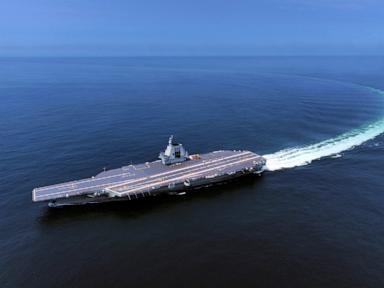
On Tuesday, China’s newest aircraft carrier, the Fujian, sailed through the Taiwan Strait. Taiwan's Ministry of National Defense confirmed the movement, noting that they used joint intelligence, surveillance, and reconnaissance methods to keep tabs on the massive vessel. They even released a grainy, top-down aerial photograph of the carrier underway, looking eerily empty without a single aircraft visible on its flight deck.
This isn't just another routine patrol. The Fujian is a massive leap forward for the People’s Liberation Army Navy (PLAN), and its appearance in the strait marks its first major mission in the waterway since April. While Beijing often claims these movements are standard training, the political reality is far more pointed. Taipei views this as part of a relentless, near-daily pressure campaign designed to wear down the island's defenses and assert dominance over a waterway that the rest of the world considers international space.
What makes the Fujian a genuine shift in power
Most people look at aircraft carriers and just see big floating targets. That's a mistake. To understand why this specific transit matters, you have to look at how this ship is built compared to China's older carriers, the Liaoning and the Shandong.
Those first two ships rely on old-school, Soviet-style "ski-jump" ramps to get planes into the air. A ramp limits everything. It means fighter jets can't take off carrying a full load of fuel or heavy missiles because they simply won't get enough lift.
The Fujian changes that entire math. It features a completely flat flight deck equipped with electromagnetic catapults, identical in concept to the technology used on the US Navy's newest Gerald R. Ford-class carriers.
[Ski-Jump Ramps: Liaoning / Shandong] ──> Limits fuel and heavy weapons load
[Electromagnetic Catapults: Fujian]   ──> Launches heavier, fully-armed stealth fighters
This mechanical shift translates directly into raw combat power. Because of those catapults, the Fujian can launch heavier, fully armed aircraft, including the new J-35 stealth fighter and the KJ-600 airborne early warning plane. It allows China to project a real bubble of air superiority far away from its coastlines, moving the PLAN from a defensive "near-seas" force into a true blue-water navy.
The war over an international highway
The physical movement of the ship is only half the story. The real fight is over who controls the legal definition of the water beneath it.
Beijing claims total sovereignty over the Taiwan Strait, treating it as internal waters. On the flip side, Taiwan, the United States, and major global allies view it as an international waterway. It’s a vital maritime artery that handles a massive chunk of global container shipping. If China successfully locks it down, they control a main valve of global trade.
By parading the Fujian through the strait, China is trying to normalize its presence and force the world to accept its jurisdiction. It’s a classic grey-zone tactic: use military pressure that stops just short of provoking an actual war, slowly shifting the status quo until everyone gets used to it.
Taiwan isn't sitting back quietly. Mainland Affairs Council Minister Chiu Chui-cheng made the island's stance entirely clear, stating that Taipei utterly refuses to accept Beijing's goal of unification and won't buckle under intensifying pressure.
Reading between the lines of the empty deck
Why did the carrier sail without any planes on deck? Military analysts point to the fact that the Fujian is still executing crucial sea trials and systems integration. It isn't fully operational yet. Moving the ship through the strait without a full air wing allows Beijing to flex its muscles and gather baseline operational data while minimizing the risk of losing expensive aircraft if something goes wrong during transit.
It also keeps Western intelligence guessing. By keeping the deck clear, China hides the exact status of its carrier-based flight operations, forcing US and Taiwanese surveillance teams to rely on satellite data and radar tracking to figure out exactly how close the ship is to full combat readiness.
If you want to track how this naval rivalry evolves, keep your eyes on the frequency of these transits. Watch whether the US Navy responds with its own freedom of navigation transits in the coming weeks, which is the standard counter-move. The real metric to watch isn't just the ship sailing—it's the moment the Fujian returns to the strait with a deck packed full of stealth fighters. That's when the balance of power truly shifts.